
— On-model lingerie · 150+ styles · 4K
Direct your next drop with the AI Lingerie Photography Generator.
Generate campaign-ready lingerie imagery around the garment you actually sell. Select lens, framing, pose, light, background, and style through clicks in a real application built for fashion teams. No studio. No sample shipping. No prompts.
- ~$0.55 per image
- ~30–40s per generation
- 150+ styles
- 2K or 4K
- Every aspect ratio
- Full commercial rights
7-day free trial • 50 tokens (10 images) • Cancel anytime

Direct the shoot. Zero prompts.
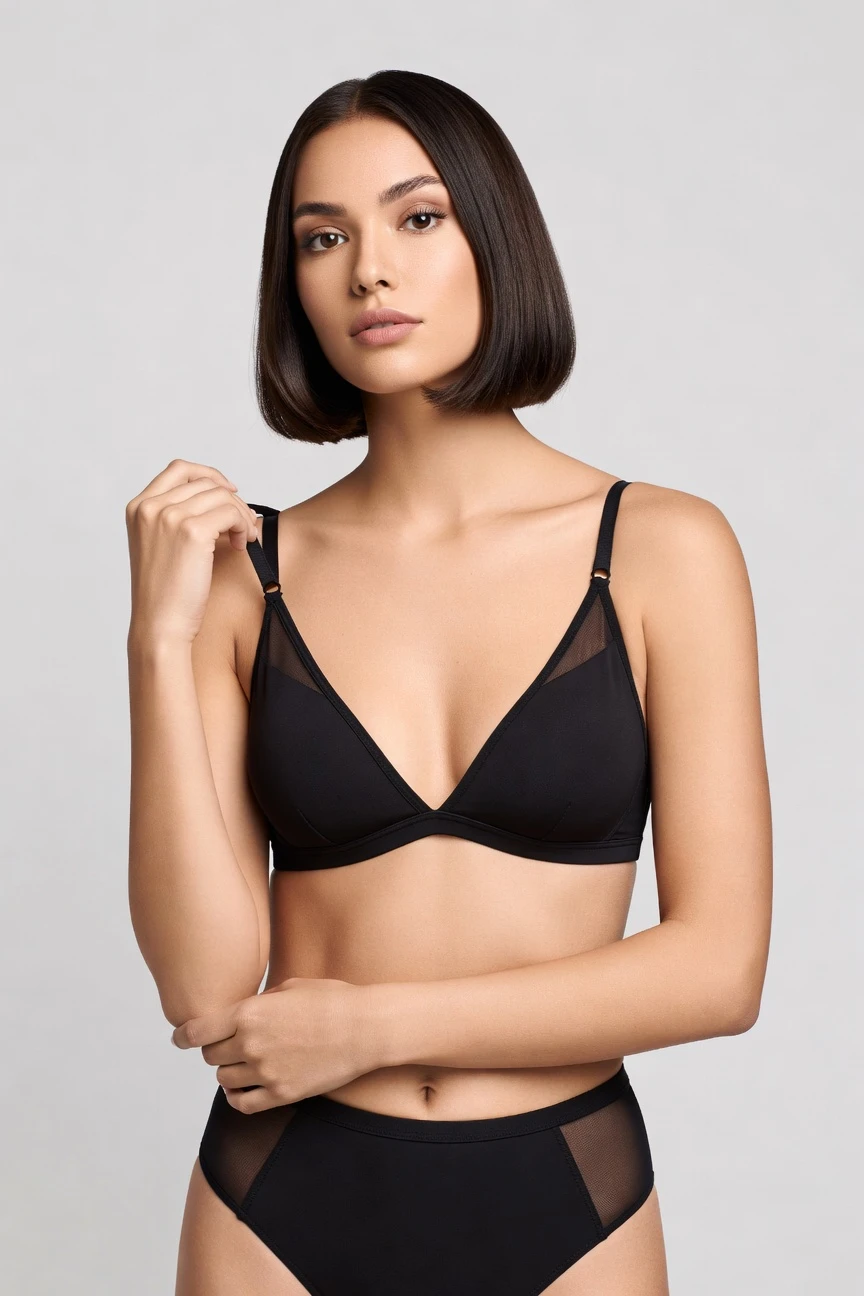
This setup starts with a half-body lingerie campaign frame in 4:5, using an 85mm lens and 4K output. You click into a polished commerce crop, then generate without typing a single instruction. ~$0.55 per image · ~30-40s
- 4 clicks · 0 keystrokes
- app.rawshot.ai / new_shoot
How it works
Build Lingerie Imagery by Click
From first product upload to SKU-scale output, every creative choice stays inside buttons, sliders, and presets.
- Step 01
Upload the Garment
Start from the real lingerie product, not a blank text box. RAWSHOT reads the item as the brief so cut, colour, trim, and proportion stay central.
- Step 02
Set the Shot
Click through lens, framing, pose, lighting, background, aspect ratio, and visual style. You direct intimate apparel imagery with controls that feel like software, not chat.
- Step 03
Generate and Scale
Create publishable stills in around 30–40 seconds, then repeat the same setup across variants and SKUs. Use the browser for one-off shoots or the REST API for catalog pipelines.
Spec sheet
Proof for Intimate Apparel Teams
These twelve points show how RAWSHOT keeps lingerie imagery controlled, garment-led, scalable, and clearly labelled for commerce use.
- 01
Composite Models by Design
Every model is built from 28 body attributes with 10+ options each. Accidental real-person likeness is statistically negligible by design.
- 02
Every Setting Is a Click
You select camera, crop, light, background, mood, and style from the interface. No empty prompt box sits between you and the shoot.
- 03
Garment-Led Representation
Lingerie depends on fit lines, straps, seams, cups, lace, mesh, logo placement, and drape. RAWSHOT is engineered to keep the product, not generic styling, in charge.
- 04
Diverse Synthetic Models
Choose from broad body representation for intimate apparel visuals while staying transparent about what the output is. Labelled synthetic talent gives teams range without hiding the method.
- 05
Consistency Across SKUs
Keep the same face, framing logic, and visual system across a bra line, matching sets, or seasonal colorways. That makes collection pages feel deliberate instead of patched together.
- 06
150+ Brand Directions
Move from clean catalog to editorial noir, campaign gloss, street flash, vintage, or beauty-led crops without rebuilding your workflow. Style stays selectable, not improvised.
- 07
2K, 4K, Any Ratio
Generate square, portrait, landscape, PDP, social, and campaign crops in 2K or 4K. The same garment setup can feed commerce and brand channels from one system.
- 08
Labelled and Compliant
Outputs are AI-labelled, watermarked, and aligned with EU AI Act Article 50, California SB 942, and GDPR expectations. Honest disclosure is built into the product.
- 09
Signed Audit Trail per Image
Each file carries C2PA-signed provenance metadata plus visible and cryptographic watermarking. That gives teams a durable record of what was made and how it should be handled.
- 10
GUI and REST API
Use the browser GUI for creative selection and single-look work, then move the same logic into batch production through the API. One product covers boutique launches and enterprise catalogs.
- 11
Clear Time and Token Math
Stills run about $0.55 per image and typically generate in 30–40 seconds. Tokens never expire, and failed generations refund their tokens.
- 12
Rights Stay Simple
Every output includes full commercial rights, permanent and worldwide. Teams can publish across PDPs, ads, email, marketplaces, and social without negotiating extra usage tiers.
Outputs
From Catalog Clean to Campaign Heat
Show the same lingerie collection in multiple visual directions without changing tools. Move from conversion-ready product frames to brand imagery with the same click-driven workflow.


Browse 150+ visual styles →
Comparison
RAWSHOT vs category tools vs DIY prompting
Three lenses on every dimension — what you optimize for in RAWSHOT versus typical category tools and blank-box AI workflows.
01
Interface
RAWSHOT
Click-driven controls for lens, framing, light, style, and product focusCategory tools + DIY
Often mix limited presets with loose text inputs and lighter operational structure. DIY prompting: Starts from a blank chat field and repeated typed instructions for every variation02
Garment fidelity
RAWSHOT
Built around the real garment so cut, trim, pattern, and logos stay centralCategory tools + DIY
Can stylise quickly but often prioritize mood over precise product representation. DIY prompting: Garments drift, straps change, fabrics mutate, and logos get invented or lost03
Model consistency
RAWSHOT
Same model logic can hold across collections, variants, and repeat shootsCategory tools + DIY
Consistency varies across sessions and often needs manual retries. DIY prompting: Faces change between outputs, making SKU families look mismatched on site04
Provenance
RAWSHOT
C2PA-signed outputs with visible and cryptographic watermarking built inCategory tools + DIY
Labelling and provenance support are often partial or absent. DIY prompting: Usually no provenance metadata and no reliable disclosure layer for published assets05
Commercial rights
RAWSHOT
Full commercial rights to every output, permanent and worldwideCategory tools + DIY
Rights terms vary by plan, partner model, or platform policy. DIY prompting: Rights clarity is often unclear across models, sources, and downstream usage06
Pricing transparency
RAWSHOT
Same per-image pricing, no per-seat gates, tokens never expireCategory tools + DIY
Seats, credits, or higher-volume tiers often change access and cost shape. DIY prompting: Usage math is inconsistent across tools and not mapped to fashion production needs07
Catalog scale
RAWSHOT
Browser GUI for one shoot, REST API for 10,000-SKU nightly pipelinesCategory tools + DIY
May focus on studio-like workflows but gate automation behind higher plans. DIY prompting: Manual copy-paste iterations collapse under batch catalog workloads08
Auditability
RAWSHOT
Signed per-image audit trail supports review, governance, and handoffCategory tools + DIY
Asset history is often shallow or detached from final deliverables. DIY prompting: No structured record of settings, provenance, or repeatable production controls
Prompting does not scale
Stop writing essays. Direct the shoot.
Most AI photo tools start with a blank text box. Rawshot turns the shoot into repeatable controls, so creative teams can produce consistent fashion imagery without prompt syntax or one-off hacks.
Category norm
ManualCreate a premium editorial fashion photograph of a model wearing the exact navy oversized wool coat from SKU-1842, full-body crop, realistic hands, consistent facial identity, clean e-commerce lighting, subtle Paris street background, 85mm lens, no logo distortion, no fabric hallucination, same pose as last campaign, repeatable for all colorways...
A prompt can describe one image. It cannot become a shared production system for hundreds of products, models, angles and markets.
Rawshot
ClicksSaved shoot recipe
Apply to 1 SKU or 10,000 via GUI, CSV or REST API.
Rawshot makes creative direction visible: buttons, presets and sliders instead of hidden prompt craft. The result is easier to teach, faster to approve and built for repeat production.
Use cases
Who This Opens the Door For
Operator archetypes and how click-directed, garment-first output fits the way they actually work.
- 01
DTC Lingerie Launches
A new intimates label can publish its first collection with polished on-model visuals before a traditional shoot budget exists.
Confidence · high
- 02
Matching Set Catalogs
Merchants can keep bras, briefs, bodysuits, and coordinated colorways visually consistent across the full product range.
Confidence · high
- 03
Size-Range Expansion
Teams extending into broader body representation can generate new imagery systems without rebuilding the whole production stack.
Confidence · high
- 04
Seasonal Color Drops
When an existing bestseller arrives in fresh shades, you can refresh imagery instead of reshooting every variant from scratch.
Confidence · high
- 05
Crowdfunded Intimate Apparel
Founders can present lingerie concepts with campaign-grade visuals before committing to expensive studio logistics and sample movement.
Confidence · high
- 06
Marketplace Seller Upgrades
Sellers on multi-brand platforms can move beyond flat product uploads into clearer on-model presentation that helps shoppers judge fit and styling.
Confidence · high
- 07
Boutique Retail Campaigns
Smaller retailers can produce branded lingerie stories for email, social, and landing pages from the same garment-led setup.
Confidence · high
- 08
Pre-Production Merchandising
Teams can photograph garments before bulk production to test assortment pages, ads, and buyer presentations earlier in the calendar.
Confidence · high
- 09
Editorial Content Planning
Brand marketers can create mood-forward intimate apparel imagery for launch narratives without splitting tools between catalog and campaign work.
Confidence · high
- 10
Wholesale Line Sheets
Sales teams can assemble cleaner visual packs for buyers who need to understand silhouette, set composition, and collection coherence quickly.
Confidence · high
- 11
Adaptive and Specialist Intimates
Brands serving overlooked needs can finally build polished imagery for products that rarely receive mainstream studio attention.
Confidence · high
- 12
Catalog Automation Teams
Operations teams can move lingerie imagery from one-off browser shoots to repeatable API workflows as SKU counts grow.
Confidence · high
— Principle
Honest is better than perfect.
Lingerie imagery asks for trust as much as taste. Every RAWSHOT output is AI-labelled, C2PA-signed, and protected with visible plus cryptographic watermarking, so customers, platforms, and internal teams know what they are handling. We host in the EU, design for GDPR, and treat provenance as product infrastructure rather than a footer disclaimer.
Rights & provenance
Full commercial rights. Forever.
- C2PA-signed on every image — EU AI Act Article 50 compliant
- 28-attribute synthetic models — real-person likeness statistically impossible
- Full commercial rights to every generation — no recurring licensing fees
- Tokens never expire · One-click cancel · Transparent pricing
EU AI Act
C2PA
Commercial use
Pricing
~$0.55 per image.
~30–40 seconds per generation. Tokens never expire. Cancel in one click.
- 01The cancel button is on the pricing page.
- 02No per-seat gates. No 'contact sales' walls for core features.
- 03Failed generations refund their tokens.
- 04Full commercial rights to every output, permanent, worldwide.
FAQ
Practical answers on control, rights, pricing, scale, and compliant publishing.
Do I need to write prompts to use RAWSHOT?
Never—you direct every output with sliders, presets, and clicks on the garment, not typed prompts. That matters for fashion teams because intimate apparel imagery depends on repeatable choices such as framing, crop, light, styling direction, and product focus, not on re-explaining the same scene in a chat box every time. In RAWSHOT, you select lens, angle, pose, background, aspect ratio, resolution, and visual style inside a real application, which keeps creative direction operational and teachable across merchandising, brand, and ecommerce roles.
For catalog teams, reliability matters more than clever wording. RAWSHOT keeps token pricing, generation timing, refund rules, commercial rights, provenance signals, watermarking, and API behavior explicit, so launches can be planned like production work rather than improvisation. The same click logic works in the browser GUI for single shoots and through the REST API for larger runs, which is why teams can standardize output without turning buyers into chat operators.
What does AI-assisted lingerie photography change for ecommerce teams managing many SKUs?
It changes access first. Instead of treating on-model lingerie imagery as something only large budgets can support, teams can generate publishable assets around the actual garment at about $0.55 per image, usually in 30–40 seconds. That shortens the distance between product arrival and visual launch, but the more important shift is consistency: you can keep a coherent model system, crop logic, and style direction across many variants instead of piecing together a catalog from unrelated shoots.
For ecommerce teams, that means faster collection coverage without sacrificing operational discipline. You can move from PDP imagery to campaign crops in 2K or 4K, choose aspect ratios for marketplaces and social, and preserve a signed record through C2PA provenance metadata and watermarking. The practical takeaway is simple: treat imagery as something you can direct in software at SKU scale, not as a bottleneck reserved for only the highest-priority products.
Why skip reshooting every lingerie SKU when colors, trims, or collections change?
Because reshooting every update is where smaller fashion operators lose momentum. A new colorway, revised lace edge, seasonal set, or expanded size run often does not justify another studio booking, sample movement, casting round, and postproduction cycle, especially when the original need is straightforward commerce imagery. RAWSHOT lets teams regenerate around the same product family with controlled framing, model continuity, and selectable visual systems, so updates stay aligned with the original catalog instead of drifting into a separate aesthetic.
That matters commercially because shoppers compare adjacent products, not isolated hero shots. If one SKU looks editorial, the next looks flat, and the third uses a different body representation or camera distance, trust drops. With RAWSHOT, teams can keep consistent output logic while refreshing what changed in the garment, then publish with permanent worldwide commercial rights and clear AI labelling. The operational advice is to rebuild repeatable visual rules once, then apply them across every planned assortment update.
How do we turn flat garments into catalogue-ready imagery without prompting?
You start with the real product and make the same decisions a shoot team would make, only through interface controls instead of typed instructions. Select the lens, framing, pose, lighting system, background, mood, style preset, aspect ratio, and resolution, then generate the image. For lingerie, that workflow matters because support lines, coverage, trim detail, cups, straps, and silhouette need directed presentation; a generic text-led workflow tends to improvise where the product requires precision.
RAWSHOT is designed so the garment stays the brief throughout that process. You can generate half-body or detail-led crops for PDPs, move into campaign-ready framing for launch pages, and keep the same structure across multiple SKUs in the browser or through the API. Failed generations refund their tokens, tokens never expire, and the end result carries provenance and watermarking signals. The practical move is to standardize a few house setups and reuse them across collections instead of rebuilding your workflow each time.
Why does garment-led control beat DIY prompting in ChatGPT, Midjourney, or other generic image tools for fashion PDPs?
Because product detail is not negotiable on a PDP. Generic image tools begin from a language-first workflow, which means the burden falls on the operator to restate cut, fabric behavior, logo placement, styling limits, crop intent, and continuity requirements over and over. In fashion, and especially in lingerie, that often leads to garment drift: invented trim, altered proportions, changed straps, missing branding, or a face that shifts between outputs. What looks acceptable as a mood image becomes a liability when shoppers are making purchase decisions.
RAWSHOT flips that logic by putting the garment and the shoot controls at the center. You click through structured options, generate with explicit production settings, and receive labelled outputs with C2PA-signed provenance plus visible and cryptographic watermarking. You also get full commercial rights and a path from GUI work to API scale. The operational takeaway is clear: use generic image models for loose ideation if you want, but use garment-led software when the asset needs to sell the actual product.
Is an ai lingerie photography generator safe to publish on storefronts and ads?
Yes, if the platform is built for transparent commercial use rather than opaque novelty. RAWSHOT outputs are AI-labelled, carry C2PA-signed provenance metadata, and include visible plus cryptographic watermarking, which gives internal teams and downstream platforms a durable signal about what the asset is. That transparency matters in fashion because trust is cumulative: customers, marketplaces, and brand teams all need to understand whether an image is synthetic, how it should be governed, and whether rights and disclosure have been handled cleanly.
RAWSHOT also gives full commercial rights to every output, permanent and worldwide, and is designed around EU hosting, GDPR expectations, and compliance-oriented labelling practices. The key publishing discipline is not to chase perfect concealment; it is to publish clearly labelled assets with consistent internal review standards for garment fidelity and campaign suitability. Teams that treat provenance as part of the workflow, not a late legal patch, are the teams that scale this responsibly.
What should a buyer or ecommerce lead check before publishing lingerie images from RAWSHOT?
Check the same things you would check in any commerce image review, but do it with garment fidelity and disclosure in mind. Confirm that the cut, color, pattern, logo, trim, and drape match the actual product, and verify that the framing supports the selling task, whether that is silhouette clarity, detail emphasis, or collection styling. For intimate apparel, also make sure the image communicates the garment honestly rather than relying on mood to obscure key construction details. These are practical merchandising checks, not abstract creative preferences.
Then verify the operational layer: use the correct aspect ratio and resolution, keep model and style consistency across related SKUs, and retain the provenance and watermarking signals that come with the file. Because RAWSHOT supplies C2PA metadata, AI labelling, and full commercial rights, the team can publish with a clearer audit path than ad hoc image generation provides. The best practice is to build a small QA checklist around product truth, catalog coherence, and disclosure before assets go live.
How much does lingerie image generation cost, and what happens if a generation fails?
For still imagery, RAWSHOT runs at about $0.55 per image, with most generations completing in roughly 30–40 seconds. That pricing is straightforward by design: tokens never expire, there are no per-seat gates for core features, and the cancel button is on the pricing page rather than hidden behind support or sales. For buyers and founders comparing production options, that makes planning easier because the unit economics are visible and tied directly to output rather than to seat count or vague enterprise packaging.
If a generation fails, the tokens are refunded. That matters operationally because fashion teams often need to test several visual routes before settling on a final system, and failed attempts should not quietly erode the budget. RAWSHOT also separates stills, video, and model generation clearly, so teams can choose the right medium for the job. The practical takeaway is to budget by asset type, keep a few controlled setups for repeat use, and rely on the refund policy to protect routine experimentation.
Can RAWSHOT plug into Shopify-scale catalog workflows or our internal product pipeline?
Yes. RAWSHOT is designed for both browser-based creative work and API-driven production, which is why it fits teams ranging from small DTC operators to larger catalog organizations. The browser GUI is useful when merchandisers and marketers are defining the visual recipe for a line, while the REST API becomes the operational surface for repeated generation across larger assortments. That split is practical, not cosmetic: it lets teams establish standards once and then apply them through their own systems.
For a Shopify-scale workflow, the typical value is consistency and throughput rather than custom engineering theatre. You can align outputs to product families, keep aspect ratios and resolutions predictable, and attach labelled, provenance-aware assets to downstream publishing steps. Because pricing stays per image and there are no per-seat gates for core features, teams can expand usage without crossing into a different product class. The best operational model is to define approved image recipes in the GUI, then run them systematically through the API.
Can one team use the browser for creative direction and the API for large nightly runs?
Yes, and that is one of the clearest strengths of the product. RAWSHOT does not split small-team usability from larger-scale operations; the same engine, model logic, and pricing structure support a one-look browser session and a much bigger production pipeline. That means brand, merchandising, and catalog teams can collaborate on a single image system instead of handing work off between disconnected tools. The result is less visual drift, fewer interpretation gaps, and a faster path from approved direction to repeated output.
In practice, a team can set lens, crop, lighting, background, style, and product focus in the GUI, validate the look against the actual garment, and then pass that recipe into API-driven batch generation. Because outputs remain labelled, watermarked, and C2PA-signed, governance does not disappear when throughput increases. The operational takeaway is to treat the browser as your control room and the API as your production line, using both under one consistent visual and compliance standard.