
— Jewellery on-model · 150+ styles · 4K
Direct polished product storytelling with the AI Model With Jewellery Photography Generator.
Generate jewellery imagery that keeps the piece, the finish, and the brand front and center. Direct camera crop, model framing, aspect ratio, and style with buttons, sliders, and presets in a real interface built for fashion teams. No studio. No samples shipped. No prompts.
- ~$0.55 per image
- ~30–40s per generation
- 150+ styles
- 2K or 4K
- Every aspect ratio
- Full commercial rights
7-day free trial • 50 tokens (10 images) • Cancel anytime

Direct the shoot. Zero prompts.
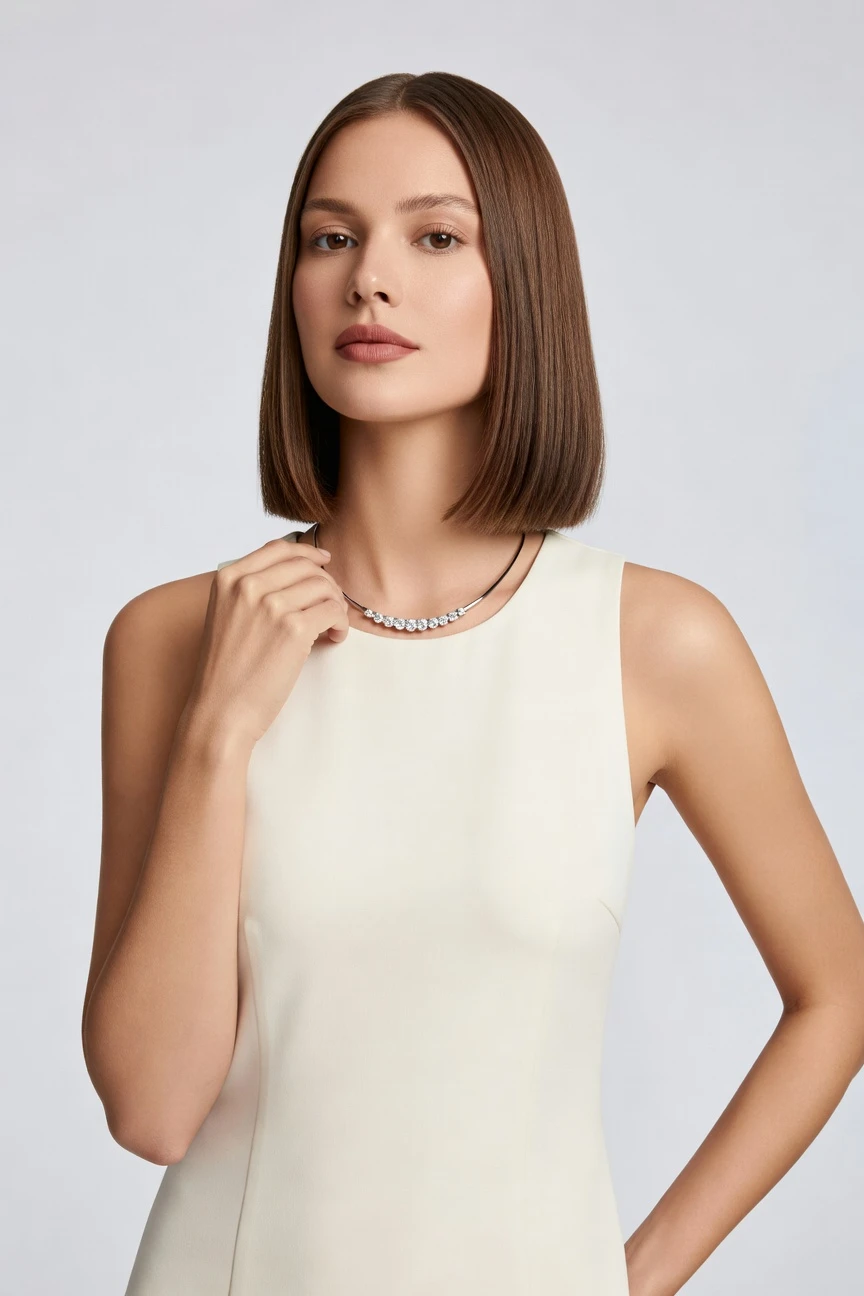
This setup starts from jewellery-first framing: an 85mm lens, half-body crop, 4:5 output, and 4K resolution so the piece stays central without losing on-model context. You click into a polished commerce frame instead of typing your way toward one. ~$0.55 per image · ~30-40s
- 4 clicks · 0 keystrokes
- app.rawshot.ai / new_shoot
How it works
Build Jewellery Imagery Around the Product
The workflow stays simple: start from the piece, direct the frame with clicks, then generate consistent output for single launches or full assortments.
- Step 01
Upload the Product
Start from the real jewellery item and choose the frame that gives it the right amount of attention. The piece stays the brief, so metal tone, shape, setting, and branding stay grounded in the product.
- Step 02
Set the Shot by Click
Select lens, crop, aspect ratio, lighting, and style from visual controls. You direct the image like an application user, not a chat operator guessing syntax.
- Step 03
Generate and Scale
Create one hero image or build repeatable output patterns across a larger catalog. Use the browser for single shoots or move the same logic into the REST API for volume.
Spec sheet
Proof for Jewellery Teams That Need Control
These twelve details show how RAWSHOT keeps product accuracy, operational clarity, and labelled output intact from first image to catalog scale.
- 01
Synthetic Models by Design
Every RAWSHOT model is built from 28 body attributes with 10+ options each. Accidental real-person likeness is statistically negligible by design, which makes jewellery imagery easier to label honestly.
- 02
Every Setting Is a Click
Camera, crop, pose, angle, light, background, style, and product focus live in controls. You direct jewellery photography with buttons, sliders, and presets, never an empty text box.
- 03
The Piece Stays Central
RAWSHOT is engineered around the real product, so cut, colour, finish, logo, proportion, and drape stay grounded in what you upload. That matters when a clasp, stone setting, or chain width must read clearly.
- 04
Diverse Model Range
Choose from a wide range of synthetic models to match brand context without compromising transparency. On-model jewellery imagery gains styling range while staying clearly labelled.
- 05
Consistency Across Variants
Keep the same face, framing logic, and visual direction across earrings, necklaces, rings, and layered sets. That consistency is hard to maintain when each image starts from scratch elsewhere.
- 06
150+ Visual Styles
Move from catalog clean to editorial gloss, noir, street, vintage, or beauty-led close framing without rebuilding your workflow. One product can support multiple campaign and commerce outputs.
- 07
2K, 4K, and Every Ratio
Generate square, portrait, landscape, and channel-specific crops in 2K or 4K. That gives jewellery teams one system for PDPs, ads, landing pages, marketplaces, and social placements.
- 08
Labelled and Compliant
Outputs are AI-labelled, C2PA-signed, and watermarked at visible and cryptographic layers. RAWSHOT is built for EU-hosted, GDPR-conscious operation and compliance-ready fashion publishing.
- 09
Per-Image Audit Trail
Each image carries a signed provenance record that supports internal review and external transparency. That matters when marketing, legal, and marketplace teams all need the same answer about what an asset is.
- 10
GUI to REST API
Use the browser interface for one-off jewellery shoots or connect the same engine to catalog pipelines through the REST API. The indie label and the enterprise assortment team use the same product.
- 11
Clear Time and Price
Still images cost about $0.55 each and generate in roughly 30–40 seconds. Tokens never expire, and failed generations refund tokens instead of turning experiments into waste.
- 12
Commercial Rights Included
Every output comes with full commercial rights, permanent and worldwide. You can publish across PDPs, campaigns, marketplaces, and paid channels without negotiating a separate usage layer.
Outputs
Jewellery Output Across Selling Contexts
From close-crop commerce frames to more styled editorial imagery, the product stays readable and the output stays operationally usable. Build a single launch image or a complete jewellery assortment with the same control surface.


Browse 150+ visual styles →
Comparison
RAWSHOT vs category tools vs DIY prompting
Three lenses on every dimension — what you optimize for in RAWSHOT versus typical category tools and blank-box AI workflows.
01
Interface
RAWSHOT
Click-driven controls for lens, framing, lighting, style, and output ratioCategory tools + DIY
Often mix light UI presets with narrower fashion-specific controls. DIY prompting: Relies on typed instructions, retries, and manual wording changes for every variation02
Garment fidelity
RAWSHOT
Built around the uploaded product so finish, logo, and proportion stay anchoredCategory tools + DIY
Can deliver usable fashion images but with less product-first grounding. DIY prompting: Garment and accessory drift is common, with invented details or changed branding03
Model consistency
RAWSHOT
Same synthetic model can stay stable across many jewellery SKUsCategory tools + DIY
Consistency varies across sessions and product groups. DIY prompting: Faces and body presentation often shift from image to image without warning04
Provenance + labelling
RAWSHOT
C2PA-signed, AI-labelled, and watermarked at visible and cryptographic layersCategory tools + DIY
Transparency signals are inconsistent across tools and exports. DIY prompting: Usually no built-in provenance metadata, signed record, or standardized labelling05
Commercial rights
RAWSHOT
Full commercial rights to every output, permanent and worldwideCategory tools + DIY
Rights can depend on plan level or separate terms interpretation. DIY prompting: Rights clarity varies by model, platform, and asset chain06
Pricing transparency
RAWSHOT
Roughly $0.55 per image, tokens never expire, one-click cancelCategory tools + DIY
Pricing commonly changes by seats, plans, or gated tiers. DIY prompting: Usage costs are harder to forecast across retries, upscale passes, and tool switching07
Catalog scale
RAWSHOT
Browser GUI for one shoot, REST API for nightly SKU pipelinesCategory tools + DIY
Some support scale but split features across plan levels. DIY prompting: Batch workflows need extra tooling, manual QA, and brittle reproducibility08
Operational overhead
RAWSHOT
Teams train on interface controls instead of wording experimentsCategory tools + DIY
More guided than generic tools but still less product-specific. DIY prompting: Prompt-engineering overhead slows approvals and creates inconsistent handoff between teammates
Prompting does not scale
Stop writing essays. Direct the shoot.
Most AI photo tools start with a blank text box. Rawshot turns the shoot into repeatable controls, so creative teams can produce consistent fashion imagery without prompt syntax or one-off hacks.
Category norm
ManualCreate a premium editorial fashion photograph of a model wearing the exact navy oversized wool coat from SKU-1842, full-body crop, realistic hands, consistent facial identity, clean e-commerce lighting, subtle Paris street background, 85mm lens, no logo distortion, no fabric hallucination, same pose as last campaign, repeatable for all colorways...
A prompt can describe one image. It cannot become a shared production system for hundreds of products, models, angles and markets.
Rawshot
ClicksSaved shoot recipe
Apply to 1 SKU or 10,000 via GUI, CSV or REST API.
Rawshot makes creative direction visible: buttons, presets and sliders instead of hidden prompt craft. The result is easier to teach, faster to approve and built for repeat production.
Use cases
Where Jewellery Brands Win More Coverage
Operator archetypes and how click-directed, garment-first output fits the way they actually work.
- 01
Indie Jewellery Designers
Launch a new necklace or ring line with polished on-model imagery before a traditional shoot budget exists.
Confidence · high
- 02
DTC Accessory Brands
Create PDP, ad, and landing-page assets from the same piece while keeping finish and scale readable.
Confidence · high
- 03
Crowdfunding Creators
Show supporters what the jewellery looks like on a person without shipping samples into a studio workflow.
Confidence · high
- 04
Marketplace Sellers
Standardize imagery across mixed assortments of earrings, bracelets, pendants, and watches for cleaner listings.
Confidence · high
- 05
Resale and Vintage Operators
Present one-off jewellery pieces with a more elevated on-model frame than flat product-only uploads allow.
Confidence · high
- 06
Small Catalog Teams
Maintain the same face and framing logic across hundreds of SKUs so the assortment reads as one brand.
Confidence · high
- 07
Editorial Merchandisers
Build beauty-led crops and moodier campaign treatments around jewellery without changing tools or retraining the team.
Confidence · high
- 08
Factory-Direct Manufacturers
Show buyers polished accessory imagery early in the sales cycle before full sample routing is practical.
Confidence · high
- 09
Private Label Retailers
Turn raw product assortments into AI-assisted jewellery photography suited to both commerce and seasonal campaigns.
Confidence · high
- 10
Social Commerce Teams
Generate vertical, square, and portrait assets for paid and organic channels from one controlled setup.
Confidence · high
- 11
Students and Emerging Stylists
Build portfolio-ready fashion and jewellery images with application controls instead of studio access barriers.
Confidence · high
- 12
Agency Production Teams
Use click-directed jewellery shoots to test visual directions quickly before committing larger campaign resources.
Confidence · high
— Principle
Honest is better than perfect.
Jewellery imagery often sits close to skin, face, and brand detail, which makes transparency more valuable, not less. Every RAWSHOT output is AI-labelled, C2PA-signed, and watermarked with visible and cryptographic layers so teams can publish with proof, not vagueness. We build for honest commerce: EU-hosted, GDPR-compliant, and ready for disclosure-forward workflows.
Rights & provenance
Full commercial rights. Forever.
- C2PA-signed on every image — EU AI Act Article 50 compliant
- 28-attribute synthetic models — real-person likeness statistically impossible
- Full commercial rights to every generation — no recurring licensing fees
- Tokens never expire · One-click cancel · Transparent pricing
EU AI Act
C2PA
Commercial use
Pricing
~$0.55 per image.
~30–40 seconds per generation. Tokens never expire. Cancel in one click.
- 01The cancel button is on the pricing page.
- 02No per-seat gates. No 'contact sales' walls for core features.
- 03Failed generations refund their tokens.
- 04Full commercial rights to every output, permanent, worldwide.
FAQ
Practical answers on control, rights, pricing, scale, and compliant publishing.
Do I need to write prompts to use RAWSHOT?
Never—you direct every output with sliders, presets, and clicks on the garment, not typed prompts. That matters because fashion teams do not need another tool that turns buyers, merchandisers, or founders into syntax specialists before they can get a usable image. In RAWSHOT, you choose framing, lens, angle, pose, lighting, background, visual style, resolution, aspect ratio, and product focus inside a real interface, so the work feels like directing a shoot rather than negotiating with a text box.
For catalog and campaign teams, that control model is easier to repeat across products and across people. The same logic works whether you are making one jewellery image in the browser GUI or scaling output through the REST API for larger assortments. Tokens, timings, refunds for failed generations, commercial rights, provenance signals, and labelled output are explicit rather than hidden behind guesswork, which makes the process easier to train, easier to approve, and easier to operationalize.
What does AI-assisted jewellery photography change for ecommerce and catalog teams?
It changes who gets to publish polished on-model imagery at all. Instead of waiting for samples, coordinating a studio day, and choosing which SKUs deserve the budget, teams can generate jewellery-focused images directly from the product with controlled framing, model presentation, lighting, and aspect ratio. That is especially useful in commerce because earrings, necklaces, watches, and bracelets often need both context and clarity: the customer has to understand how the piece sits on a body while still seeing the finish, scale, and styling intent.
RAWSHOT makes that practical with a click-driven interface, roughly $0.55 still images, and generation times around 30–40 seconds. You can move from a clean PDP crop to a more editorial campaign frame without leaving the same system, and outputs arrive with full commercial rights, C2PA provenance, watermarking, and clear AI labelling. For operations teams, the real shift is not novelty; it is reliable access to imagery that used to be reserved for bigger budgets.
Why skip reshooting every SKU when seasons, channels, or styling directions change?
Because the commercial need usually changes faster than a traditional shoot calendar can respond. A jewellery assortment may need one treatment for core PDPs, another for paid social, and another for a seasonal landing page, yet the underlying product has not changed enough to justify fresh logistics, sample handling, and studio coordination every time. When teams can regenerate visual direction from the same source product, they can adapt to channel needs without reopening the entire production chain.
RAWSHOT supports that with reusable synthetic models, multiple aspect ratios, 150+ visual styles, and 2K or 4K output inside the same workflow. You can preserve consistency across a collection while adjusting crop, mood, lighting, or campaign tone for the next drop. The takeaway for commerce teams is simple: reserve physical shoots for moments that truly need them, and use click-directed image generation to keep seasonal updates, assortment refreshes, and channel variants moving on schedule.
How do we turn flat product assets into catalogue-ready imagery without prompting?
You start from the real product and set the visual logic through interface controls. In practice, that means choosing the lens, framing, pose, camera angle, lighting system, background, style preset, resolution, and aspect ratio that best present the jewellery on a model. Because the piece remains the brief, the workflow is anchored in the uploaded item rather than in improvised text, which helps teams keep chain width, logo details, stone placement, and overall proportion more stable.
Inside RAWSHOT, the same process works for a single launch image or a larger catalog motion. A merchandiser can create one browser-based shot for a hero PDP, while an operations lead can translate that logic into repeatable API usage for wider assortments. With clear token pricing, refunded failed generations, labelled outputs, and audit-friendly provenance records, the workflow is built to move from creative exploration into production practice without changing tools halfway through.
Why does garment-led control beat DIY prompting in ChatGPT, Midjourney, or generic image AI for fashion PDPs?
Because fashion commerce is less forgiving than general image making. Generic tools can create attractive pictures, but they often drift on the details that matter to a buyer and to a shopper: logos change, hardware gets invented, proportions shift, and faces or body presentation vary unpredictably from one output to the next. When you are publishing PDP imagery for jewellery, that kind of drift creates review overhead and weakens confidence in the asset before it even reaches a customer.
RAWSHOT is built around the uploaded product and directed through explicit controls, not wording experiments. That means your team is deciding crop, lighting, framing, and style in a consistent interface while keeping provenance, watermarking, AI labelling, rights, and refund logic visible. For fashion operators, garment-led control wins because it produces assets that are easier to review, easier to repeat, and easier to trust inside an actual merchandising workflow.
Can we use the ai model with jewellery photography generator for paid ads and product pages with clear rights?
Yes. Every RAWSHOT output includes full commercial rights that are permanent and worldwide, which gives teams a clear basis for using images across PDPs, paid social, landing pages, marketplaces, and broader campaign surfaces. That clarity matters because fashion operators often move the same asset across multiple channels, and uncertainty around usage slows launch calendars just as much as production delays do. Rights should be explicit from the start, not something you discover after creative approval.
RAWSHOT also pairs usage clarity with transparency signals that support modern commerce practice. Outputs are AI-labelled, C2PA-signed, and watermarked with visible and cryptographic layers, and each image carries an audit-ready provenance record. For teams handling jewellery, beauty-adjacent crops, and close product detail, that combination of rights and disclosure helps marketing, legal, and marketplace stakeholders work from the same source of truth.
What quality checks should a buyer or merchandiser run before publishing jewellery imagery?
Start with the product itself. Confirm that metal tone, shape, logos, stone count, clasp position, layering logic, and overall scale read correctly against the body and within the crop you selected. Then review the presentation layer: make sure the framing suits the selling context, the model choice fits the brand, and the chosen style preset supports the product rather than overpowering it. Good jewellery imagery is not just attractive; it is informative enough to support purchase decisions.
After that, verify the operational signals. RAWSHOT outputs can be reviewed for AI labelling, watermarking cues, and C2PA-backed provenance, and teams can keep those checks inside normal asset approval steps instead of treating them as afterthoughts. Because the system also gives you full commercial rights and explicit generation economics, the approval process can cover both visual quality and publishing readiness in one pass, which makes launch governance much cleaner.
How much does still-image generation cost, and what happens if a generation fails?
For stills, RAWSHOT runs at about $0.55 per image, and most image generations complete in roughly 30–40 seconds. That gives teams a straightforward planning model when they need a handful of jewellery PDP assets or a much larger assortment refresh. Tokens never expire, so experimentation does not carry the same pressure as use-it-now monthly credit systems, and one-click cancel is available directly on the pricing page rather than hidden in support flows.
Failed generations refund their tokens, which is an important operational detail for real production use. Teams need room to test framing, style, and model choices without worrying that every dead end becomes sunk cost. Video and model generation have different pricing because they use different resources, but for still jewellery imagery the economics stay simple enough to budget, compare, and scale without special enterprise gates.
How does the ai model with jewellery photography generator fit into Shopify-scale or custom catalog pipelines?
It fits in two ways: directly in the browser for hands-on creative work, and through the REST API for larger catalog operations. That split matters because most commerce teams do not work in just one mode. Buyers, founders, and brand teams often want to test visual direction manually, while operations teams need a repeatable way to apply approved settings across many products and channels. A tool that only serves one side of that workflow creates friction the moment volume increases.
RAWSHOT keeps the engine consistent across both entry points. The same click-led logic that proves out a jewellery frame in the GUI can be translated into production patterns through the API, without changing output quality, core features, or pricing logic. For Shopify-scale and custom stack teams, that means fewer handoff problems, cleaner QA, and a practical path from creative approval to larger batch generation.
Can one team handle a single launch image today and a 10,000-SKU workflow later without changing tools?
Yes. RAWSHOT is designed so the same product supports one-shoot browser work and catalog-scale generation without forcing a platform switch when volume grows. The indie founder creating a small jewellery drop and the enterprise team processing a large assortment use the same engine, the same synthetic model logic, the same per-image pricing approach, and the same output standards. That continuity matters because changing tools mid-growth usually means retraining teams, rebuilding QA, and losing consistency just when brand scale starts to matter most.
Operationally, that means your team can begin by directing images through clicks in the GUI, lock in the visual system that works, and then extend those choices into repeatable API workflows as assortment size expands. With no per-seat gates for core features, explicit token rules, permanent commercial rights, and per-image provenance records, growth does not require negotiating access to the fundamentals. The process simply scales with you.
Keep exploring