
— 28 attributes · 10+ options each · Save once
AI Danish Male Generator — with click-driven control over every attribute.
When a Danish male look is the starting point, consistency matters more than improvisation. Select from 28 body attributes with 10+ options each, save the model once, and reuse it across your whole catalog without face drift. Every output is a synthetic composite with C2PA-signed provenance and clear labelling.
- ~$0.99 per model
- ~50–60s per generation
- 150+ styles
- 28 attributes × 10+ options
- Save once, reuse across catalog
- C2PA-signed
7-day free trial • 50 tokens (10 images) • Cancel anytime

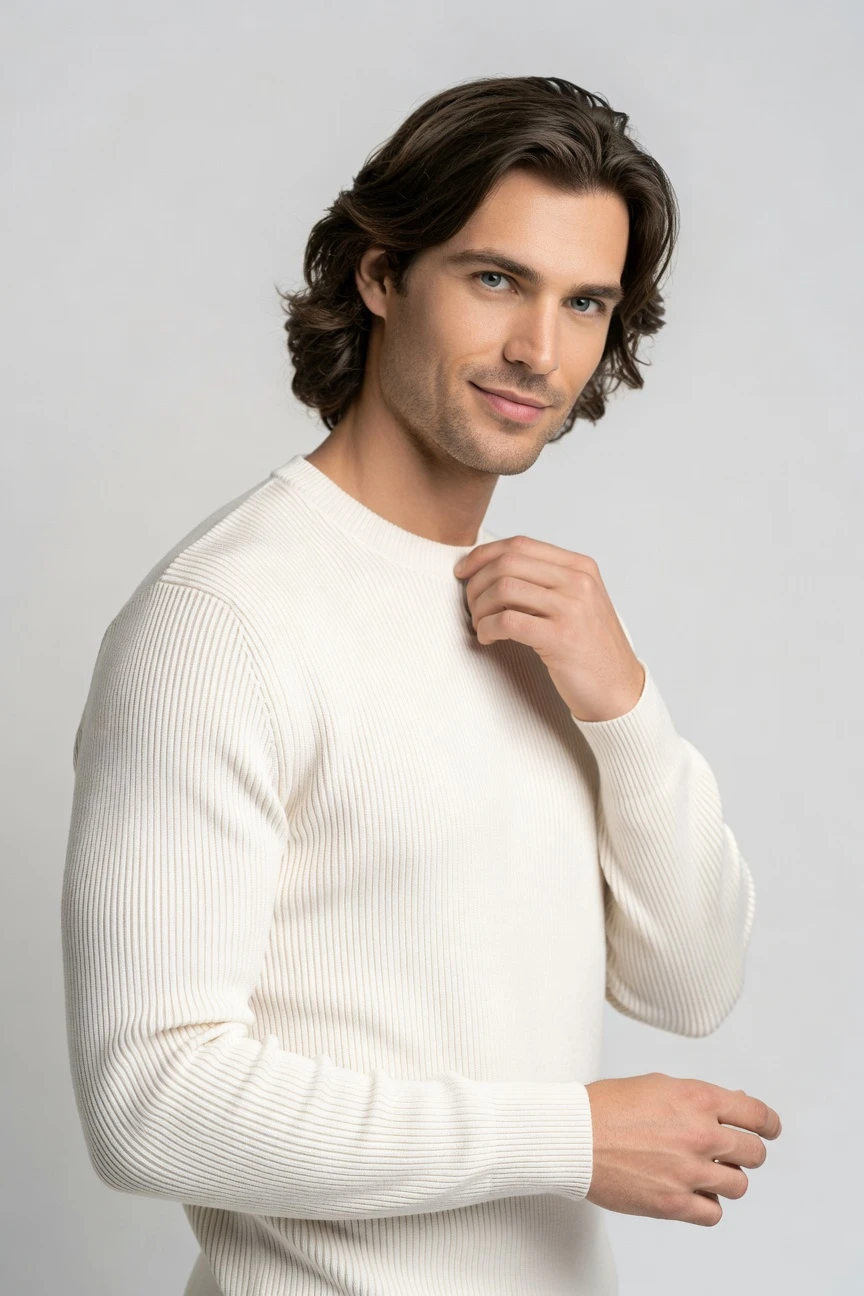
Saved model setup
Female · 26–35 · Dark brown · 175cm
Build a model. Zero prompts.
This setup starts from a Scandinavian male presentation with an adult age range, average build, longer wavy hair, and dark brown hair colour. You click the attributes once, save the model to your library, and reuse it across every garment drop. 28 attributes · 10+ options each
- 5 clicks · 0 keystrokes
- app.rawshot.ai / build_model
How it works
Build Once, Reuse Across the Catalog
Start with the model attributes that matter, save the identity, and keep every future shoot consistent without rewriting creative instructions.
- Step 01
Set the Core Attributes
Choose the Danish male starting point through visible controls, then refine age range, build, height, hair, eyes, and expression. Every decision is made with clicks, not text.
- Step 02
Save the Model Identity
Once the face and body are right, save the synthetic model to your library. That gives your team one reusable identity for lookbooks, PDPs, campaigns, and seasonal refreshes.
- Step 03
Reuse Across Every Shoot
Apply the saved model in the browser GUI or through the REST API for SKU-scale work. The result is the same face, same body, and the same audit-ready provenance across outputs.
Spec sheet
Proof for Repeatable Model Control
These twelve signals show how RAWSHOT keeps model building usable for small brands and reliable enough for catalog operations.
- 01
Attribute Depth, Not Guesswork
Build from 28 body attributes with 10+ options each, then save the exact combination. Synthetic composite design keeps accidental real-person likeness statistically negligible by design.
- 02
Every Setting Is a Click
You direct the model builder with buttons, sliders, and presets. The interface behaves like software for fashion teams, not a chat box.
- 03
Garment-Led Representation
Once the model is saved, the garment remains the brief. Cut, colour, pattern, logo, fabric, drape, and proportion stay central to the output.
- 04
Diverse Synthetic Cast
Build a Scandinavian-leaning male presentation when that fits the brand, or shift to other attribute mixes as needed. Diversity lives in controls, not in a random roll of the dice.
- 05
Consistent Across SKUs
The same face and body can carry one garment or a thousand. That consistency matters for PDP trust, line sheets, and seasonal continuity.
- 06
150+ Visual Styles
Move the saved model across catalog, editorial, lifestyle, studio, street, Y2K, noir, vintage, and campaign presets. Brand mood changes without rebuilding identity from scratch.
- 07
Ready for Any Output Frame
Use the same saved model in 2K or 4K output and across every aspect ratio. That keeps ecommerce, social, and wholesale assets aligned.
- 08
Labelled and Compliance-Ready
Outputs are AI-labelled, watermarked, and aligned with EU AI Act Article 50 and California SB 942 expectations. We host in the EU and build compliance into the product surface.
- 09
Signed Audit Trail per Image
Each image carries provenance records and traceable metadata. That gives teams a clearer chain of custody for review, approval, and publication.
- 10
GUI for One Shoot, API for Scale
Build a model in the browser for hands-on art direction or call the same system through REST for nightly catalog pipelines. The product stays the same as volume grows.
- 11
Fast, Transparent Economics
Model generation runs at about $0.99 and usually finishes in 50–60 seconds. Tokens never expire, and failed generations refund tokens automatically.
- 12
Commercial Rights Included
Every output comes with permanent worldwide commercial rights. You do not need a separate negotiation to publish, merchandise, or distribute the result.
Outputs
Saved Model, Many Contexts
A single saved identity can move from clean catalog work to sharper editorial treatments without losing continuity. That is what makes model building useful for both indie launches and large assortments.


Browse all 600+ models →
Comparison
RAWSHOT vs category tools vs DIY prompting
Three lenses on every dimension — what you optimize for in RAWSHOT versus typical category tools and blank-box AI workflows.
01
Interface
RAWSHOT
Buttons, sliders, presets, and saved model states throughout the workflowCategory tools + DIY
Usually mix lightweight controls with looser creative direction and less explicit model-state saving. DIY prompting: Typed instructions in a generic chat or image box, with manual retries for every change02
Model consistency
RAWSHOT
Save one identity and reuse it across looks, channels, and seasonsCategory tools + DIY
Often keep general casting direction but allow more variation between outputs. DIY prompting: Faces drift between generations, so catalogs end up with near-matches instead of one repeatable model03
Garment fidelity
RAWSHOT
Built around the garment so cut, logo, colour, and drape stay centralCategory tools + DIY
Can stylise well but may prioritise mood over exact apparel representation. DIY prompting: Garment drift, invented logos, and altered trims appear when text instructions are interpreted loosely04
Provenance + labelling
RAWSHOT
C2PA-signed outputs with AI labels and layered watermarking by defaultCategory tools + DIY
Labelling and provenance support vary, often without a signed record on every asset. DIY prompting: No dependable provenance metadata, inconsistent labelling, and no audit-ready chain of custody05
Commercial rights
RAWSHOT
Permanent worldwide commercial rights included for every outputCategory tools + DIY
Rights are often usable but can depend on plan terms or platform language. DIY prompting: Rights clarity is murky across tools, models, and source assets used in generation06
Pricing transparency
RAWSHOT
Per-model pricing stays visible, tokens never expire, one-click cancelCategory tools + DIY
May add seat gates, package tiers, or sales-led upgrades for core workflows. DIY prompting: Low entry cost hides heavy iteration time, failed attempts, and manual cleanup overhead07
Catalog scale
RAWSHOT
Same engine works in browser GUI and REST API for large assortmentsCategory tools + DIY
Some support scale, but advanced automation can be segmented behind higher plans. DIY prompting: No structured fashion pipeline, weak reproducibility, and manual coordination across many SKUs08
Iteration workflow
RAWSHOT
Change one attribute, save, compare, and redeploy the model quicklyCategory tools + DIY
Iteration is faster than studios but often less deterministic across repeated runs. DIY prompting: Each revision restarts the instruction loop, adding overhead before useful outputs appear
Prompting does not scale
Stop writing essays. Direct the shoot.
Most AI photo tools start with a blank text box. Rawshot turns the shoot into repeatable controls, so creative teams can produce consistent fashion imagery without prompt syntax or one-off hacks.
Category norm
ManualCreate a premium editorial fashion photograph of a model wearing the exact navy oversized wool coat from SKU-1842, full-body crop, realistic hands, consistent facial identity, clean e-commerce lighting, subtle Paris street background, 85mm lens, no logo distortion, no fabric hallucination, same pose as last campaign, repeatable for all colorways...
A prompt can describe one image. It cannot become a shared production system for hundreds of products, models, angles and markets.
Rawshot
ClicksSaved shoot recipe
Apply to 1 SKU or 10,000 via GUI, CSV or REST API.
Rawshot makes creative direction visible: buttons, presets and sliders instead of hidden prompt craft. The result is easier to teach, faster to approve and built for repeat production.
Use cases
Where a Saved Danish Male Model Helps
Operator archetypes and how click-directed, garment-first output fits the way they actually work.
- 01
Indie Menswear Labels
Build one Danish male identity for your first drop, then reuse it across tees, shirting, denim, and outerwear without recasting every launch.
Confidence · high
- 02
Nordic-Inspired DTC Brands
Keep the visual language aligned with a Scandinavian brand world while changing lighting, framing, and styling from campaign to PDP.
Confidence · high
- 03
Marketplace Sellers
Save a clean male model for repeatable catalogue images when you need product consistency more than one-off art direction.
Confidence · high
- 04
Factory-Direct Manufacturers
Show sample ranges on the same saved model before retail buyers ask for a full physical shoot plan.
Confidence · high
- 05
Crowdfunded Apparel Projects
Present a cohesive male fit story early, even when the budget does not stretch to a studio day and agency casting.
Confidence · high
- 06
Resale and Vintage Stores
Use one repeatable model identity to unify mixed inventory that originally came from different eras, labels, and source photos.
Confidence · high
- 07
Subscription Basics Brands
Carry the same male presentation across recurring SKU updates so shoppers focus on colourway changes, not casting changes.
Confidence · high
- 08
Wholesale Line Sheet Teams
Generate consistent on-model references for buyer decks where clean proportion and repeatability matter more than elaborate scenes.
Confidence · high
- 09
Adaptive Menswear Startups
Keep one reliable model identity while testing alternate garment cuts, closures, and fit communication for a niche audience.
Confidence · high
- 10
Student Fashion Collections
Create a coherent Danish male casting direction for graduate portfolios without absorbing the cost of a traditional production day.
Confidence · high
- 11
Catalog Ops Managers
Lock a male model once, then distribute that saved identity through browser workflows and API jobs for larger assortments.
Confidence · high
- 12
Seasonal Lookbook Teams
Shift the same saved model from neutral studio frames to stronger editorial styling while preserving cast continuity across the story.
Confidence · high
— Principle
Honest is better than perfect.
When you build a Danish male model in RAWSHOT, you are not borrowing a real person and hoping nobody notices. The model is a synthetic composite, every output is AI-labelled, and provenance plus watermarking travel with the asset so commerce teams can publish with clearer records and fewer grey areas.
Rights & provenance
Full commercial rights. Forever.
- C2PA-signed on every image — EU AI Act Article 50 compliant
- 28-attribute synthetic models — real-person likeness statistically impossible
- Full commercial rights to every generation — no recurring licensing fees
- Tokens never expire · One-click cancel · Transparent pricing
EU AI Act
C2PA
Commercial use
Pricing
~$0.99 per model generation.
~50–60 seconds per generation. Save the model once, reuse it across your entire catalog.
- 01Tokens never expire. Cancel in one click.
- 02Same face, same body, every SKU — no drift between shoots.
- 03No per-seat gates. No 'contact sales' walls for core features.
- 04Failed generations refund their tokens.
FAQ
Practical answers on control, rights, pricing, scale, and compliant publishing.
Do I need to write prompts to use RAWSHOT?
Never—you direct every output with sliders, presets, and clicks on the garment, not typed prompts. That UI control is consistent across GUI and REST API payloads, which is why ecommerce teams onboard buyers without rewriting creative briefs as chat threads.
For catalog teams, reliability matters more than model cleverness; RAWSHOT keeps tokens, timings, refund rules, commercial rights framing, provenance signalling, watermarking cues, REST surface, and SKU-scale batch patterns explicit so operations can rehearse PDP launches without hallucinated garment inventions.
What does an AI Danish male generator actually deliver for apparel teams?
It gives your team a reusable synthetic male model that can be defined through visible attributes and then applied across many garments, scenes, and channels. For fashion operators, that matters because consistency in face, build, and overall presentation is what makes a catalog feel intentional instead of assembled from unrelated shoots. RAWSHOT lets you set age range, body type, height, hair, expression, and other model attributes inside a click-driven interface, then save that identity to a library for later use.
The practical result is not novelty for its own sake. It is a reliable cast member for PDPs, lookbooks, launch pages, wholesale decks, and seasonal updates without the cost and coordination of arranging a fresh studio production each time. Teams use the saved model in the browser for one-off work or through the REST API for larger assortments, with C2PA-signed provenance, AI labelling, and permanent worldwide commercial rights attached to the final outputs.
Why skip reshooting every SKU when the cast needs to stay the same?
Because repeated physical shoots are expensive, slow to schedule, and hard to keep visually aligned across time. A brand may nail the first session, then lose continuity when a second shoot brings a different face, different posture, slightly different lensing, or changed lighting. For apparel commerce, those small differences create noise on PDPs and in campaign grids, especially when shoppers are comparing colourways or fit across a collection.
RAWSHOT solves that by letting you save the model identity once and apply it again whenever new garments arrive. The same underlying model can be used for a single restock image or a broad seasonal refresh while preserving the brand’s casting logic. That makes range extensions, launch corrections, and late product additions operationally easier, and it helps teams spend time on assortment decisions rather than rebuilding visual continuity from scratch for every SKU wave.
How do we turn flat garments into catalogue-ready imagery without prompting?
You start by uploading the garment and selecting the framing, model, styling direction, and other visible controls inside the application. The garment remains the brief, so your team works from product reality instead of trying to coax a text box into remembering logos, trims, colours, and drape. That is especially useful for catalog teams that need predictable outputs more than improvisation, because each creative choice is tied to a specific setting that can be reviewed and repeated.
Once the saved model is chosen, you can generate upper-body, lower-body, full-outfit, detail, or accessory-focused compositions in the browser GUI, and the same logic can be carried into REST API jobs for scale. RAWSHOT supports 2K and 4K outputs, multiple aspect ratios, 150+ visual styles, and permanent commercial rights, so the workflow moves cleanly from garment file to publishable imagery. In practice, teams treat it like production software: set the controls, review the result, approve the asset, and move to the next SKU.
Why does garment-led control beat ChatGPT, Midjourney, or generic image tools for fashion PDPs?
Generic tools are not built around apparel accuracy, so they often force teams into repeated text rewrites while still producing drifting garments, invented logos, altered trims, and inconsistent faces. That can be tolerable for loose concept work, but it breaks down fast when a product page needs the exact neckline, exact colour balance, or the same model across twenty related SKUs. The issue is not just output quality; it is reproducibility and the amount of operator time lost to trial and error.
RAWSHOT is designed as a fashion application with direct controls for model attributes, camera choices, framing, lighting, style, and product focus. You are not translating commerce needs into open-ended instruction syntax every time you want a revision. On top of that, RAWSHOT adds C2PA-signed provenance, watermarking, AI labelling, clear commercial rights, and scale paths through both GUI and REST API. For PDP work, that combination is more useful than raw model flexibility because it makes the workflow dependable enough to operationalise.
Can we use these outputs commercially, and are they clearly labelled as AI?
Yes. RAWSHOT includes permanent worldwide commercial rights for the outputs you generate, so teams can publish them across ecommerce, advertising, merchandising, and wholesale materials without entering a separate licensing maze for each asset. Just as important, the outputs are clearly labelled as AI and carry layered watermarking plus provenance records. That transparency is not an afterthought; it is part of how the product is built for modern commerce teams that need assets they can account for as well as use.
The models themselves are synthetic composites rather than scans or replicas of a real individual. That design reduces accidental real-person likeness risk and supports a more accountable workflow for brands that need consistency without pretending the asset came from a physical shoot. When legal, brand, and ecommerce teams review the same file, they can see a cleaner record of what it is, how it was produced, and how it should be handled in downstream publishing.
What should our team check before publishing a saved male model across the catalog?
Start with the basics that matter to shoppers: garment accuracy, proportion, logo integrity, visible trims, and whether the saved model still fits the intended product category and audience. Then check consistency factors such as face continuity, posture, crop, and lighting style across the product set. For commerce work, quality control is not only about whether an image looks good in isolation; it is about whether adjacent SKUs feel like they belong to the same brand system and whether the product remains the focal point in every frame.
RAWSHOT supports that review process with a click-driven setup, saved model identities, 150+ styles, multiple output formats, and audit-ready provenance. Teams should also confirm that AI labelling and watermarking remain intact in the file handling chain and that the chosen aspect ratio matches the destination channel. A solid practice is to approve one reference image per collection segment, then use that as the baseline while scaling the rest of the set through browser batches or API jobs.
How much does this cost if we only need a reusable male model, not a full shoot?
RAWSHOT charges about $0.99 per model generation, and the model build usually completes in around 50–60 seconds. That matters for smaller brands because you can establish a reusable identity without committing to a larger production package or negotiating access to basic features. Tokens never expire, failed generations refund their tokens, and cancellation is available in one click on the pricing page, so the cost structure stays legible instead of turning into a planning exercise.
From an operations standpoint, the model generation cost is only part of the value. Once the identity is saved, the same face and body can be reused across future garments, reducing visual drift and setup repetition for every later asset. Teams that think in assortments rather than isolated images usually find that a saved model becomes infrastructure: one stable reference that supports many outputs, across many timelines, without reopening the casting problem for each new SKU.
Can our Shopify or PIM workflow use RAWSHOT through an API?
Yes. RAWSHOT offers a REST API alongside the browser GUI, so teams can move from manual creative review to structured catalog workflows without changing products or entering a different commercial tier for the core engine. That is useful for Shopify, PIM, ERP, or custom ecommerce stacks because the same saved model logic can sit inside a repeatable pipeline instead of living only in an art director’s browser session. In practice, that means one team can define the model and visual rules while another team automates asset generation and delivery downstream.
The API path is especially helpful when assortments grow, when multiple regions need parallel outputs, or when nightly jobs have to keep up with frequent SKU changes. Since the saved model is reusable, you do not lose continuity as you scale. Teams still retain access to provenance records, AI labelling, rights clarity, and failed-generation refunds, which makes the API useful not just for throughput, but for accountable production operations.
How do teams scale from one saved model in the browser to thousands of SKUs without losing consistency?
The usual pattern is simple: define the model identity once in the GUI, test it on a small set of representative garments, lock the visual rules, and then extend the same configuration across larger batches. That approach works because the saved model acts as a stable reference point while the garment, crop, lighting, and style can vary in controlled ways. For a brand team, this reduces disagreement between creative and operations because both sides are working from the same reusable identity rather than approximating the same cast over and over again.
RAWSHOT supports that scale with the same engine across single-shoot browser work and REST API pipelines, without per-seat gates or a separate enterprise-only core workflow. The value is not just speed, although generation times are clear and predictable; it is operational continuity. A small label can start by clicking through one launch in the app, then grow into batch production later without abandoning the same controls, the same saved model logic, or the same provenance and rights standards.