
— 28 attributes · 10+ options each · Save once
AI Photo Person Generator — with click-driven control over every attribute.
Build the person your catalog actually needs, then reuse that exact face and body across every SKU. You select body attributes, presentation, hair, height, and expression in a real interface, save the model once, and keep consistency across the whole range. Each model is a synthetic composite designed for statistically negligible real-person likeness, with labelled output and C2PA-signed provenance.
- ~$0.99 per generation
- ~50–60s per generation
- 28 attributes × 10+ options each
- Save once, reuse across catalog
- 2K or 4K
- Full commercial rights
7-day free trial • 50 tokens (10 images) • Cancel anytime

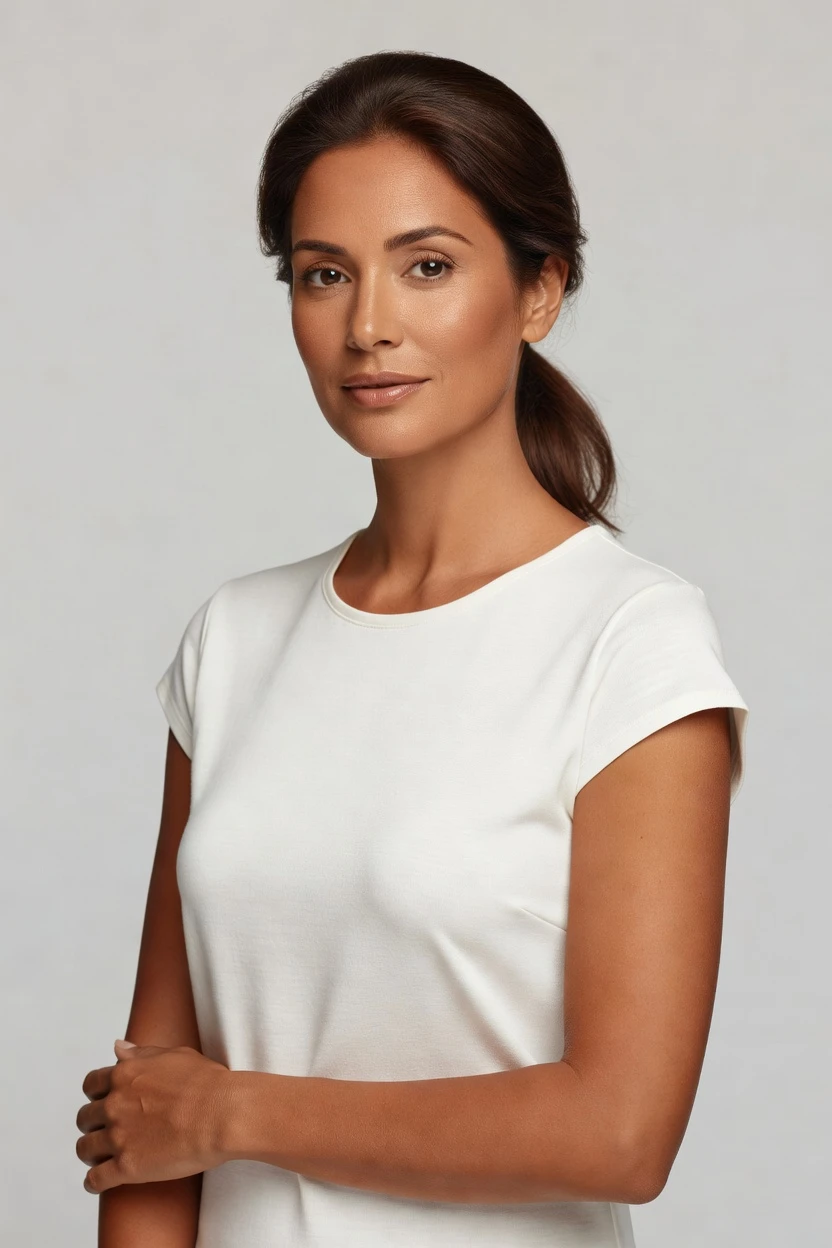
Saved model setup
Female · 26–35 · Dark brown · 175cm
Build a model. Zero prompts.
This setup starts from a copper skin tone and builds a reusable catalog model with balanced proportions, neutral expression, and versatile hair. You click through the attributes, save the result to your library, and keep the same identity across every product line. 28 attributes · 10+ options each
- 6 clicks · 0 keystrokes
- app.rawshot.ai / build_model
How it works
Build Once, Reuse Across the Catalog
This model workflow turns a one-time setup into repeatable identity consistency for product pages, launches, and large apparel ranges.
- Step 01
Set the Person
Choose the model with buttons, sliders, and presets across 28 body attributes. You define the identity in a few clicks instead of translating fashion intent into a text box.
- Step 02
Save the Identity
Store the selected face and body in your library once the configuration is right. That saved model becomes a reusable asset for catalog work, campaigns, and seasonal refreshes.
- Step 03
Reuse Across Every SKU
Apply the same saved model across garments, categories, and channels without drift between outputs. The result is a consistent person your team can direct at one-look scale or through a larger pipeline.
Spec sheet
Twelve Proof Points Behind the Model
These are the product truths that matter when you need a reusable fashion person, not a one-off output that changes every time.
- 01
No-Likeness by Design
Every model is a synthetic composite built from 28 body attributes with 10+ options each. Accidental real-person likeness is statistically negligible by design.
- 02
Every Setting Is a Click
You direct the model with controls, not a blank text field. Identity, expression, and body setup live in a real application built for fashion teams.
- 03
Garment-Led Representation
RAWSHOT is engineered around the product, so cut, colour, pattern, logo, fabric, and drape stay central. The garment is the brief.
- 04
Diverse Synthetic Models
You work with transparently labelled synthetic models built for broad fashion representation. That gives smaller brands access to imagery without casting barriers.
- 05
Same Face Across SKUs
Save a model once and reuse the same identity across your entire catalog. No drift between shoots, no nearly-right substitutes.
- 06
150+ Visual Styles
Move the saved model through catalog, lifestyle, editorial, campaign, street, Y2K, vintage, noir, and more. Style changes without rebuilding the person.
- 07
2K, 4K, Any Ratio
Generate outputs in 2K or 4K and frame for every aspect ratio your channels require. One saved model can serve PDPs, marketplaces, and social placements.
- 08
Signed and Labelled Output
Every output is C2PA-signed, AI-labelled, and aligned with EU AI Act Article 50 and California SB 942 requirements. Honest labelling is built in, not bolted on.
- 09
Per-Image Audit Trail
Each image carries a signed audit trail that supports review, approval, and downstream governance. That matters when creative, ecommerce, and compliance teams share responsibility.
- 10
GUI for One Shoot, API for Scale
Use the browser GUI for hands-on direction or the REST API for catalog-scale pipelines. The same engine serves one outfit or ten thousand SKUs.
- 11
Fast, Flat, Transparent Pricing
Photo generation runs at about ~$0.55 per image in ~30–40 seconds, and tokens never expire. The economics stay clear instead of hiding behind seat limits or volume gates.
- 12
Commercial Rights Stay Clear
You get full commercial rights to every output, permanent and worldwide. That makes approval and publishing simpler for operators who need clean usage terms.
Outputs
Saved Models, reused everywhere.
A single model can anchor multiple product categories, visual styles, and aspect ratios without changing identity. That consistency is what turns experimentation into a usable fashion workflow.


Browse all 600+ models →
Comparison
RAWSHOT vs category tools vs DIY prompting
Three lenses on every dimension — what you optimize for in RAWSHOT versus typical category tools and blank-box AI workflows.
01
Interface
RAWSHOT
Click-driven controls for identity, styling, framing, and reuse.Category tools + DIY
Often mix limited controls with thinner workflow depth and shorter setup surfaces. DIY prompting: You type instructions into generic image tools and iterate through trial and error.02
Garment fidelity
RAWSHOT
Engineered around the garment, with faithful cut, colour, pattern, and logos.Category tools + DIY
Can look fashion-specific but often hold weaker product accuracy under variation. DIY prompting: Garment drift and invented logos appear as outputs mutate between attempts.03
Model consistency across SKUs
RAWSHOT
Save one synthetic model and reuse the same face and body.Category tools + DIY
Consistency exists, but can be gated, partial, or less dependable at scale. DIY prompting: Faces change from image to image, breaking catalog continuity and brand trust.04
Provenance + labelling
RAWSHOT
C2PA-signed, AI-labelled, watermarked, with compliance-first output handling.Category tools + DIY
Many tools stop at generation and offer little provenance infrastructure. DIY prompting: Missing provenance metadata, no clear labelling, and no signed record per output.05
Commercial rights
RAWSHOT
Full commercial rights, permanent and worldwide, on every output.Category tools + DIY
Rights may be narrower, tiered, or harder to verify across plans. DIY prompting: Usage terms can be unclear for commerce teams needing dependable publishing rights.06
Pricing transparency
RAWSHOT
Flat per-model pricing, no per-seat gates, tokens never expire.Category tools + DIY
Per-seat pricing and volume tiers often appear as usage grows. DIY prompting: Tool access may be cheap upfront, but iteration overhead turns into hidden labor cost.07
Catalog API
RAWSHOT
Browser GUI and REST API use the same product and model logic.Category tools + DIY
API access is often thinner or pushed behind enterprise packaging. DIY prompting: No clean catalog pipeline, just manual prompting and file-by-file handling.08
Iteration speed per variant
RAWSHOT
Reusable saved models reduce setup time for each new garment.Category tools + DIY
Iterations can require more rework when controls are narrower. DIY prompting: Prompt-engineering overhead slows every revision before useful outputs even start.
Prompting does not scale
Stop writing essays. Direct the shoot.
Most AI photo tools start with a blank text box. Rawshot turns the shoot into repeatable controls, so creative teams can produce consistent fashion imagery without prompt syntax or one-off hacks.
Category norm
ManualCreate a premium editorial fashion photograph of a model wearing the exact navy oversized wool coat from SKU-1842, full-body crop, realistic hands, consistent facial identity, clean e-commerce lighting, subtle Paris street background, 85mm lens, no logo distortion, no fabric hallucination, same pose as last campaign, repeatable for all colorways...
A prompt can describe one image. It cannot become a shared production system for hundreds of products, models, angles and markets.
Rawshot
ClicksSaved shoot recipe
Apply to 1 SKU or 10,000 via GUI, CSV or REST API.
Rawshot makes creative direction visible: buttons, presets and sliders instead of hidden prompt craft. The result is easier to teach, faster to approve and built for repeat production.
Use cases
Where Reusable Model Consistency Pays Off
Operator archetypes and how click-directed, garment-first output fits the way they actually work.
- 01
Indie Designers
Build a copper-skin catalog model once and launch new drops with a consistent person even when a studio day was never in budget.
Confidence · high
- 02
DTC Apparel Brands
Keep one reusable model across denim, knitwear, outerwear, and basics so your storefront reads as a single brand world, not a patchwork.
Confidence · high
- 03
Marketplace Sellers
Create a dependable AI-assisted model identity for listings in multiple aspect ratios without recasting every time the assortment changes.
Confidence · high
- 04
Resale and Vintage Stores
Present one-off garments on the same saved person so the catalog feels organized even when every SKU is unique.
Confidence · high
- 05
Crowdfunding Creators
Show pre-launch collections on a repeatable model before production, giving backers a clearer view of fit direction and brand tone.
Confidence · high
- 06
Adaptive Fashion Labels
Build representation intentionally with a reusable synthetic person and carry that identity through product education, campaign images, and PDPs.
Confidence · high
- 07
Kidswear Buying Teams
Use the same identity logic across seasonal category pages and reduce the visual inconsistency that usually comes with fragmented sample photography.
Confidence · high
- 08
Lingerie DTC Operators
Keep a stable person across bras, briefs, shapewear, and loungewear so fit storytelling stays coherent across the full range.
Confidence · high
- 09
Factory-Direct Manufacturers
Create catalog people for private-label programs and scale outputs through the same workflow from browser tests to API production.
Confidence · high
- 10
On-Demand Labels
Save a model once and update the product mix constantly without rebuilding the face, body, and presentation for every release.
Confidence · high
- 11
Student Fashion Founders
Use an AI photo person workflow to get campaign-ready identity and catalog continuity before you can afford conventional production.
Confidence · high
- 12
Enterprise Catalog Teams
Standardize one approved model setup across hundreds or thousands of SKUs, then push the workflow into nightly pipelines with auditability.
Confidence · high
— Principle
Honest is better than perfect.
When you build a reusable fashion person, trust matters as much as consistency. RAWSHOT labels outputs, applies visible and cryptographic watermarking, and attaches C2PA-signed provenance so teams can publish with a clear record of what the asset is. That matters for brand protection, internal governance, and compliant rollout across regions.
Rights & provenance
Full commercial rights. Forever.
- C2PA-signed on every image — EU AI Act Article 50 compliant
- 28-attribute synthetic models — real-person likeness statistically impossible
- Full commercial rights to every generation — no recurring licensing fees
- Tokens never expire · One-click cancel · Transparent pricing
EU AI Act
C2PA
Commercial use
Pricing
~$0.99 per model generation.
~50–60 seconds per generation. Save the model once, reuse it across your entire catalog.
- 01Tokens never expire. Cancel in one click.
- 02Same face, same body, every SKU — no drift between shoots.
- 03No per-seat gates. No 'contact sales' walls for core features.
- 04Failed generations refund their tokens.
FAQ
Practical answers on control, rights, pricing, scale, and compliant publishing.
Do I need to write prompts to use RAWSHOT?
Never—you direct every output with sliders, presets, and clicks on the garment, not typed prompts. That UI control is consistent across GUI and REST API payloads, which is why ecommerce teams onboard buyers without rewriting creative briefs as chat threads. Instead of guessing the right wording, you select the model attributes, framing, style, lighting, and product focus directly in the interface, which keeps decisions visible and repeatable for everyone involved.
For catalog teams, reliability matters more than model cleverness; RAWSHOT keeps tokens, timings, refund rules, commercial rights framing, provenance signalling, watermarking cues, REST surface, and SKU-scale batch patterns explicit so operations can rehearse PDP launches without hallucinated garment inventions. The practical takeaway is simple: your team learns a product workflow, not a text trick, and that makes approvals, iteration, and scale much easier to manage.
What does an AI photo person generator actually change for fashion catalog teams?
It changes who gets access to consistent on-model imagery. Instead of treating each new garment as a new casting, shoot, and retouch cycle, your team can build a reusable synthetic model once and keep that identity stable across the full assortment. That matters for commerce because shoppers do not experience images one by one; they experience continuity across product pages, collection pages, marketplaces, and campaign touchpoints.
With RAWSHOT, the person is saved to your library and reused through the same interface across categories and channels. You still control styling direction, framing, and output format, but you no longer restart identity from scratch every time. Combined with clear commercial rights, C2PA-signed provenance, and a browser GUI plus REST API, that turns model consistency into repeatable infrastructure instead of a fragile creative workaround.
Why skip reshooting every SKU when the season, assortment, or channel changes?
Because most assortments change faster than a conventional production calendar can comfortably absorb. If every seasonal update requires new casting, new shoot coordination, new sample logistics, and new post-production, smaller teams stay trapped in backlog and larger teams end up with inconsistent visual systems. Reusing an approved synthetic model lets you update the assortment while preserving the person your shoppers already recognize across PDPs and brand channels.
RAWSHOT is built for that reuse pattern. You save the model once, carry the same face and body through new garments, and adapt styles, ratios, and channels as needed without rebuilding identity. That gives buying, merchandising, and ecommerce teams a cleaner operating model for launches, sale periods, line expansions, and regional rollouts, while keeping provenance, labelling, and rights clear from the start.
How do we turn flat garments into catalogue-ready imagery without prompting?
You start by building the person in the model interface, then pair that saved identity with the garment and direct the output through visual controls. The workflow is concrete: choose attributes, save the model, select the garment setup, adjust framing and style, and generate. Because the controls are explicit, teams can review decisions together instead of interpreting loosely worded text instructions after the fact.
That matters when the same item needs multiple uses, from a clean storefront image to a more styled collection page asset. RAWSHOT keeps the product central, supports 2K and 4K outputs, and lets teams move between browser-based single-shoot work and larger API-driven production without changing systems. In practice, that means faster approvals, fewer interpretation errors, and a much cleaner path from product file to publishable imagery.
Why does RAWSHOT beat ChatGPT, Midjourney, or generic image models for fashion PDP work?
Generic image tools are built around open-ended text generation, which is a poor match for product-detail accountability. In fashion commerce, the failures are familiar: garments drift between iterations, logos appear that are not yours, and faces change every time you try to build a catalog line around one person. Even when an image looks close, the workflow remains brittle because the underlying logic is not centered on the garment or on repeatable SKU consistency.
RAWSHOT takes the opposite approach. You direct the shoot through controls, save the model once for reuse, keep the garment as the brief, and receive outputs with commercial-rights clarity plus C2PA-signed provenance and watermarking. That combination is what makes the system useful for product pages and assortment operations rather than only for moodboarding or one-off experimentation.
Can we use these labelled synthetic models in paid commerce and campaign work?
Yes. RAWSHOT gives full commercial rights to every output, permanent and worldwide, which is the baseline commerce teams need before publishing to storefronts, marketplaces, ads, or campaign destinations. Just as important, the outputs are transparently labelled and carry provenance signals instead of pretending to be something they are not. That protects brand trust while giving operators a workable usage framework.
RAWSHOT also adds visible and cryptographic watermarking plus C2PA-signed metadata, so the record of the asset travels with the image rather than living only in an internal note. For legal, brand, and operations teams, that makes review much simpler because the answer is not only that the asset may be used, but that it is clearly identified and documented as synthetic output from the start.
What should our team check before publishing a synthetic person across the catalog?
Review the same things you would review in any apparel image set, but do it with explicit attention to garment fidelity, identity consistency, and labelling. Confirm that cut, colour, pattern, drape, and branding are represented faithfully, and make sure the saved model remains the same across the relevant SKU group. Then verify the intended ratio, resolution, and channel framing so the asset matches where it will actually be published.
With RAWSHOT, teams should also confirm the provenance layer and watermarking cues are intact and that the asset belongs to the right workflow state before release. Because each output carries signed metadata and an audit trail, the quality check can include governance rather than only visual taste. That turns publishing from an informal creative guess into a repeatable operational checkpoint that scales across teams.
How much does the model workflow cost, and what happens to unused tokens?
The model workflow is priced at about ~$0.99 per model generation, with typical generation times around 50–60 seconds. Tokens never expire, so teams are not forced into artificial deadlines just to preserve value on the account. That matters for apparel operators because range plans, sample readiness, and launch timing rarely move in perfectly neat cycles, and creative infrastructure should not punish that reality.
RAWSHOT also keeps the commercial terms straightforward: failed generations refund their tokens, core features are not hidden behind per-seat gates, and cancelling is available in one click on the pricing page. In practical use, that means you can build a saved model library gradually, iterate when needed, and budget for model consistency as an operating line rather than a surprise platform bill.
Can our developers plug saved-model workflows into Shopify-scale or PLM-led pipelines?
Yes. RAWSHOT supports a browser GUI for hands-on creative direction and a REST API for catalog-scale production, so teams do not need separate products for experimentation and rollout. Developers can work from the same underlying model logic the creative team uses in the interface, which reduces translation errors between a pilot workflow and an automated one. That is especially useful when the same approved identity must persist across large assortments and repeated refresh cycles.
The platform is also PLM-integration ready and provides a signed audit trail per image, which helps connect generation events to broader merchandising and governance systems. For Shopify-scale operations, that means saved-model consistency can move from one-off creative output into an actual production pipeline with trackable records, stable inputs, and reliable downstream handling.
How do teams scale from one saved model in the browser to thousands of SKUs in production?
The scaling path is to approve the identity once, standardize the workflow around that saved model, and then expand output volume through the same system rather than switching tools midstream. A merchandiser, designer, or ecommerce lead can establish the person and visual direction in the GUI, while operations or engineering turns that approved setup into repeatable production runs. Because the product logic is shared, teams keep consistency instead of rebuilding it during handoff.
RAWSHOT is designed for one shoot or ten thousand, with the same engine, the same reusable model logic, and the same commercial-rights and provenance handling on every output. That lets smaller brands start manually and larger teams industrialize later without changing the creative foundation. The result is a workflow that grows with assortment volume while keeping identity, governance, and publish-readiness intact.
Keep exploring