
— On-model textiles · 150+ styles · 4K
Direct garment-faithful campaign imagery with the AI Textile Fashion Photo Generator
Generate on-model textile imagery that stays centered on the garment, from clean catalog frames to styled campaign shots. Direct camera, framing, pose, light, background, and output format with buttons, sliders, and presets in a real application. No studio. No samples shipped. No prompts.
- ~$0.55 per image
- ~30–40s per generation
- 150+ styles
- 2K or 4K
- Every aspect ratio
- Full commercial rights
7-day free trial • 50 tokens (10 images) • Cancel anytime

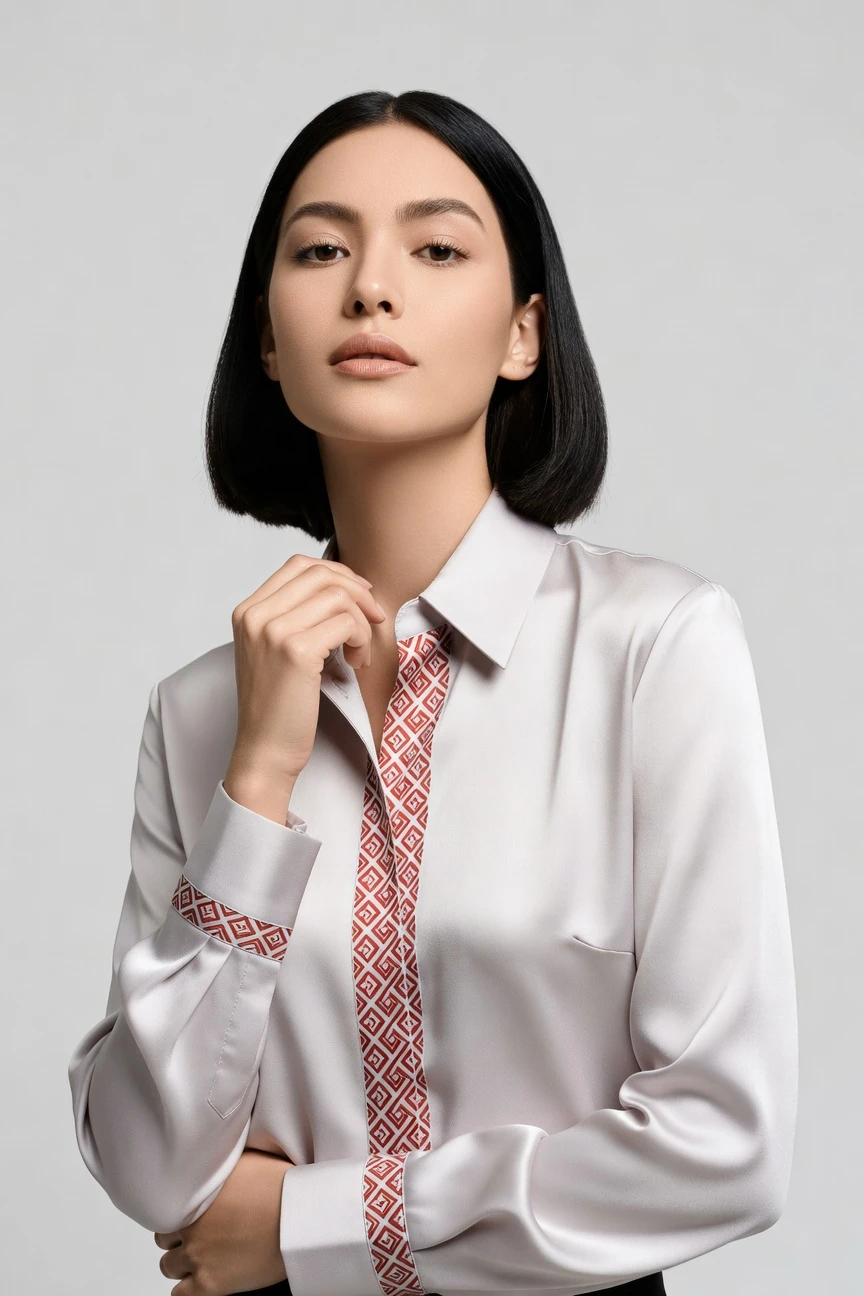
Direct the shoot. Zero prompts.
This setup starts with a textile-focused half-body frame in 4K and 4:5 so fabric, cut, and print stay readable in PDPs, lookbooks, and social crops. You click into lens and framing choices, then generate without typing a single instruction. ~$0.55 per image · ~30-40s
- 4 clicks · 0 keystrokes
- app.rawshot.ai / new_shoot
How it works
From Textile Detail to On-Model Output
Three steps turn a real garment into campaign-ready or catalog-ready imagery without studio logistics or typed instructions.
- Step 01
Upload the Garment
Start from the real product so cut, colour, print, logo, and proportion stay central to the output. That makes textile detail the brief from the first click.
- Step 02
Set the Shoot With Controls
Choose lens, framing, angle, lighting, background, visual style, and product focus from visible controls. You direct the result like an application user, not a chat operator.
- Step 03
Generate and Scale Variants
Create stills in around 30–40 seconds, compare options, and keep the setup moving from one look to a whole SKU range. The same system works in the browser and through the REST API.
Spec sheet
Proof for Textile-Focused Image Production
These twelve proof points show how RAWSHOT keeps garments central while giving fashion teams speed, control, scale, and clear labelling.
- 01
Built From Synthetic Attributes
Every model is a synthetic composite built from 28 body attributes with 10+ options each. Accidental real-person likeness is statistically negligible by design.
- 02
Every Setting Is a Click
Camera, framing, pose, light, background, style, and product focus live in the interface. You direct the shoot with controls, not an empty text box.
- 03
The Garment Stays the Brief
RAWSHOT is engineered around the product so cut, colour, pattern, logo, fabric, and drape are represented faithfully. Textile detail is not bent around guesswork.
- 04
Diverse Models, Transparently Labelled
Choose from diverse synthetic models for different brand contexts and customer segments. Outputs are AI-labelled so representation and transparency travel together.
- 05
Consistency Across SKU Runs
Keep the same setup, visual direction, and model logic across repeated generations. That means fewer mismatched PDPs and cleaner range-wide presentation.
- 06
150+ Visual Style Presets
Move from catalog clean to campaign gloss, street flash, noir, vintage, or studio minimal in a few clicks. The style library covers commerce basics and brand expression.
- 07
2K, 4K, and Every Ratio
Generate in 2K or 4K and choose the crop that fits your channel. Square, portrait, landscape, and social-first formats are all supported.
- 08
Provenance and Compliance Built In
Every output is C2PA-signed, watermarked, and AI-labelled, with support for EU AI Act Article 50, California SB 942, GDPR, and EU hosting.
- 09
Signed Audit Trail Per Image
Each image carries a record of what it is and where it came from. That helps teams document provenance for publishing, review, and internal approval.
- 10
Browser for One Shoot, API for Scale
Use the GUI for single-look creative work or connect the REST API for catalog pipelines. The same engine serves a one-off drop and a nightly bulk run.
- 11
Fast, Clear, and Token-Safe
Images cost about $0.55 and generate in around 30–40 seconds. Tokens never expire, and failed generations refund their tokens.
- 12
Commercial Rights Stay Clear
Every output includes full commercial rights, permanent and worldwide. Teams can publish, list, launch, and reuse imagery without rights ambiguity.
Outputs
See the Outputs, Not the Hype
From clean textile-first catalog frames to styled campaign crops, the point is clear direction and garment fidelity. You choose the setup, then generate labelled output that is ready to work.


Browse 150+ visual styles →
Comparison
RAWSHOT vs category tools vs DIY prompting
Three lenses on every dimension — what you optimize for in RAWSHOT versus typical category tools and blank-box AI workflows.
01
Interface
RAWSHOT
Click-driven controls for lens, framing, light, background, style, and focusCategory tools + DIY
Often mix presets with short text fields and less granular shoot direction. DIY prompting: Typed instructions in a chat box with manual retries and inconsistent wording02
Garment fidelity
RAWSHOT
Engineered around the real garment so cut, print, logo, and drape stay centralCategory tools + DIY
Can stylise quickly but often soften textile specifics across outputs. DIY prompting: Garments drift, logos mutate, prints change, and construction details get invented03
Model consistency
RAWSHOT
Stable setup logic supports repeatable on-model imagery across many SKUsCategory tools + DIY
Consistency improves with platform-specific workflows but often varies by run. DIY prompting: Faces, body shape, pose, and styling shift from image to image04
Provenance
RAWSHOT
C2PA-signed, visibly watermarked, cryptographically watermarked, and AI-labelled by defaultCategory tools + DIY
Labelling may be partial or provenance metadata may be absent. DIY prompting: No dependable provenance metadata and no default audit trail for publication05
Commercial rights
RAWSHOT
Full commercial rights to every output, permanent and worldwideCategory tools + DIY
Rights are usually stated but can be tiered or product-specific. DIY prompting: Rights position can be unclear across models, platforms, and source conditions06
Pricing transparency
RAWSHOT
About $0.55 per image, tokens never expire, failed generations refund tokensCategory tools + DIY
Often bundle credits, seats, or plan gates around core workflows. DIY prompting: Usage costs vary by model and retries, with no fashion-specific refund logic07
Catalog scale
RAWSHOT
Same product works in browser GUI and REST API for large SKU pipelinesCategory tools + DIY
Scale features can sit behind plan gates or separate enterprise flows. DIY prompting: No reliable fashion pipeline, weak repeatability, and heavy manual cleanup per batch08
Operational overhead
RAWSHOT
Teams click visible settings and reuse them across categories and channelsCategory tools + DIY
Workflows are faster than manual shoots but still require interpretation layers. DIY prompting: Prompt-engineering overhead slows buyers, marketers, and merchandisers before output starts
Prompting does not scale
Stop writing essays. Direct the shoot.
Most AI photo tools start with a blank text box. Rawshot turns the shoot into repeatable controls, so creative teams can produce consistent fashion imagery without prompt syntax or one-off hacks.
Category norm
ManualCreate a premium editorial fashion photograph of a model wearing the exact navy oversized wool coat from SKU-1842, full-body crop, realistic hands, consistent facial identity, clean e-commerce lighting, subtle Paris street background, 85mm lens, no logo distortion, no fabric hallucination, same pose as last campaign, repeatable for all colorways...
A prompt can describe one image. It cannot become a shared production system for hundreds of products, models, angles and markets.
Rawshot
ClicksSaved shoot recipe
Apply to 1 SKU or 10,000 via GUI, CSV or REST API.
Rawshot makes creative direction visible: buttons, presets and sliders instead of hidden prompt craft. The result is easier to teach, faster to approve and built for repeat production.
Use cases
Where Textile-First Imagery Opens the Door
Operator archetypes and how click-directed, garment-first output fits the way they actually work.
- 01
Indie Designer Launching a First Drop
Photograph textile samples before a full campaign budget exists, then publish clean on-model imagery that looks considered from day one.
Confidence · high
- 02
DTC Brand Updating PDPs
Refresh core product pages with garment-led fashion photos that keep fabric, fit, and colour readable across the range.
Confidence · high
- 03
Marketplace Seller Improving Listings
Turn flat product stock into consistent on-model images that make mixed catalog inventory easier to browse and trust.
Confidence · high
- 04
Crowdfunded Apparel Project
Show textile concepts clearly before large production runs so backers understand the product without financing a studio day first.
Confidence · high
- 05
Factory-Direct Manufacturer Selling Under Its Own Label
Move from anonymous product shots to branded fashion imagery without waiting on distributed photoshoot logistics.
Confidence · high
- 06
Kidswear Label Testing Seasonal Prints
Compare textile-heavy variants quickly so print stories and colourways can be reviewed before committing to broad rollout.
Confidence · high
- 07
Adaptive Fashion Team
Present garments with clear framing and controlled styling so function, access details, and fabric choices remain visible.
Confidence · high
- 08
Lingerie DTC Merchandising New Lines
Create tasteful, controlled product imagery that stays focused on fit lines, textile finish, and collection consistency.
Confidence · high
- 09
Vintage and Resale Operator
Standardise mixed-condition inventory with repeatable fashion photography that makes each garment easier to list and compare.
Confidence · high
- 10
Student Building a Graduate Collection
Direct a polished textile fashion photo generator workflow through clicks, then spend limited budget on design rather than studio hire.
Confidence · high
- 11
Lookbook Team Shaping a Small Campaign
Move from catalog-clean crops to editorial variants in the same system while keeping the garment itself stable.
Confidence · high
- 12
Enterprise Catalog Ops Running High SKU Volume
Use the same browser and API product to generate consistent on-model textile imagery across thousands of products without changing engines.
Confidence · high
— Principle
Honest is better than perfect.
Textile imagery gets used in product pages, ads, lookbooks, and wholesale decks, so provenance cannot be an afterthought. RAWSHOT signs outputs with C2PA metadata, applies visible and cryptographic watermarking, and labels AI output clearly so fashion teams can publish with documentation, not ambiguity. That matters for brand trust as much as it does for compliance.
Rights & provenance
Full commercial rights. Forever.
- C2PA-signed on every image — EU AI Act Article 50 compliant
- 28-attribute synthetic models — real-person likeness statistically impossible
- Full commercial rights to every generation — no recurring licensing fees
- Tokens never expire · One-click cancel · Transparent pricing
EU AI Act
C2PA
Commercial use
Pricing
~$0.55 per image.
~30–40 seconds per generation. Tokens never expire. Cancel in one click.
- 01The cancel button is on the pricing page.
- 02No per-seat gates. No 'contact sales' walls for core features.
- 03Failed generations refund their tokens.
- 04Full commercial rights to every output, permanent, worldwide.
FAQ
Practical answers on control, rights, pricing, scale, and compliant publishing.
Do I need to write prompts to use RAWSHOT?
Never. You direct every output with sliders, presets, and clicks on the garment rather than typed instructions. That matters for fashion teams because buyers, merchandisers, and marketers should not have to translate a product into chatbot syntax before they can review images. In RAWSHOT, camera, angle, framing, lighting, background, visual style, aspect ratio, and product focus are all visible controls, so the workflow behaves like production software rather than a guessing game.
That click-driven structure is the same idea whether you are working in the browser for a single look or sending jobs through the REST API for a larger catalog run. Teams get explicit timings, token pricing, refunds on failed generations, full commercial rights, and labelled output with provenance signals instead of vague black-box behaviour. The practical takeaway is simple: your team can train on one interface, reuse settings across garments, and generate repeatable fashion imagery without a single typed prompt.
What does an ai textile fashion photo generator actually change for ecommerce catalog teams?
It changes who gets access to proper apparel imagery and how consistently that imagery can be produced. Instead of waiting for samples, booking studio time, and coordinating models, a catalog team can start from the real garment and direct on-model output through a controlled interface. That is especially important for textile-led products, where fabric, print, logo placement, and silhouette need to stay readable across dozens or hundreds of SKUs. The result is not just speed; it is a more usable production system for teams that were previously priced out of frequent photography.
With RAWSHOT, the garment remains the brief, and the same engine supports one image or large-scale runs through the API. You can choose 2K or 4K, set the crop for PDPs or campaign channels, keep outputs AI-labelled, and maintain a signed record for each image. For commerce operations, that means fewer stop-start handoffs, more repeatable standards, and a clearer path from product file to publishable asset.
Why skip reshooting every SKU when a season update only changes styling, background, or crop?
Because many seasonal changes are art-direction problems, not garment problems. If the product stays the same but the visual context changes, teams should be able to switch framing, lighting, mood, or aspect ratio without rebuilding the entire shoot calendar. Traditional reshoots make sense when the physical item changes materially, but they become expensive friction when the task is really a channel refresh or a campaign adaptation. A better workflow lets the garment stay fixed while the image treatment moves around it.
RAWSHOT is designed for exactly that kind of iteration. You can keep a textile-focused setup stable, move from catalog clean to editorial or lifestyle presets, and generate new outputs in roughly 30–40 seconds per image. Because pricing is per image, tokens never expire, and failed generations refund tokens, teams can plan seasonal updates without hidden penalties. Operationally, that means your merchandisers and marketers can refresh presentation layers while protecting garment consistency and budget discipline.
How do we turn flat garments into catalogue-ready imagery without prompting?
You start with the real product and then direct the visual setup through controls that mirror a shoot plan. Choose the framing that best serves the product, set the lens, pick the lighting and backdrop, define the output ratio, and decide whether the garment should read as a full outfit, upper-body feature, lower-body item, or accessory-led composition. Because those choices are preset fields rather than typed instructions, the workflow is easier to standardise across teams and much easier to repeat. That matters for catalogue work, where consistency is often more valuable than novelty.
RAWSHOT supports every aspect ratio, 2K and 4K outputs, and a wide range of style presets, so the same garment can be directed for PDP, marketplace, lookbook, and social use without rebuilding the process from scratch. The practical habit for operations teams is to save a small set of approved combinations by category, then reuse them across incoming products. That creates a reliable path from flat garment source material to publishable on-model imagery.
Why does garment-led control beat DIY prompting in ChatGPT, Midjourney, or generic image tools for fashion PDPs?
Because fashion product pages fail when the garment drifts. Generic image systems are built to interpret broad instructions, not to protect cut lines, logos, fabric behaviour, or exact print placement across repeated outputs. That often leads to invented details, changing silhouettes, unstable faces, and long retry loops just to get something close to the product. For marketing experiments that may be tolerable, but for commerce pages it creates operational cleanup and trust problems.
RAWSHOT takes the opposite approach by putting the garment first and the controls in the interface. You click through lens, framing, style, background, and output settings while keeping the product central, then receive labelled imagery with provenance signals and full commercial rights. That means fewer surprises, clearer governance, and a process buyers can actually repeat at scale. If your team cares about SKU consistency and publishable documentation, controlled garment-led generation is the stronger operating model.
Can we use RAWSHOT outputs commercially if they are labelled AI?
Yes. RAWSHOT provides full commercial rights to every output, permanent and worldwide, and it labels outputs clearly rather than hiding what they are. For fashion teams, that combination matters because usage rights and transparency are separate issues: you need confidence that you may publish the image, and you also need confidence that provenance is visible if a retailer, platform, or internal review process asks questions. Labelled output is not a weakness here; it is part of a cleaner publishing standard.
RAWSHOT also adds C2PA-signed provenance metadata plus visible and cryptographic watermarking, which helps teams maintain an audit trail around where the asset came from. That makes the images easier to govern across ecommerce, campaign, wholesale, and marketplace use. In practice, the right move is to treat labelled, documented output as brand-safe infrastructure: publish it with confidence, and keep the provenance layer intact as part of your workflow.
What should our team check before publishing textile-focused AI fashion imagery to PDPs or ads?
Check the garment first, not the atmosphere first. Review cut, seam logic, colour accuracy, print placement, logo integrity, drape, and proportion in the crop you actually plan to publish. Then confirm the frame serves the selling task: PDPs usually need clarity and consistency, while paid social or campaign placements may tolerate more mood. A final operational check should cover the image label and provenance state so your team knows the asset is documented as intended.
With RAWSHOT, that review is easier because the controls are explicit and the outputs carry C2PA signing, visible and cryptographic watermarking, and AI labelling. Teams can also rely on repeatable presets rather than trying to remember which wording produced which result. The practical publishing rule is simple: approve against garment fidelity, channel fit, and provenance completeness in that order. That keeps textile detail central while maintaining a clear governance trail.
How much does the ai textile fashion photo generator cost per image, and what happens to unused tokens?
RAWSHOT photo generation costs about $0.55 per image, and a typical still completes in roughly 30–40 seconds. Tokens never expire, which is important for apparel teams because production cycles are uneven: you may need a burst for a launch week and then a quieter period while assortments shift. One-click cancel is available on the pricing page, so teams are not trapped in a complicated plan structure just because their workflow changes. Failed generations also refund their tokens, which protects budget predictability during testing.
That pricing model is meant to work for both small labels and larger catalog operations using the same product. There are no per-seat gates and no contact-sales wall around core functionality, so a buyer, founder, or content lead can start working without procurement theatre. The practical takeaway is that you can budget image creation by output volume, not by seat count or expiring credit pressure.
Can RAWSHOT plug into Shopify-scale catalogs or internal apparel pipelines through an API?
Yes. RAWSHOT includes a REST API for catalog-scale workflows as well as a browser interface for single-shoot work. That means a team can prove a visual setup in the GUI, align on the output standard, and then move the same production logic into a larger batch process for ecommerce operations. For apparel organizations, that matters because catalog work rarely lives in one tool; it sits across PLM, merchandising systems, ecommerce platforms, and asset review steps.
The same engine, model system, and pricing logic apply whether you are generating one image or processing a large SKU set. Each image can carry a signed audit trail, and outputs remain commercially usable and clearly labelled. Operationally, the best pattern is to define category-level presets in the browser, then connect those standards to your batch pipeline through the API. That keeps creative direction and throughput aligned rather than splitting them across separate products.
How do small teams and enterprise catalog ops use the same product without different feature walls?
They use the same core system because RAWSHOT is built as one product rather than a stripped-down version for smaller brands and a gated version for larger ones. An indie label can open the browser, direct a handful of textile looks, and publish assets with the same fundamentals that an enterprise team relies on later: garment-led controls, labelled output, provenance records, fixed per-image economics, and no per-seat gatekeeping. That consistency matters because growth should not force a team to relearn the workflow or renegotiate basic access.
At larger scale, operations teams can move from manual review in the GUI to recurring pipelines through the REST API while preserving the same output logic. The price per image stays the same, tokens do not expire, and there is no separate enterprise-only engine hiding behind a sales process for the core workflow. The practical benefit is continuity: your process can start with a founder and end in a catalog operation without changing tools or standards.
Keep exploring