
— Underwear imagery · 150+ styles · 4K
Direct your next intimatewear campaign with the AI Underwear Photo Generator.
Generate clean, campaign-ready underwear imagery that keeps the garment central. Select lens, framing, ratio, and finish through buttons, sliders, and presets built for fashion teams. No studio. No samples. No prompts.
- ~$0.55 per image
- ~30–40s per generation
- 150+ styles
- 2K or 4K
- Every aspect ratio
- Full commercial rights
7-day free trial • 50 tokens (10 images) • Cancel anytime

Direct the shoot. Zero prompts.
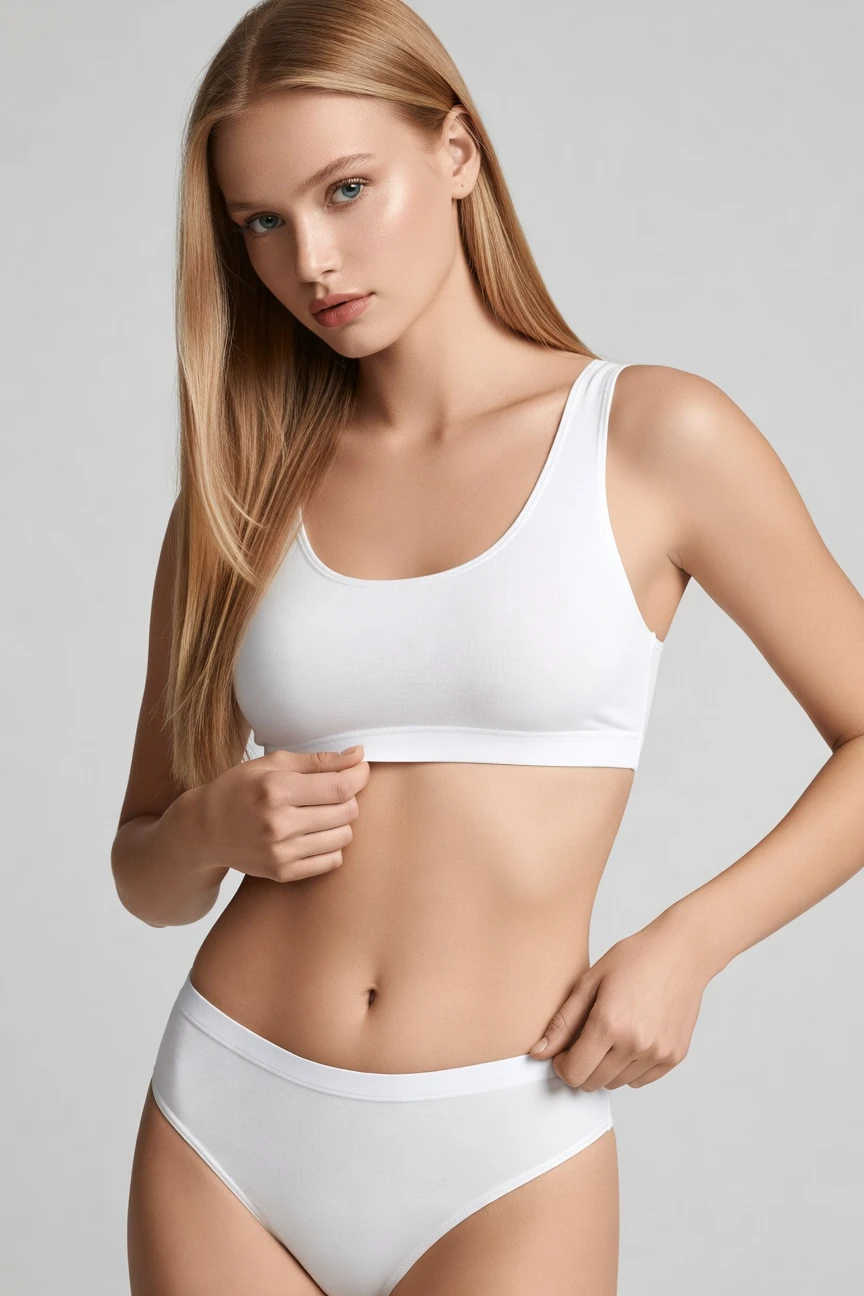
This setup is tuned for underwear PDPs and campaign selects: an 85mm lens, half-body framing, 4:5 crop, and 4K output to keep fit, waistband detail, and fabric texture clear. You click the controls and generate from the garment outward. ~$0.55 per image · ~30-40s
- 4 clicks · 0 keystrokes
- app.rawshot.ai / new_shoot
How it works
Build Underwear Imagery From the Garment Up
A click-driven workflow for intimatewear teams that need clean fit presentation, repeatable styling, and fast variants without a studio booking.
- Step 01
Upload the Garment
Start with the underwear product you need to sell. RAWSHOT is built around the garment, so fit, cut, waistband, colour, and branding stay central from the first click.
- Step 02
Set the Shoot With Clicks
Choose lens, framing, lighting, background, aspect ratio, and visual style from the interface. Every decision is a control, so buyers and marketers can direct the result without syntax or guesswork.
- Step 03
Generate and Scale Variants
Create campaign, catalog, and marketplace-ready images in seconds, then repeat the same logic across more SKUs. The same workflow works for a single launch image or a nightly API pipeline.
Spec sheet
Proof for Underwear Teams That Need Control
These twelve surfaces show how RAWSHOT handles fit-sensitive products, repeatable output, labelled provenance, and scale from browser to API.
- 01
Synthetic Models by Design
Every model is built from 28 body attributes with 10+ options each, making accidental real-person likeness statistically negligible by design.
- 02
Every Setting Is a Click
Lens, crop, pose, lighting, ratio, and visual style live in the interface. You direct the shoot with controls, not an empty text box.
- 03
Garment-Led Fidelity
Underwear needs clean representation of cut, seam placement, colour, logo, and fabric behaviour. RAWSHOT is engineered around the actual product, not around generic image drift.
- 04
Diverse Synthetic Models
Cast across a wide range of body attributes while staying transparent about what the imagery is. That gives brands broader representation without borrowing anyone's likeness.
- 05
Consistent Across SKUs
Keep the same face, framing logic, and visual direction across briefs, drops, and product families. Consistency matters when customers compare fit across an entire intimates range.
- 06
150+ Visual Style Presets
Move from catalog clean to campaign gloss, editorial noir, or lifestyle warmth with preset visual systems tuned for fashion output.
- 07
2K, 4K, and Every Ratio
Generate stills in 2K or 4K across 1:1, 4:5, 3:4, 2:3, 16:9, and more. Build once for PDPs, paid social, marketplaces, and lookbooks.
- 08
Labelled and Compliant
Outputs are AI-labelled, watermarked, and supported by C2PA provenance metadata, with compliance aligned to EU AI Act Article 50, California SB 942, and GDPR expectations.
- 09
Signed Audit Trail per Image
Each asset carries a recordable provenance layer that supports internal review, partner handoff, and accountable publishing workflows.
- 10
Browser GUI to REST API
Use the interface for one-off shoots or connect catalog operations through the API for repeatable SKU-scale production. Same engine, same quality, same pricing logic.
- 11
Fast, Clear Economics
Images run about $0.55 each, generate in roughly 30–40 seconds, tokens never expire, and failed generations refund their tokens.
- 12
Permanent Commercial Rights
Every output includes full commercial rights, permanent and worldwide. That keeps publishing, merchandising, and campaign deployment straightforward.
Outputs
Underwear Output Across Channels
From clean PDP frames to campaign-led crops, the same garment can be directed into multiple outputs without changing tools. Keep the fit story consistent while matching each channel's visual job.


Browse 150+ visual styles →
Comparison
RAWSHOT vs category tools vs DIY prompting
Three lenses on every dimension — what you optimize for in RAWSHOT versus typical category tools and blank-box AI workflows.
01
Interface
RAWSHOT
Click-driven controls for lens, framing, lighting, ratio, and styleCategory tools + DIY
Often mix limited UI presets with text-led direction. DIY prompting: You type instructions manually and keep rewriting for every variation02
Garment fidelity
RAWSHOT
Built around real underwear products, preserving cut, logo, colour, and drapeCategory tools + DIY
Can stylise nicely but still soften product-specific details. DIY prompting: Garments drift, waistbands mutate, and logos get invented or dropped03
Model consistency
RAWSHOT
Same model logic can stay stable across repeated SKU outputsCategory tools + DIY
Consistency varies across sessions and product batches. DIY prompting: Faces and body presentation shift between generations with little control04
Provenance + labelling
RAWSHOT
C2PA-signed, visibly watermarked, cryptographically watermarked, and AI-labelledCategory tools + DIY
Labelling and provenance support are often partial or absent. DIY prompting: No reliable provenance metadata and no standard output labelling trail05
Commercial rights
RAWSHOT
Full commercial rights to every output, permanent and worldwideCategory tools + DIY
Rights language may vary by plan or workflow. DIY prompting: Usage clarity depends on model terms and can stay ambiguous for teams06
Pricing transparency
RAWSHOT
About $0.55 per image, tokens never expire, one-click cancelCategory tools + DIY
Pricing can vary by seat, plan tier, or gated feature set. DIY prompting: Costs spread across subscriptions, retries, and wasted generations07
Catalog scale
RAWSHOT
Browser GUI for one shoot, REST API for 10,000-SKU pipelinesCategory tools + DIY
Scale features are frequently pushed into higher-tier sales motions. DIY prompting: No dependable garment pipeline, audit trail, or batch-friendly fashion workflow08
Iteration overhead
RAWSHOT
Adjust a control, regenerate, and compare variants quicklyCategory tools + DIY
Some iteration exists but can stay less garment-specific. DIY prompting: Prompt-engineering overhead slows every revision and breaks reproducibility
Prompting does not scale
Stop writing essays. Direct the shoot.
Most AI photo tools start with a blank text box. Rawshot turns the shoot into repeatable controls, so creative teams can produce consistent fashion imagery without prompt syntax or one-off hacks.
Category norm
ManualCreate a premium editorial fashion photograph of a model wearing the exact navy oversized wool coat from SKU-1842, full-body crop, realistic hands, consistent facial identity, clean e-commerce lighting, subtle Paris street background, 85mm lens, no logo distortion, no fabric hallucination, same pose as last campaign, repeatable for all colorways...
A prompt can describe one image. It cannot become a shared production system for hundreds of products, models, angles and markets.
Rawshot
ClicksSaved shoot recipe
Apply to 1 SKU or 10,000 via GUI, CSV or REST API.
Rawshot makes creative direction visible: buttons, presets and sliders instead of hidden prompt craft. The result is easier to teach, faster to approve and built for repeat production.
Use cases
Where Underwear Brands Need Better Access
Operator archetypes and how click-directed, garment-first output fits the way they actually work.
- 01
Indie Underwear Labels
Launch your first line with on-model imagery that shows fit, cut, and finish before a traditional shoot budget exists.
Confidence · high
- 02
DTC Intimates Brands
Produce campaign and PDP assets for bras, briefs, boxers, and sets while keeping visual direction consistent across the range.
Confidence · high
- 03
Marketplace Sellers
Generate clean underwear product imagery in the ratios and framings marketplaces demand without rebuilding every listing by hand.
Confidence · high
- 04
Crowdfunded Product Launches
Show supporters what the garment will look like on body before committing to costly production samples and studio days.
Confidence · high
- 05
Factory-Direct Manufacturers
Turn underwear SKUs into sellable visuals fast for wholesale decks, direct storefronts, and partner presentations.
Confidence · high
- 06
Resale and Vintage Operators
Create cleaner on-model presentation for intimatewear inventory where one-off stock makes traditional shooting hard to justify.
Confidence · high
- 07
Adaptive Underwear Lines
Represent specialised cuts and practical design features with more control than generic image tools usually allow.
Confidence · high
- 08
Subscription Underwear Brands
Keep recurring drops visually consistent across monthly releases, bundles, and retention campaigns.
Confidence · high
- 09
Private-Label Retail Teams
Test multiple visual directions for the same underwear product across channels without changing workflow or vendor stack.
Confidence · high
- 10
Students and New Designers
Build a professional underwear portfolio with garment-led controls instead of learning syntax before you can art direct.
Confidence · high
- 11
Boutique Lingerie Shops
Refresh merchandising images for intimate apparel without waiting on a full seasonal reshoot.
Confidence · high
- 12
Catalog Operations Teams
Move from single product tests to repeatable intimates pipelines through the browser interface first, then the API when volume grows.
Confidence · high
— Principle
Honest is better than perfect.
Underwear imagery sits close to the body, which makes trust more important, not less. RAWSHOT labels outputs, adds visible and cryptographic watermarking, and attaches C2PA provenance metadata so commerce teams can publish with clear disclosure and a signed record. We host in the EU, align with GDPR, and design synthetic models to avoid real-person likeness as a system choice, not a disclaimer.
Rights & provenance
Full commercial rights. Forever.
- C2PA-signed on every image — EU AI Act Article 50 compliant
- 28-attribute synthetic models — real-person likeness statistically impossible
- Full commercial rights to every generation — no recurring licensing fees
- Tokens never expire · One-click cancel · Transparent pricing
EU AI Act
C2PA
Commercial use
Pricing
~$0.55 per image.
~30–40 seconds per generation. Tokens never expire. Cancel in one click.
- 01The cancel button is on the pricing page.
- 02No per-seat gates. No 'contact sales' walls for core features.
- 03Failed generations refund their tokens.
- 04Full commercial rights to every output, permanent, worldwide.
FAQ
Practical answers on control, rights, pricing, scale, and compliant publishing.
Do I need to write prompts to use RAWSHOT?
Never—you direct every output with sliders, presets, and clicks on the garment, not typed prompts. That UI control is consistent across GUI and REST API payloads, which is why ecommerce teams onboard buyers without rewriting creative briefs as chat threads. For underwear in particular, that matters because small changes in framing, lens choice, and crop can change how fit, waistband height, seam placement, and fabric texture are perceived by shoppers.
For catalog teams, reliability matters more than model cleverness; RAWSHOT keeps tokens, timings, refund rules, commercial rights framing, provenance signalling, watermarking cues, REST surface, and SKU-scale batch patterns explicit so operations can rehearse PDP launches without hallucinated garment inventions. The practical takeaway is simple: your team clicks through a real application, sets the visual system once, and generates repeatable outputs without learning syntax first.
What does an ai underwear photo generator actually change for ecommerce teams?
It changes who gets access to on-model underwear imagery and how repeatable that imagery becomes. Instead of treating product visuals as something you only buy when a studio day is available, you can generate assets on demand from the garment itself and direct them through a controlled interface. That gives smaller brands, marketplace sellers, and fast-moving catalog teams a way to publish fit-focused visuals far earlier in the product cycle.
In RAWSHOT, that means choosing lens, framing, ratio, lighting, and style with controls that are purpose-built for fashion output. You can generate 2K or 4K stills, keep a model direction stable across multiple SKUs, and publish assets that carry AI labelling, watermarking, and C2PA provenance metadata. For operations teams, the result is not vague efficiency language; it is a clearer workflow for PDPs, campaign variants, and merchandising updates that would otherwise never get photographed.
Why skip reshooting every underwear SKU for seasonal updates?
Because seasonal refreshes often need new context more than a full new production day. If the garment itself has not changed, brands usually need revised crops, campaign styling, marketplace ratios, or a new visual mood that reflects the current drop. Traditional reshoots force those changes through calendars, sample handling, logistics, and day rates that make minor updates disproportionately expensive.
RAWSHOT lets you keep the garment as the anchor while changing the presentation around it through clicks. You can move from catalog clean to campaign gloss, swap aspect ratios for different channels, or regenerate updated merchandising images in roughly 30–40 seconds per still. Tokens never expire and failed generations refund tokens, so teams can iterate without the waste patterns that normally come with repeated reshoots. The operational win is not replacing photography; it is making visual upkeep possible for teams that would otherwise postpone it.
How do we turn flat underwear garments into catalogue-ready imagery without prompting?
You start with the product and then set the shoot conditions in the interface. Teams choose lens, framing, background, visual style, resolution, and aspect ratio as explicit controls, which is far more reliable than trying to steer a generic image tool toward a fit-sensitive category. For underwear, that control matters because customers read shape, rise, coverage, and fabric finish from subtle visual cues.
RAWSHOT is designed around the garment rather than around a blank text field, so the product remains the brief. You can generate half-body or full-body compositions, select catalog-clean or campaign-led styling, and create outputs ready for PDPs, paid social, marketplaces, or lookbooks. Because the same logic works in the browser GUI and through the REST API, teams can test one garment manually and then scale the approved setup across broader assortments without changing the underlying workflow.
Why does garment-led control beat ChatGPT, Midjourney, or generic image tools for fashion PDPs?
Generic tools are built to interpret open-ended instructions, not to preserve product truth across commercial apparel workflows. That difference becomes obvious with underwear, where waistband logos, seam positions, cut lines, fabric behaviour, and body-adjacent fit all need to stay coherent from image to image. In DIY systems, teams spend time chasing drift, rewriting instructions, and rejecting outputs that invent or distort exactly the details customers use to decide whether to buy.
RAWSHOT replaces that roulette with a fashion-specific application. You work with direct controls, generate against a garment-led system, and receive outputs that are AI-labelled, watermarked, and backed by C2PA provenance metadata. Commercial rights are clear, failed generations refund tokens, and the same setup can move from a single browser session to a batchable API pipeline. For commerce teams, that means fewer surprises, cleaner review cycles, and a much more reproducible path from product file to publishable asset.
Can I use RAWSHOT underwear images commercially, and are they clearly labelled?
Yes. RAWSHOT grants full commercial rights to every output, permanent and worldwide, so brands can use the imagery across PDPs, ads, marketplaces, lookbooks, and launch materials without waiting for separate clearance on each asset. Just as important, the outputs are not passed off as something else: they are AI-labelled and carry visible plus cryptographic watermarking to support honest publishing practices.
That transparency is reinforced with C2PA provenance metadata and a signed audit trail per image, giving teams a clearer record of what the asset is and where it came from. RAWSHOT is EU-hosted, GDPR-compliant, and aligned with the disclosure direction of EU AI Act Article 50 and California SB 942. For brand and legal teams, the practical takeaway is that you can adopt the workflow without hiding the method, which is a stronger long-term policy than hoping nobody asks how the image was made.
What should buyers and merchandisers check before publishing underwear imagery?
They should review the same things shoppers use to judge the product: cut accuracy, waistband position, leg opening shape, fabric appearance, logo treatment, and whether the framing actually supports the selling task of the page. For underwear, small visual mistakes matter because the category depends on trust and precise expectation-setting. Teams should also verify that the selected style and crop match the channel, whether that is a clean PDP, a marketplace tile, or a campaign-led social placement.
On the governance side, confirm that the output remains AI-labelled, carries watermarking, and preserves its provenance record for internal handoff or external publishing. RAWSHOT supports this with C2PA metadata and a per-image audit trail, which helps teams build review checklists into normal merchandising operations rather than treating trust as an afterthought. The best practice is to make visual QA and disclosure QA part of the same approval pass before assets go live.
How much does still-image generation cost for underwear listings and campaign variants?
RAWSHOT still images cost about $0.55 per image, and each generation typically completes in around 30–40 seconds. Tokens never expire, failed generations refund their tokens, and cancellation is one click from the pricing page, which makes budgeting much easier than stitched-together workflows with unclear retry costs. For underwear brands producing multiple crops, style variants, and channel-specific aspect ratios, that pricing model keeps experimentation operational instead of stressful.
It also helps teams separate still-image needs from higher-cost motion work. Video uses more tokens per second than stills, so it is priced differently, while model generation is its own unit. For merchants and marketers, the practical approach is to use stills first for PDP coverage, paid social tests, and marketplace updates, then add motion only where it changes conversion or storytelling. That sequencing keeps output matched to channel value rather than spending blindly on every asset type at once.
Can we connect this to Shopify-scale catalog workflows through an API?
Yes. RAWSHOT offers a REST API for catalog-scale pipelines, so teams can move beyond one-off browser sessions once their visual system is approved. That matters for operators managing large underwear assortments, where the real challenge is not making one good image but producing a dependable stream of assets with stable framing, styling logic, rights clarity, and provenance support.
The browser GUI remains useful for art direction and setup, while the API handles repeatable production across many SKUs. Because the same engine, model system, and pricing logic apply in both environments, teams do not need to relearn the product when they scale. The operational takeaway is to validate your shoot pattern in the interface first, then encode that approved pattern into your pipeline so nightly catalog runs stay aligned with brand rules and merchandising needs.
How do small teams and larger catalog ops use the same underwear workflow without feature gates?
They use the same product and the same economics, just at different volumes. A founder launching three underwear styles can work inside the browser, click through framing and visual choices, and generate publishable assets without hiring a specialist just to operate the tool. A larger catalog team can take that same logic into the REST API and run much broader batches without being pushed into a different core product or blocked by seat-based restrictions.
RAWSHOT keeps pricing per image, not per department, and does not hide core capability behind a sales wall for ordinary use. Tokens do not expire, failed generations refund tokens, and every output includes permanent worldwide commercial rights plus provenance support. That combination makes the system workable across brand, merchandising, creative, and operations roles. In practice, the workflow can begin as a single launch experiment and grow into a stable catalog function without a platform migration in the middle.
Keep exploring