
— Accessory close-ups · 150+ styles · 4K
Direct polished jewelry imagery with the AI Earrings Product Photography Generator.
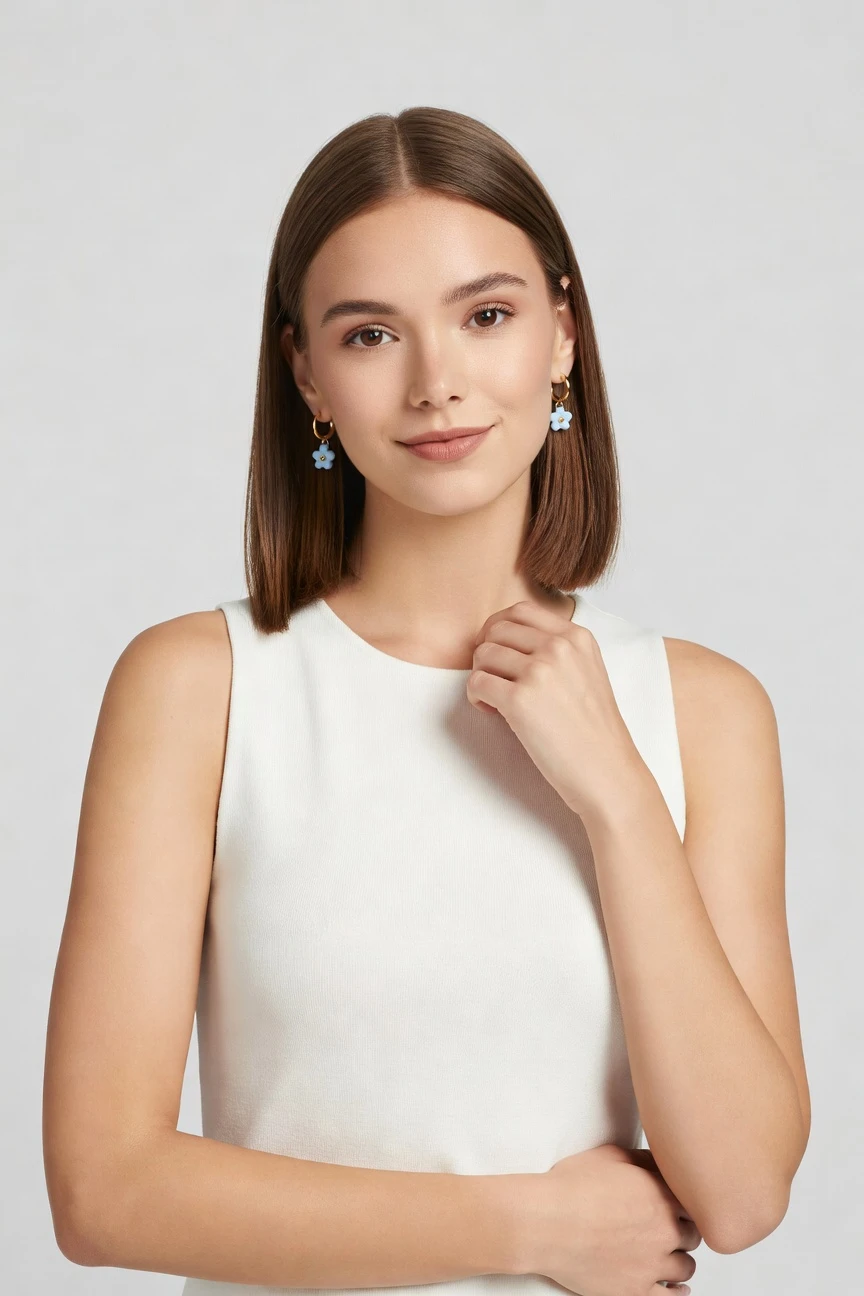
Generate clean detail shots, model-worn earring imagery, and campaign-ready accessories visuals around the product itself. Select lens, framing, crop, style, and output format with buttons and presets built for commerce teams. No studio. No samples. No prompts.
- ~$0.55 per image
- ~30–40s per generation
- 150+ styles
- 2K or 4K
- Every aspect ratio
- Full commercial rights
7-day free trial • 50 tokens (10 images) • Cancel anytime

Direct the shoot. Zero prompts.
For earrings, we preselect an 85mm lens, half-body framing, a 4:5 crop, 4K output, and accessory focus so you can start from commerce-friendly jewelry coverage and refine from there with clicks. ~$0.55 per image · ~30-40s
- 5 clicks · 0 keystrokes
- app.rawshot.ai / new_shoot
How it works
Build Earring Shoots With Clicks
From tight jewelry detail to model-worn accessory imagery, the workflow stays product-led, repeatable, and easy to scale.
- Step 01
Upload the Earrings
Start with the product you need to show. RAWSHOT builds the shoot around the earrings, so finish, color, shape, and scale stay central to the image.
- Step 02
Set the Visual Direction
Choose framing, lens, crop, background, and style with interface controls made for fashion work. You direct packshot clarity, close detail, or model-worn presentation without typed instructions.
- Step 03
Generate and Repeat at Scale
Render polished outputs in 2K or 4K, then create more variants for PDPs, ads, or marketplaces. Use the browser for one-off shoots or the API when the catalog gets large.
Spec sheet
Proof for Jewelry Commerce Teams
These twelve proof points show how RAWSHOT handles control, fidelity, provenance, rights, and throughput for accessory imagery.
- 01
Synthetic Models by Design
Every model is built from 28 body attributes with 10+ options each. Accidental real-person likeness is statistically negligible by design, not left to chance.
- 02
Every Setting Is a Click
You direct lens, crop, framing, light, background, and style through a real interface. No empty text box stands between you and a usable earrings shoot.
- 03
Jewelry Stays Product-Led
RAWSHOT is engineered around the item being sold. Finish, silhouette, closure, stones, metal tone, and proportion are represented around the garment or accessory, not bent around generic image habits.
- 04
Diverse Synthetic Casting
Choose from broad body and appearance ranges for model-worn accessory scenes. That gives smaller brands access to casting range without running a physical studio day.
- 05
Consistency Across SKU Sets
Keep the same face, crop logic, and visual system across many earring variants. Collections stay coherent without drift from one output to the next.
- 06
150+ Styles for Accessories
Switch between catalog clean, campaign gloss, editorial noir, street flash, vintage tones, and more. The product stays consistent while the visual world changes around it.
- 07
2K, 4K, and Every Crop
Export square marketplace images, 4:5 social crops, vertical ads, or wide banners from the same system. Resolution and aspect ratio are controls, not limitations.
- 08
Labelled and Compliant Output
Every output is AI-labelled, watermarked, and aligned with EU AI Act Article 50 readiness, California SB 942 expectations, and GDPR-conscious EU hosting.
- 09
Signed Audit Trail per Image
Each file carries C2PA-signed provenance metadata. That gives teams a durable record of what the image is and how it should be handled downstream.
- 10
GUI for One Shoot, API for Scale
Use the browser when you are styling a handful of earrings for launch week. Use the REST API when hundreds or thousands of accessory SKUs need the same logic nightly.
- 11
Fast, Clear Economics
Images run about $0.55 each and generate in roughly 30–40 seconds. Tokens never expire, and failed generations refund tokens automatically.
- 12
Permanent Commercial Rights
Every output includes full commercial rights, permanent and worldwide. That makes handoff simpler across ecommerce, paid media, marketplaces, and agencies.
Outputs
Earring Outputs, Ready to Publish
Move from clean product detail to styled accessory imagery without changing tools. The same click-driven workflow covers PDP crops, campaign visuals, and marketplace-safe formats.


Browse 150+ visual styles →
Comparison
RAWSHOT vs category tools vs DIY prompting
Three lenses on every dimension — what you optimize for in RAWSHOT versus typical category tools and blank-box AI workflows.
01
Interface
RAWSHOT
Buttons, sliders, and presets built for fashion image directionCategory tools + DIY
Often mix light UI controls with vague text-led workflows. DIY prompting: You type everything manually and hope the model interprets it consistently02
Garment fidelity
RAWSHOT
Product-led system keeps earring shape, finish, and proportion centralCategory tools + DIY
Accessory details can soften when style effects take priority. DIY prompting: Generic models often drift on scale, metal finish, and clasp details03
Model consistency
RAWSHOT
Same model logic can stay stable across many accessory SKUsCategory tools + DIY
Consistency varies across runs and larger batch work. DIY prompting: Faces and styling often shift between outputs with no reliable continuity04
Provenance
RAWSHOT
C2PA-signed files with visible and cryptographic watermarking cuesCategory tools + DIY
Provenance support is uneven or absent across the category. DIY prompting: No native provenance metadata and no clear audit trail per asset05
Commercial rights
RAWSHOT
Full commercial rights for every output, permanent and worldwideCategory tools + DIY
Rights terms differ by plan or product tier. DIY prompting: Rights clarity depends on model terms and is often operationally unclear06
Iteration speed
RAWSHOT
Generate, adjust, and rerun variants in about 30–40 secondsCategory tools + DIY
Iteration can be slowed by plan limits or less direct controls. DIY prompting: Each revision means rewriting instructions and troubleshooting inconsistent outputs07
Pricing transparency
RAWSHOT
Same per-image pricing, no per-seat gates, tokens never expireCategory tools + DIY
Seats, tiers, or gated features can complicate forecasting. DIY prompting: Low entry cost hides time spent on failed attempts and unusable outputs08
Catalog scale
RAWSHOT
Browser GUI and REST API share the same engine and qualityCategory tools + DIY
Scale workflows may require separate enterprise layers. DIY prompting: Batch production is fragile, manual, and hard to standardize across teams
Prompting does not scale
Stop writing essays. Direct the shoot.
Most AI photo tools start with a blank text box. Rawshot turns the shoot into repeatable controls, so creative teams can produce consistent fashion imagery without prompt syntax or one-off hacks.
Category norm
ManualCreate a premium editorial fashion photograph of a model wearing the exact navy oversized wool coat from SKU-1842, full-body crop, realistic hands, consistent facial identity, clean e-commerce lighting, subtle Paris street background, 85mm lens, no logo distortion, no fabric hallucination, same pose as last campaign, repeatable for all colorways...
A prompt can describe one image. It cannot become a shared production system for hundreds of products, models, angles and markets.
Rawshot
ClicksSaved shoot recipe
Apply to 1 SKU or 10,000 via GUI, CSV or REST API.
Rawshot makes creative direction visible: buttons, presets and sliders instead of hidden prompt craft. The result is easier to teach, faster to approve and built for repeat production.
Use cases
Where Earring Imagery Opens Doors
Operator archetypes and how click-directed, garment-first output fits the way they actually work.
- 01
Indie Jewelry Designers
Launch a new pair before funding a full studio day, with polished close-ups and model-worn imagery directed in the browser.
Confidence · high
- 02
DTC Accessories Brands
Create consistent earring PDP visuals across multiple finishes, stones, and seasonal variants without rebuilding the workflow each time.
Confidence · high
- 03
Marketplace Sellers
Generate clean square crops and neutral-background accessory images that fit platform requirements and still look considered.
Confidence · high
- 04
Crowdfunded Product Launches
Show earrings in campaign-ready scenes early, so backers understand proportion, styling, and finish before bulk production begins.
Confidence · high
- 05
Boutique Merch Teams
Refresh accessory imagery for site updates, bundles, and promotions without waiting for another physical reshoot.
Confidence · high
- 06
Resale and Vintage Sellers
Standardize mixed one-off earring inventory into a more coherent storefront, even when each item only exists once.
Confidence · high
- 07
Factory-Direct Manufacturers
Turn sample-stage accessory lines into usable sales imagery for buyers, distributors, and wholesale presentations.
Confidence · high
- 08
Social Commerce Teams
Produce 4:5 and 9:16 jewelry visuals that keep the product readable in paid social and creator-style placements.
Confidence · high
- 09
Editorial Stylists
Build close accessory stories around metal, texture, and shine while keeping the product itself clear enough for commerce reuse.
Confidence · high
- 10
Small Agency Studios
Offer earring product photography coverage to clients who cannot afford a physical accessories shoot for every drop.
Confidence · high
- 11
Catalog Operators
Use the same model, crop logic, and background system across broad SKU sets to keep accessory pages visually stable.
Confidence · high
- 12
Student and Graduate Labels
Present a first collection with credible jewelry imagery before the brand has budget for traditional production.
Confidence · high
— Principle
Honest is better than perfect.
Accessory imagery travels across storefronts, marketplaces, ads, and brand decks, so clear provenance matters. Every RAWSHOT output is AI-labelled, watermarked, and C2PA-signed, giving commerce teams a usable record instead of ambiguity. We treat transparency as part of the product, not a footnote.
Rights & provenance
Full commercial rights. Forever.
- C2PA-signed on every image — EU AI Act Article 50 compliant
- 28-attribute synthetic models — real-person likeness statistically impossible
- Full commercial rights to every generation — no recurring licensing fees
- Tokens never expire · One-click cancel · Transparent pricing
EU AI Act
C2PA
Commercial use
Pricing
~$0.55 per image.
~30–40 seconds per generation. Tokens never expire. Cancel in one click.
- 01The cancel button is on the pricing page.
- 02No per-seat gates. No 'contact sales' walls for core features.
- 03Failed generations refund their tokens.
- 04Full commercial rights to every output, permanent, worldwide.
FAQ
Practical answers on control, rights, pricing, scale, and compliant publishing.
Do I need to write prompts to use RAWSHOT?
Never—you direct every output with sliders, presets, and clicks on the garment, not typed prompts. That UI control is consistent across GUI and REST API payloads, which is why ecommerce teams onboard buyers without rewriting creative briefs as chat threads. Instead of translating a jewelry shoot into syntax, you select framing, lens, aspect ratio, style, background, and product focus inside the app.
For catalog teams, reliability matters more than model cleverness; RAWSHOT keeps tokens, timings, refund rules, commercial rights framing, provenance signalling, watermarking cues, REST surface, and SKU-scale batch patterns explicit so operations can rehearse PDP launches without hallucinated garment inventions. The practical takeaway is simple: build a repeatable accessory workflow your team can actually use, then generate variants without teaching everyone a new language first.
What does AI-assisted product photography change for accessory catalogs?
It changes who gets access to professional-looking coverage in the first place. Instead of waiting for budget, studio coordination, sample logistics, and retouch rounds, teams can generate usable earring imagery in roughly 30–40 seconds per image and keep moving through launch calendars. That matters most for smaller operators, fast-moving merch teams, and catalogs where accessories are commercially important but often underproduced.
With RAWSHOT, the workflow is built around the product and the decisions commerce teams already make: crop, lens, background, visual style, aspect ratio, and output resolution. You can create close detail shots, model-worn accessory imagery, and marketplace-safe formats in 2K or 4K while keeping rights, provenance, and refund logic explicit. In practice, that means earrings stop being the category you postpone because the shoot day was reserved for something else.
Why skip reshooting every earring SKU for each seasonal update?
Because seasonal merchandising rarely changes the need for clear product representation, but it often changes context, crop, styling direction, and channel mix. Running a fresh physical shoot for each seasonal refresh is expensive, slow, and hard to justify when you mainly need new visual framing for PDPs, social placements, or marketplace assortments. Accessories especially get trapped in that cycle because they are smaller-ticket items but still need polished imagery.
RAWSHOT lets teams keep the product at the center while changing the surrounding visual system through clicks. You can move from clean catalog imagery to more expressive campaign treatments, adjust framing for platform requirements, and output fresh variants without renegotiating a production day. The smart operating model is to reserve physical photography for the moments that truly need it, then use RAWSHOT to extend, update, and multiply the coverage around your earring line.
How do we turn flat product assets into catalogue-ready earrings imagery without prompting?
You start from the item, then set the shoot through interface controls rather than text. For earrings, that usually means choosing a detail-led lens, deciding whether you need close-up or model-worn framing, selecting the right crop for PDP or social placement, and picking a visual style that fits the collection. The process feels like directing a shoot in software, not negotiating with a chat box.
RAWSHOT supports accessory-focused outputs with options for 2K and 4K resolution, every major aspect ratio, and more than 150 visual styles. Teams can use the browser GUI when they are shaping a handful of launch assets, then move the same logic into the REST API for broader catalog production. The operational takeaway is to standardize your earring image recipe once, then reuse it across finishes, stone colors, and seasonal drops with far less friction.
Why does garment-led control beat DIY prompting in ChatGPT, Midjourney, or generic image tools for fashion PDPs?
Because commerce work is less about surprising images and more about reliable product representation. Generic tools are built to interpret text loosely, which is why earrings can come back with altered scale, softened detail, invented closures, changed stones, or background styling that overwhelms the item being sold. That may be tolerable for moodboarding, but it is a poor fit for a PDP where the product itself is the brief.
RAWSHOT replaces that guesswork with direct controls and a fashion-specific system. You click lens, framing, style, product focus, ratio, and resolution, then generate outputs that are easier to repeat across a range. Add C2PA provenance, visible and cryptographic watermarking, and clearer commercial rights handling, and the difference becomes operational rather than cosmetic. Teams that care about consistent earring listings should choose a tool designed for reproducible commerce images, not open-ended image improvisation.
Can I use an ai earrings product photography generator for paid ads and storefronts with clear rights?
Yes—RAWSHOT gives full commercial rights to every output, permanent and worldwide, which is what commerce teams need when an image may move from PDP to paid social to email to marketplaces. Rights clarity matters more than most teams expect because accessory images often get reused across many touchpoints long after the original campaign ends. You do not want a workflow that creates uncertainty every time a file changes channel.
RAWSHOT also pairs that rights model with explicit labelling and provenance. Outputs are AI-labelled, watermarked with visible and cryptographic layers, and C2PA-signed so downstream teams have a record of what the asset is. That combination supports honest handling rather than ambiguity, which is the practical standard brands should apply before publishing earring imagery at scale.
What should a merch team check before publishing AI earring images on a PDP?
Start with product truth. Check that the earring shape, finish, stone color, proportions, attachment details, and overall scale align with the item you are selling, then confirm the crop serves the channel rather than hiding key features. For jewelry, tiny inaccuracies matter, so teams should review detail visibility with the same seriousness they apply to price and material copy.
Then review operational signals: confirm the asset is the intended aspect ratio, verify the chosen visual style matches the brand system, and make sure provenance and labelling are handled correctly. RAWSHOT supports that with C2PA-signed metadata, visible and cryptographic watermarking, AI labelling, and a per-image audit trail. The right habit is to make QA part of the publishing checklist, not a last-minute visual glance after assets have already been distributed.
How much does the ai earrings product photography generator cost per image?
RAWSHOT photo generation runs at about $0.55 per image, with most stills generating in roughly 30–40 seconds. Tokens never expire, failed generations refund their tokens, and cancellation is one click from the pricing page, which keeps budgeting straightforward for smaller brands as well as larger catalog teams. That pricing structure matters because accessories often need many variants, crops, and channel-specific assets even when each individual SKU has a modest retail price.
The more useful way to budget is by output plan rather than by abstract subscription value. Estimate how many PDP images, campaign variants, and marketplace crops you need for each earring style, then allocate tokens accordingly without worrying about seat gates or core-feature sales walls. That gives teams a clearer production model for accessories than either traditional shoot-day budgeting or opaque software tiers.
Can RAWSHOT plug into a Shopify-scale or ERP-led accessories workflow through API?
Yes. RAWSHOT is built for both browser-led creative work and catalog-scale production through a REST API, so teams do not have to switch products when their workflow grows. That matters for accessory catalogs because the same earring may need repeated handling across PDP updates, collection launches, marketplace feeds, and localization workflows. Once a visual logic is working, operations teams need a way to apply it reliably at scale.
The API uses the same underlying engine and output logic as the GUI, which means smaller teams can prove the look in the interface first and automate later without accepting a quality drop. Combined with per-image audit trails and explicit provenance handling, that makes RAWSHOT suitable for production environments where traceability matters as much as speed. The practical move is to define your accessory image recipe in the GUI, then operationalize it through the API when volume demands it.
How many earrings SKUs can a small team realistically push through the UI before moving to batch production?
A small team can handle meaningful launch work directly in the browser because the interface is designed for direct selection rather than text-heavy trial and error. If each image generates in about 30–40 seconds and the control set is standardized, buyers and merch leads can move through accessory variants far faster than a manual shoot workflow would allow. The exact number depends on review standards, but the UI is practical for one-off launches, capsule drops, and focused catalog updates.
When the workload turns into repeated daily production across large SKU ranges, the better model is to carry the same visual rules into the REST API. RAWSHOT keeps pricing logic, output quality, and core controls aligned across both paths, so growth does not force a separate enterprise-only product. That means teams can begin with a browser-based earring workflow, prove consistency, and then scale without rebuilding the operation around a different tool.
Keep exploring