
— Fair skin · Catalog and campaign · Saved consistency
AI Fair Skin Female Generator — with click-driven control over every attribute.
When fair skin is part of the brand casting brief, consistency matters across every SKU, season, and channel. You set skin tone, age range, body type, hair, height, and expression through 28 body attributes with 10+ options each, then save the model once and reuse it across the whole catalog. Every model is a synthetic composite by design, with labelled outputs and signed provenance metadata.
- ~$0.99 per model
- ~50–60s per generation
- 150+ styles
- 28 attributes × 10+ options
- Save once, reuse across catalog
- C2PA-signed
7-day free trial • 50 tokens (10 images) • Cancel anytime

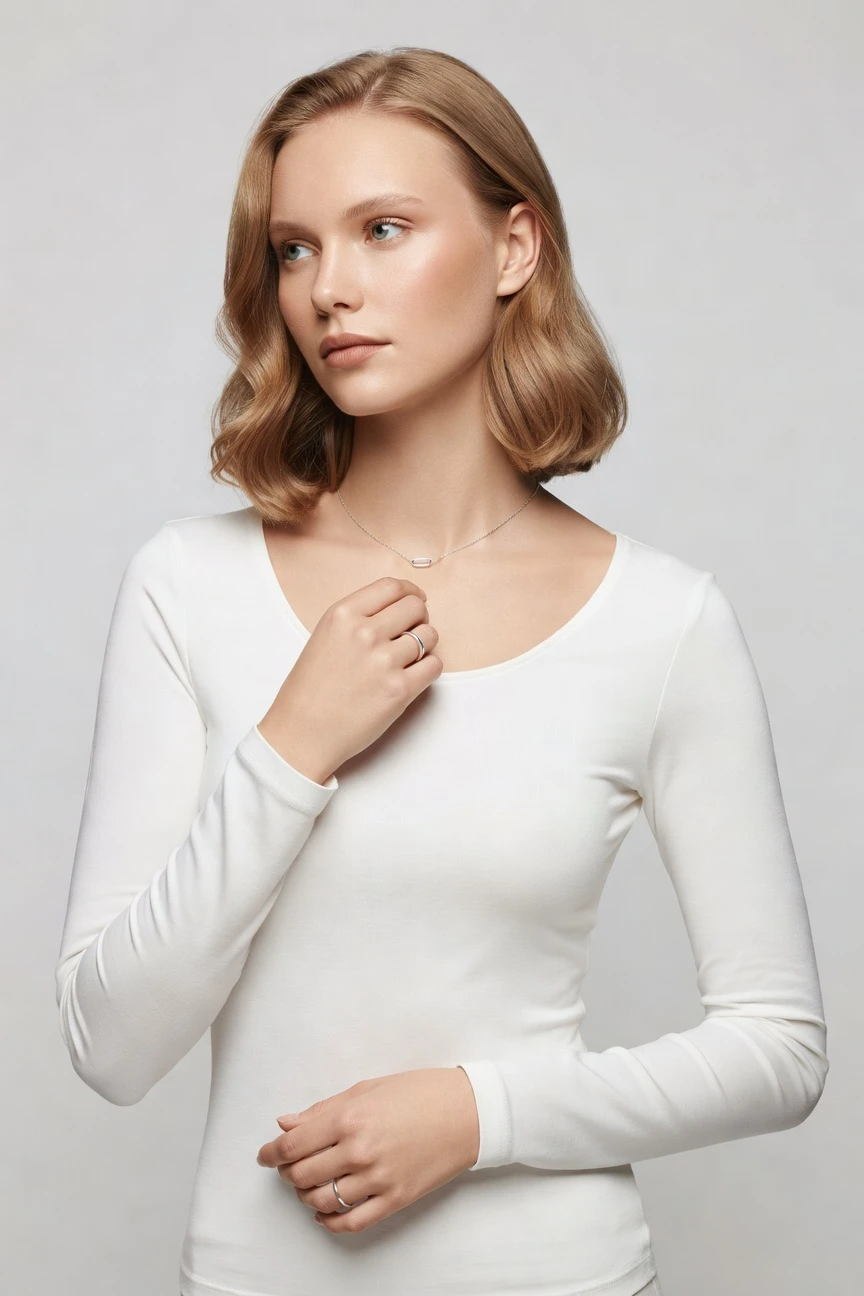
Saved model setup
Female · 26–35 · Dark brown · 175cm
Build a model. Zero prompts.
This setup starts with a fair-skin female presentation, then locks in age range, height, hair shape, and hair colour for repeatable casting. You click the attributes once, save the model to your library, and keep the same face and body across future shoots. 28 attributes · 10+ options each
- 5 clicks · 0 keystrokes
- app.rawshot.ai / build_model
How it works
Build a Reusable Fair-Skin Cast
Set the attributes once, save the model, and keep catalog casting stable across every garment and channel.
- Step 01
Set the Entry Attribute
Start from skin tone, then click through gender presentation, age range, body type, height, hair, and expression. The model build begins with the attribute that matters to your casting brief.
- Step 02
Save the Model Once
When the configuration is right, save it to your library as a reusable casting asset. That keeps the same face and body available for every future garment, campaign, or catalog run.
- Step 03
Reuse Across Every Shoot
Apply the saved model in the browser for one-off styling or through the API for large SKU pipelines. The casting stays stable while garments, framing, lighting, and styles change around it.
Spec sheet
Proof for Repeatable Model Casting
These twelve surfaces show how RAWSHOT keeps model setup controlled, labelled, reusable, and ready for both browser shoots and SKU-scale pipelines.
- 01
Attribute Depth by Design
Build from 28 body attributes with 10+ options each. Every saved model is a synthetic composite, designed to avoid accidental real-person likeness.
- 02
Every Setting Is a Click
Skin tone, age range, body type, hair, expression, and more live in buttons, sliders, and presets. You direct the model in an application interface, not an empty text box.
- 03
Garment-Led Output
Once the model is saved, the garment stays the brief. Cut, colour, pattern, logo, fabric, and drape are represented around the product instead of being bent by guesswork.
- 04
Diverse Synthetic Models
Build fair-skin female casting within a broader system for varied body attributes and presentations. That gives brands a consistent library without relying on a single photographed person.
- 05
Same Face Across SKUs
Reuse one saved model for a single lookbook or a thousand-product catalog. The face and body stay stable instead of drifting between outputs.
- 06
150+ Visual Styles
Move the same saved model through catalog, lifestyle, editorial, campaign, studio, street, vintage, noir, and more. Brand expression changes without rebuilding the cast.
- 07
2K, 4K, Every Ratio
Generate stills in 2K or 4K and frame for PDP, marketplace, social, paid media, or print. Output specs flex to the channel while the model remains consistent.
- 08
Labelled and Compliant
Outputs carry C2PA-signed provenance metadata, visible and cryptographic watermarking, and AI labelling. The system is built for EU-hosted, GDPR-aware compliance workflows.
- 09
Signed Audit Trail
Each image carries a recordable provenance layer that supports review, publishing, and platform governance. That matters when teams need traceability, not just attractive output.
- 10
GUI to REST API
Build a model in the browser for directorial work, then reuse it in catalog-scale API pipelines. One product serves both creative and operations teams without separate editions.
- 11
Predictable Token Economics
Model generations run at about $0.99 in roughly 50–60 seconds, tokens never expire, and failed generations refund tokens. The workflow stays usable for small brands and large catalogs alike.
- 12
Full Commercial Rights
Every output includes permanent worldwide commercial rights. You can publish, sell, syndicate, and scale without negotiating a separate licensing layer for core usage.
Outputs
Saved Model. Many directions.
A single fair-skin female model can move from clean catalog framing to editorial mood without losing casting consistency. Save once, direct the rest with visual controls.


Browse all 600+ models →
Comparison
RAWSHOT vs category tools vs DIY prompting
Three lenses on every dimension — what you optimize for in RAWSHOT versus typical category tools and blank-box AI workflows.
01
Interface
RAWSHOT
Click-set attributes, presets, and saved models in a real applicationCategory tools + DIY
Often mix lightweight controls with vague generation steps and thinner casting control. DIY prompting: You type instructions manually and keep re-explaining the same model every time02
Model consistency across SKUs
RAWSHOT
Save one model once and reuse the same face and bodyCategory tools + DIY
Consistency can vary between sessions or require manual workaround logic. DIY prompting: Faces drift between outputs and matching a prior result becomes trial and error03
Garment fidelity
RAWSHOT
Engineered around real garments, with attention to cut, colour, logos, and drapeCategory tools + DIY
Fashion-focused but still prone to softening details under style pressure. DIY prompting: Garments drift, logos get invented, and fabric details can change between renders04
Provenance and labelling
RAWSHOT
C2PA-signed, watermarked, and clearly AI-labelled on outputCategory tools + DIY
Labelling and provenance support may be partial or absent. DIY prompting: No dependable provenance metadata and no signed output trail by default05
Commercial rights
RAWSHOT
Permanent worldwide commercial rights included with every outputCategory tools + DIY
Rights can depend on plan tiers or platform wording. DIY prompting: Usage terms are often unclear for production commerce assets06
Pricing transparency
RAWSHOT
Flat per-model pricing, no seat gates, tokens never expireCategory tools + DIY
May add seat limits, sales gates, or plan-based restrictions. DIY prompting: Tool pricing rarely maps cleanly to repeatable catalog production work07
Catalog scale
RAWSHOT
Browser GUI for one shoot, REST API for 10,000-SKU pipelinesCategory tools + DIY
Scale tooling may sit behind enterprise packaging or limited integrations. DIY prompting: No native fashion pipeline, weak reproducibility, and heavy manual orchestration08
Iteration workload
RAWSHOT
Adjust attributes and resave the model with a few direct controlsCategory tools + DIY
Iteration is faster than studios but still less deterministic across variants. DIY prompting: Prompt-engineering overhead slows every revision and creates inconsistent outputs
Prompting does not scale
Stop writing essays. Direct the shoot.
Most AI photo tools start with a blank text box. Rawshot turns the shoot into repeatable controls, so creative teams can produce consistent fashion imagery without prompt syntax or one-off hacks.
Category norm
ManualCreate a premium editorial fashion photograph of a model wearing the exact navy oversized wool coat from SKU-1842, full-body crop, realistic hands, consistent facial identity, clean e-commerce lighting, subtle Paris street background, 85mm lens, no logo distortion, no fabric hallucination, same pose as last campaign, repeatable for all colorways...
A prompt can describe one image. It cannot become a shared production system for hundreds of products, models, angles and markets.
Rawshot
ClicksSaved shoot recipe
Apply to 1 SKU or 10,000 via GUI, CSV or REST API.
Rawshot makes creative direction visible: buttons, presets and sliders instead of hidden prompt craft. The result is easier to teach, faster to approve and built for repeat production.
Use cases
Where Fair-Skin Female Casting Helps
Operator archetypes and how click-directed, garment-first output fits the way they actually work.
- 01
Indie womenswear founder
Launch a first collection with a saved fair-skin female model before studio budgets, samples, and booked talent exist.
Confidence · high
- 02
DTC basics brand
Keep core tees, denim, and knitwear on the same fair-skin female cast across every seasonal refresh.
Confidence · high
- 03
Marketplace seller
Publish clearer listings by pairing one fair-skin female model with repeated PDP framing across high-volume apparel SKUs.
Confidence · high
- 04
Crowdfunded fashion project
Test campaign imagery with a fair-skin female presentation before manufacturing quantities are locked.
Confidence · high
- 05
Lingerie label
Direct more controlled close crops, full-body framing, and style shifts while holding the saved model constant.
Confidence · high
- 06
Jewelry and accessories team
Use a fair-skin female cast for earrings, sunglasses, watches, and handbags where skin presentation affects product contrast.
Confidence · high
- 07
Outerwear startup
Show one coat line across studio catalog and editorial looks without recasting every drop.
Confidence · high
- 08
Resale curator
Standardise mixed-inventory listings on a repeatable fair-skin female model instead of inconsistent source photography.
Confidence · high
- 09
Adaptive fashion operator
Hold casting steady while focusing creative decisions on fit, access details, and garment function.
Confidence · high
- 10
Student designer
Build a polished graduate collection around a fair-skin female cast without hiring a full production team.
Confidence · high
- 11
Factory-direct manufacturer
Create sales assets for buyer outreach with the same saved model used later in ecommerce rollout.
Confidence · high
- 12
Catalog operations lead
Maintain approved fair-skin female casting across browser shoots and API-driven nightly batches for large assortments.
Confidence · high
— Principle
Honest is better than perfect.
When teams build around a specific skin presentation, transparency matters as much as control. RAWSHOT labels outputs, signs them with C2PA provenance metadata, and applies visible plus cryptographic watermarking. The model itself is a synthetic composite, designed so casting consistency does not depend on a real person's likeness.
Rights & provenance
Full commercial rights. Forever.
- C2PA-signed on every image — EU AI Act Article 50 compliant
- 28-attribute synthetic models — real-person likeness statistically impossible
- Full commercial rights to every generation — no recurring licensing fees
- Tokens never expire · One-click cancel · Transparent pricing
EU AI Act
C2PA
Commercial use
Pricing
~$0.99 per model generation.
~50–60 seconds per generation. Save the model once, reuse it across your entire catalog.
- 01Tokens never expire. Cancel in one click.
- 02Same face, same body, every SKU — no drift between shoots.
- 03No per-seat gates. No 'contact sales' walls for core features.
- 04Failed generations refund their tokens.
FAQ
Practical answers on control, rights, pricing, scale, and compliant publishing.
Do I need to write prompts to use RAWSHOT?
Never—you direct every output with sliders, presets, and clicks on the garment, not typed prompts. That matters in fashion because buyers, merchandisers, and ecommerce teams need a repeatable workflow they can actually operate, not a fragile chat routine that changes with wording. In RAWSHOT, model setup, camera choices, framing, lighting, background, visual style, and product focus all live in interface controls, so the work behaves like production software rather than improvisation.
For catalog teams, reliability beats novelty. RAWSHOT keeps token pricing, generation times, refund rules, commercial rights, provenance signalling, watermarking, GUI actions, and REST API usage explicit, which means the same operating logic works for a one-off launch and a nightly SKU pipeline. The practical takeaway is simple: your team can build and reuse a model, direct imagery through clicks, and publish labelled outputs without turning fashion operators into syntax specialists.
What does an AI fair skin female generator actually deliver for catalog teams?
It delivers a reusable casting asset, not just a one-off image. For catalog teams, that means you can define a fair-skin female presentation through structured attributes like age range, body type, height, hair, and expression, then save that model and keep it stable across many garments. That stability is what makes product pages, collection pages, and marketplace listings feel coherent instead of assembled from unrelated shoots.
In RAWSHOT, the model sits inside a garment-led workflow. You save the cast once, then apply it to new products, new framings, and new style presets without rebuilding the person each time. Because outputs are labelled, C2PA-signed, and covered by permanent worldwide commercial rights, commerce teams can move from model creation to production use with fewer approval gaps. The result is a repeatable visual system for apparel operations, not an isolated creative experiment.
Why skip reshooting every SKU when the season changes?
Because most seasonal changes are about styling direction, channel needs, and assortment turnover, not the need to rebuild casting from zero. Traditional reshoots tie every update to calendar coordination, sample handling, talent availability, and production budgets that many brands never had in the first place. A saved synthetic model lets you keep the cast consistent while updating garments, visual style, framing, and output ratios for the new season.
RAWSHOT is useful here because the same model can move through catalog, editorial, lifestyle, and campaign presets without losing the approved face and body. Teams can refresh collection pages, launch capsules, or test paid media variants without rebooking a studio day. When the priority is continuity across changing assortments, the operational move is to lock the model, change the product and art direction, and publish labelled outputs with a clear provenance trail.
How do we turn flat garments into catalogue-ready imagery without prompting?
You start by building or selecting the model, then place the garment into a click-driven shoot workflow where framing, camera, lighting, background, and style are controlled through the interface. That is especially important for catalogue work because the goal is repeatability across many products, not a one-off image that only works once. Teams need a process buyers and content operators can follow in the same way every day.
RAWSHOT keeps the garment as the brief. The system is built to represent product details like cut, colour, pattern, logos, fabric, and drape while the operator selects the visual setup around them. From there, you generate in 2K or 4K, choose aspect ratios for each sales channel, and keep the saved model consistent across the range. The practical workflow is straightforward: build the cast, assign the garment, set the controls, generate, review, and publish.
Why does garment-led control beat ChatGPT, Midjourney, or generic image models for fashion PDPs?
Because PDP imagery lives or dies on product accuracy and repeatability, and generic image tools are not built around either requirement. In a general-purpose system, you are usually trying to coax the right result from typed instructions, which leads to drifting garments, invented logos, unstable faces, and endless reruns for basic consistency. That may be acceptable for loose concept work, but it is weak infrastructure for commerce.
RAWSHOT reverses that logic. The garment is central, the controls are explicit, and the model can be saved and reused instead of re-described every time. You also get permanent commercial rights, C2PA-signed provenance metadata, and visible plus cryptographic watermarking, which generic image tools do not package as a fashion production baseline. For PDP teams, the advantage is less about novelty and more about operational trust: controlled inputs, steadier outputs, and clearer publishing proof.
Can we use a saved fair-skin female model commercially, and are the outputs labelled?
Yes. RAWSHOT includes permanent worldwide commercial rights for the outputs, so teams can use them across ecommerce, marketplaces, paid media, brand sites, and campaign materials without a separate rights negotiation for normal production use. That matters because fashion teams need certainty before pushing assets into revenue channels, and uncertainty around usage terms slows launches more than generation itself.
RAWSHOT also treats transparency as part of the product, not a legal footnote. Outputs are AI-labelled, carry C2PA-signed provenance metadata, and include visible plus cryptographic watermarking. The models are synthetic composites rather than scans of a real person, which is important when brands want stable casting without relying on a real likeness. In practice, that means your approvals can consider rights, labelling, and traceability from the beginning rather than patching them in later.
What should our team check before publishing apparel images made with a saved model?
Check the same things that matter in any fashion asset review, but do it with garment fidelity and attribution at the center. Teams should verify that the product shape, colour, pattern, logos, trims, and visible drape read correctly, that the selected model still matches the approved casting profile, and that framing fits the channel where the image will appear. The point is not just visual polish; it is commercial accuracy.
With RAWSHOT, publishing review should also confirm that labelled output and provenance requirements are intact. Because images are C2PA-signed and watermarked, teams can bake compliance into QA rather than treating it as an afterthought. If something fails generation, the tokens are refunded, so there is no reason to force a weak asset through approval. The sound operating habit is to review garment truth, cast consistency, channel fit, and provenance status before anything goes live.
How much does model building cost, and what happens to unused tokens?
Model generation is about $0.99 per model and usually completes in around 50–60 seconds. That pricing is useful because it is legible to small brands building a first cast and to larger catalog teams planning a repeatable production workflow. You are not estimating a day rate, negotiating seat access, or guessing whether a core feature lives behind a sales conversation.
Unused tokens never expire, which gives teams room to build libraries over time instead of racing against a monthly reset. RAWSHOT also refunds tokens for failed generations, and cancellation is one click from the pricing page, so spend stays visible and reversible. For operations, the practical takeaway is to treat model building as a reusable setup cost: define the cast carefully once, save it, and amortise that consistency across every future garment shoot.
Can we plug saved models into Shopify-scale or marketplace-scale pipelines through the API?
Yes. RAWSHOT supports browser-based work for directorial setup and a REST API for catalog-scale production, which means the same saved model can move from hands-on creative approval into automated workflows. That matters for commerce teams because model consistency only becomes valuable when it survives beyond a single designer session and reaches the systems that actually publish product imagery at scale.
In practice, teams can build and approve a model in the GUI, then reference that model in repeatable generation jobs across large assortments. Because the product keeps pricing, rights, and provenance behaviour consistent across interface and API use, the operational handoff is cleaner than stitching together separate tools. The right setup is to approve the cast centrally, connect it to your catalog flow, and let batch production inherit the same model logic across every SKU.
How do creative and catalog teams share one casting system without losing speed?
They share the saved model, not a loose description of it. Creative teams can use the browser interface to define and approve the face, body, age range, hair, and expression with visual control, while catalog teams reuse that exact model for high-volume product runs. That split is useful because art direction and production have different rhythms, but they still need one source of casting truth.
RAWSHOT supports that shared system through a product that works for one shoot or ten thousand. The GUI handles the directorial part, the REST API handles scale, and the pricing model stays flat without seat gates for core usage. Because outputs are labelled, signed, and commercially usable, both teams can move faster without introducing avoidable trust gaps. The practical habit is to centralise model approval once, then let each team work in its own mode against the same saved cast.