
— Dress imagery · 150+ styles · 4K
Direct campaign-ready dress imagery with the AI Flowy Dress For Photography Generator.
Generate elegant on-model visuals for flowy silhouettes with movement, proportion, and fabric character intact. Direct lens, framing, crop, ratio, and finish with buttons, sliders, and visual presets in a real application for fashion teams. No studio. No samples. No prompts.
- ~$0.55 per image
- ~30–40s per generation
- 150+ styles
- 2K or 4K
- Every aspect ratio
- Full commercial rights
7-day free trial • 50 tokens (10 images) • Cancel anytime

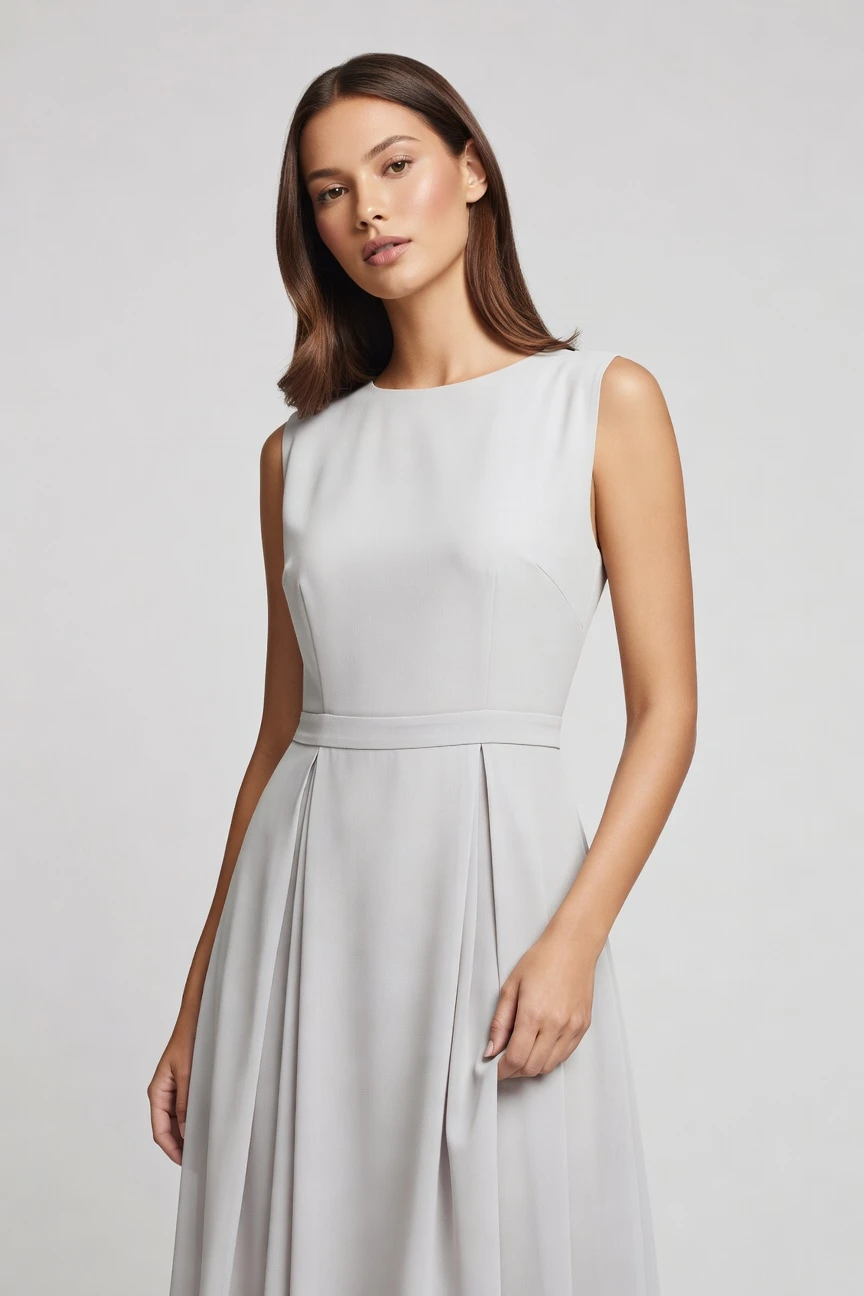
Direct the shoot. Zero prompts.
For this flowy dress setup, the controls are tuned for a clean campaign crop that shows drape, waistline, and movement without overcomplicating the frame. You click into a flattering portrait ratio, sharper lens perspective, and 4K output, then generate. ~$0.55 per image · ~30-40s
- 4 clicks · 0 keystrokes
- app.rawshot.ai / new_shoot
How it works
Direct Dress Imagery in Three Click-Led Steps
Build polished fashion visuals around the garment, then carry the same setup from a single look to catalog-scale production.
- Step 01
Upload the Dress
Start with the garment you need to show. RAWSHOT builds the image around the product, so cut, colour, print, logo, and drape stay central instead of getting bent around a text box.
- Step 02
Set the Visual Direction
Choose lens, framing, lighting, background, aspect ratio, and style from the interface. You direct how the flowy dress is seen, from clean catalog crops to more editorial fashion framing.
- Step 03
Generate and Reuse at Scale
Create images in roughly 30–40 seconds, then repeat the same setup across more looks and more SKUs. The same click-driven workflow works in the browser for one shoot and through the REST API for catalog pipelines.
Spec sheet
Proof for Dress Campaign and Catalog Work
These twelve signals show what matters in production: faithful garments, dependable controls, clear rights, honest labelling, and room to scale.
- 01
Built to Avoid Real-Person Likeness
Every RAWSHOT model is a synthetic composite built from 28 body attributes with 10+ options each. That design makes accidental resemblance statistically negligible by construction, not by luck.
- 02
Every Setting Is a Click
You direct the shoot with controls for lens, framing, light, background, mood, ratio, and style. The interface behaves like software for fashion teams, not a blank command field.
- 03
The Dress Stays the Brief
Flared hems, soft volume, gathered waists, prints, trims, and proportion are represented around the actual garment. RAWSHOT is engineered so fabric behaviour and silhouette stay legible in the output.
- 04
Diverse Synthetic Models, Clearly Labelled
Choose from a broad range of synthetic model options for different brand contexts and audiences. The result is transparent fashion imagery with consistent presentation across collections.
- 05
Repeat the Same Look Across SKUs
Keep the same face, framing, and visual direction as you move through a dress range. That consistency matters when one collection spans colours, prints, lengths, and seasonal drops.
- 06
Dress Styles Beyond One Aesthetic
Switch between catalog, campaign, editorial, studio, street, Y2K, vintage, noir, and more with 150+ visual presets. You can change the visual language without rebuilding the workflow each time.
- 07
2K, 4K, and Every Ratio
Export dress imagery in square, portrait, landscape, and social-first layouts at 2K or 4K. That gives one garment a clean path from PDP to lookbook to paid media crop sets.
- 08
Labelled, Signed, and Compliance-Ready
Every output is AI-labelled, watermarked, and C2PA-signed. RAWSHOT is built for EU-hosted operation, GDPR alignment, EU AI Act Article 50 readiness, and California SB 942 compliance.
- 09
An Audit Trail per Image
Each image carries signed provenance metadata and a durable record of what it is. That makes internal review, platform disclosure, and downstream governance much simpler for commerce teams.
- 10
One Workflow for Browser and API
Use the browser GUI when you are styling a single dress story, then move the same logic into the REST API for larger assortments. No separate core product is hidden behind a sales wall.
- 11
Fast, Clear, and Refund-Safe
Images cost about $0.55 each and generate in roughly 30–40 seconds. Tokens never expire, and failed generations refund tokens automatically.
- 12
Commercial Rights Stay Simple
Every output includes full commercial rights, permanent and worldwide. That clarity matters when dress imagery moves from your site to ads, email, marketplaces, and seasonal campaign assets.
Outputs
Flow, Shape, and Finish
Show the same dress as clean commerce imagery or styled brand creative without changing tools. Move from polished PDP crops to mood-led editorial frames while keeping the garment legible.


Browse 150+ visual styles →
Comparison
RAWSHOT vs category tools vs DIY prompting
Three lenses on every dimension — what you optimize for in RAWSHOT versus typical category tools and blank-box AI workflows.
01
Interface
RAWSHOT
Click-driven controls for lens, frame, light, style, and ratioCategory tools + DIY
Limited fashion controls with partial UI and generic generation flows. DIY prompting: Typed instructions in a chat-style workflow with inconsistent reproducibility02
Garment fidelity
RAWSHOT
Engineered around the garment's cut, colour, print, and drapeCategory tools + DIY
Often stylise apparel well but lose smaller construction details. DIY prompting: Garment drift, invented logos, altered hems, and changed fabric behaviour03
Model consistency
RAWSHOT
Same synthetic model can stay consistent across whole dress rangesCategory tools + DIY
Consistency varies between sessions and product batches. DIY prompting: Faces shift from image to image with no dependable continuity04
Provenance
RAWSHOT
C2PA-signed, AI-labelled, with visible and cryptographic watermarkingCategory tools + DIY
Labelling and provenance support are often partial or absent. DIY prompting: No native provenance metadata or reliable downstream disclosure record05
Commercial rights
RAWSHOT
Full commercial rights to every output, permanent and worldwideCategory tools + DIY
Rights clarity depends on plan terms and platform specifics. DIY prompting: Usage terms can be unclear for retail deployment and resale channels06
Iteration speed
RAWSHOT
Generate a new dress variant in about 30–40 secondsCategory tools + DIY
Fast for simple variants but less controlled for apparel detail. DIY prompting: Multiple retries needed because results depend on wording and luck07
Pricing transparency
RAWSHOT
About $0.55 per image, tokens never expire, refunds on failuresCategory tools + DIY
Credits, seats, or gated plans can complicate forecasting. DIY prompting: Cheap entry, but hidden time cost from repeated trial and error08
Catalog scale
RAWSHOT
Browser GUI and REST API use the same core engineCategory tools + DIY
Scale features often reserved for higher plans or separate products. DIY prompting: No dependable batch workflow for SKU pipelines and audit needs
Prompting does not scale
Stop writing essays. Direct the shoot.
Most AI photo tools start with a blank text box. Rawshot turns the shoot into repeatable controls, so creative teams can produce consistent fashion imagery without prompt syntax or one-off hacks.
Category norm
ManualCreate a premium editorial fashion photograph of a model wearing the exact navy oversized wool coat from SKU-1842, full-body crop, realistic hands, consistent facial identity, clean e-commerce lighting, subtle Paris street background, 85mm lens, no logo distortion, no fabric hallucination, same pose as last campaign, repeatable for all colorways...
A prompt can describe one image. It cannot become a shared production system for hundreds of products, models, angles and markets.
Rawshot
ClicksSaved shoot recipe
Apply to 1 SKU or 10,000 via GUI, CSV or REST API.
Rawshot makes creative direction visible: buttons, presets and sliders instead of hidden prompt craft. The result is easier to teach, faster to approve and built for repeat production.
Use cases
Where Flowy Dress Imagery Unlocks Access
Operator archetypes and how click-directed, garment-first output fits the way they actually work.
- 01
Indie Dress Labels
Launch a small collection with polished on-model imagery before traditional photography is financially possible.
Confidence · high
- 02
Crowdfunded Fashion Drops
Show a flowy silhouette in campaign-ready visuals for pre-orders, landing pages, and investor updates without waiting on samples.
Confidence · high
- 03
DTC Occasionwear Brands
Create elegant dress photography for product pages, paid social, and email while keeping the same visual direction across the range.
Confidence · high
- 04
Resort and Summer Capsules
Present lightweight shapes, volume, and movement in imagery that suits seasonal storytelling and commerce at the same time.
Confidence · high
- 05
Marketplace Dress Sellers
Standardise mixed inventory into cleaner catalog presentation when listings come from many suppliers and arrive with uneven source photos.
Confidence · high
- 06
Vintage and Resale Shops
Turn one-off flowing garments into more cohesive apparel imagery so product pages look considered even when stock is unique.
Confidence · high
- 07
Factory-Direct Manufacturers
Show prospective buyers how a dress style reads on-model before booking a full shoot or shipping samples across borders.
Confidence · high
- 08
Adaptive Fashion Teams
Test different framing choices that prioritise garment function, fit cues, and customer clarity for more inclusive retail presentation.
Confidence · high
- 09
Modest Fashion Brands
Direct coverage, crop, and styling context with precision so longline and loose-fit dresses are represented clearly and respectfully.
Confidence · high
- 10
Kidswear Occasion Lines
Build launch imagery for special-event dresses in a controlled, labelled workflow when studio production is out of reach.
Confidence · high
- 11
Editorial Lookbook Teams
Move from clean commerce crops into more expressive fashion direction for seasonal stories without changing tools or rebuilding the shoot.
Confidence · high
- 12
Large Catalog Operations
Run repeatable dress imagery across many SKUs through the API while maintaining consistent model, framing, and output governance.
Confidence · high
— Principle
Honest is better than perfect.
Dress imagery is often reused across PDPs, ads, social, wholesale decks, and marketplaces, so clarity about what an image is matters. Every RAWSHOT output is AI-labelled, C2PA-signed, and watermarked with visible and cryptographic layers. That gives fashion teams a cleaner disclosure path while keeping provenance attached to the asset itself.
Rights & provenance
Full commercial rights. Forever.
- C2PA-signed on every image — EU AI Act Article 50 compliant
- 28-attribute synthetic models — real-person likeness statistically impossible
- Full commercial rights to every generation — no recurring licensing fees
- Tokens never expire · One-click cancel · Transparent pricing
EU AI Act
C2PA
Commercial use
Pricing
~$0.55 per image.
~30–40 seconds per generation. Tokens never expire. Cancel in one click.
- 01The cancel button is on the pricing page.
- 02No per-seat gates. No 'contact sales' walls for core features.
- 03Failed generations refund their tokens.
- 04Full commercial rights to every output, permanent, worldwide.
FAQ
Practical answers on control, rights, pricing, scale, and compliant publishing.
Do I need to write prompts to use RAWSHOT?
Never—you direct every output with sliders, presets, and clicks on the garment, not typed prompts. That matters for fashion teams because a buyer, marketer, or founder should be able to set lens, framing, lighting, aspect ratio, and visual style without translating the product into command syntax first. RAWSHOT is built like a real application, so the workflow stays legible, repeatable, and easier to hand across a team than chat-based generation.
For catalog operations, reliability matters more than clever wording. RAWSHOT keeps the control surface explicit across the browser GUI and REST API, while pricing, generation time, refund rules, commercial rights, provenance signalling, and watermarking are stated clearly instead of buried behind ambiguity. The practical takeaway is simple: your team can direct outputs around the garment, rehearse repeatable image setups, and scale production without training everyone to become a specialist in text-led generation.
What does AI-assisted dress photography change for SKU-scale catalogs?
It changes who gets access to consistent fashion imagery and how quickly a team can deploy it across a range. Instead of treating every new colourway, print, or length as a fresh shoot problem, you can keep the same visual direction and regenerate around the garment with controlled settings for lens, framing, style, and ratio. That is especially useful when a catalog includes many near-duplicate silhouettes where inconsistency makes the range look disjointed on site.
RAWSHOT is designed for that kind of operational repeatability. You can use the browser for one-off styling work or move into the REST API when the job becomes batch production, while keeping per-image pricing the same and avoiding per-seat gates for core use. With 2K and 4K output, 150+ styles, AI labelling, signed provenance metadata, and permanent worldwide commercial rights, teams get a workflow that supports both merchandising discipline and downstream governance.
Why skip reshooting every dress SKU for seasonal updates or new channels?
Because reshooting each variation is often where access breaks down first. Seasonal refreshes, aspect-ratio changes, marketplace listings, and creative tests can require a level of production coordination that smaller brands and lean catalog teams simply do not have. When the dress already exists as a product to be sold, the smarter move is often to regenerate the presentation around that garment with a controlled image system rather than rebuild the whole production chain.
RAWSHOT lets you change the visual outcome without starting over operationally. You can keep the dress central, switch from catalog clean to campaign gloss, move from square to 4:5 or 9:16, and deliver a new output in roughly 30–40 seconds at about $0.55 per image. For commerce teams, that means channel adaptation becomes an interface decision with clear rights, refunds on failures, and explicit provenance, not another expensive scheduling problem.
How do we turn flat garments into catalogue-ready dress imagery without prompting?
You start by uploading the product and then directing the presentation through the interface. In practice, that means choosing the lens, framing, background, lighting, ratio, and visual style that best shows the silhouette, waistline, hem movement, print, and fabric character of the dress. Because the garment is treated as the center of the workflow, teams can make practical merchandising decisions without writing speculative text or hoping a generic tool interprets apparel details correctly.
RAWSHOT is useful here because the same controls work whether you are preparing a single PDP image or planning a larger assortment. You can generate outputs in 2K or 4K, use one of 150+ visual styles, keep the process in the browser for quick work, and then move into the REST API when batch volume increases. The operational takeaway is that catalogue-ready fashion imagery becomes a repeatable product workflow, not a one-off creative gamble.
Why does garment-led control beat DIY prompting in ChatGPT, Midjourney, or generic image models for fashion PDPs?
Because product pages fail when the garment stops being trustworthy. Generic image tools are strong at broad visual ideas, but they often drift on the details that matter in apparel commerce: altered hems, softened logos, changed prints, inconsistent proportions, or a dress that suddenly behaves like a different fabric between outputs. That creates more review work, more retries, and more uncertainty about whether the image is serving the customer or just approximating the brief.
RAWSHOT takes a different route by putting controls in the application and engineering the workflow around the garment. You set concrete visual parameters instead of improvising phrasing, and every output carries AI labelling, watermarking, and C2PA-signed provenance metadata. For a fashion team, the practical advantage is not novelty; it is reproducibility, clearer governance, and a lower chance that the product itself gets distorted by the generation process.
Can I use AI Flowy Dress For Photography Generator outputs in ads, ecommerce, and marketplaces?
Yes. RAWSHOT includes full commercial rights to every output, permanent and worldwide, which is the baseline most fashion teams need before assets can move into paid media, ecommerce pages, email, wholesale decks, and marketplace listings. Rights clarity matters because imagery is rarely used in just one place; a dress asset often travels through several teams and external channels, and uncertainty at that stage slows launches down.
RAWSHOT also pairs rights clarity with transparent labelling rather than treating disclosure as an afterthought. Outputs are AI-labelled, C2PA-signed, and watermarked with visible and cryptographic layers, giving teams a cleaner path for internal approval and downstream platform use. The practical rule is straightforward: you can plan distribution with confidence, while still maintaining honest provenance and an audit-friendly record of what the image is.
What should our team check before publishing on-model dress images made in RAWSHOT?
Check the same things a disciplined commerce team should always check, but do it with the garment first. Confirm the silhouette, print, colour, trims, logo use, length, and drape are represented the way the customer needs to understand them, then confirm the crop, ratio, and styling context match the channel where the image will appear. For dresses in particular, movement and proportion can change how the product reads, so review the hem behaviour, waist definition, and any layered fabric details closely.
RAWSHOT supports that review process with explicit provenance and labelling rather than hiding the image origin. Each asset is AI-labelled, watermarked, and C2PA-signed, with a per-image audit trail that helps governance teams keep records straight. The operational takeaway is to build a simple QA pass around garment accuracy, channel fit, and provenance status before publishing, so your launch process stays both brand-safe and customer-clear.
How much does the ai flowy dress for photography generator cost per image, and what happens to unused tokens?
For still images, the working price is about $0.55 per image, with generation usually taking around 30–40 seconds. Tokens never expire, which matters for fashion brands that create in bursts around drops, campaigns, wholesale deadlines, or merchandising refreshes rather than on a perfectly even monthly schedule. That structure is simpler for teams that need room to pause, test, and return without feeling punished for irregular production volume.
RAWSHOT also keeps the economics readable in ways operators care about. Failed generations refund their tokens, the cancel button is on the pricing page, and core product access is not blocked behind per-seat gates or a mandatory sales process. For commerce planning, that means you can estimate dress-image production in a straightforward way, test variants without panic over expiration, and keep the workflow aligned with real launch calendars instead of billing traps.
Can RAWSHOT plug into Shopify-scale apparel workflows or batch dress catalogs through an API?
Yes. RAWSHOT offers a REST API for catalog-scale pipelines, which means the same core engine used in the browser can be connected to larger product operations when volume increases. That matters for apparel teams managing many dress SKUs because a system only becomes operationally useful when it can support repeatable jobs, standardised settings, and downstream catalog processes instead of staying trapped as a manual creative toy.
The important point is that RAWSHOT does not split the product into a basic interface for small teams and a hidden enterprise version for serious throughput. One shoot or ten thousand, the pricing logic, model logic, and output quality stay aligned, and the platform is PLM-integration ready with a signed audit trail per image. For teams running Shopify, marketplace, or internal catalog flows, that means you can move from manual styling to structured batch production without swapping tools halfway through.
How do small brands and large catalog teams use the same dress imaging workflow without hitting feature gates?
They use the same underlying product, just at different volumes and with different entry points. A founder or merchandiser can open the browser GUI, select framing, lens, lighting, ratio, and style, and generate a campaign or catalog image for a single dress. A larger operations team can take that same logic into batch workflows through the REST API, keeping output consistency intact while increasing throughput across many SKUs.
RAWSHOT is built around access, not artificial separation between beginner and advanced users. There are no per-seat gates for core features, no forced jump to a hidden edition to unlock the real workflow, and no token expiry pushing teams to overproduce. The practical result is that a small label can start with one look, and a catalog organisation can scale to thousands of assets, while both stay inside the same controlled, labelled, garment-led system.
Keep exploring