
— On-model kit imagery · 150+ styles · 4K
Direct your next drop with the Cycling Apparel AI Product Photography Generator
Generate campaign-ready and catalog-ready cycling apparel imagery built around the garment. Click lens, framing, aspect ratio, and product focus to show jerseys, bib shorts, outerwear, and matching kits clearly. No studio. No shipped samples. No prompts.
- ~$0.55 per image
- ~30–40s per generation
- 150+ styles
- 2K or 4K
- Every aspect ratio
- Up to 4 products
7-day free trial • 50 tokens (10 images) • Cancel anytime

Direct the shoot. Zero prompts.
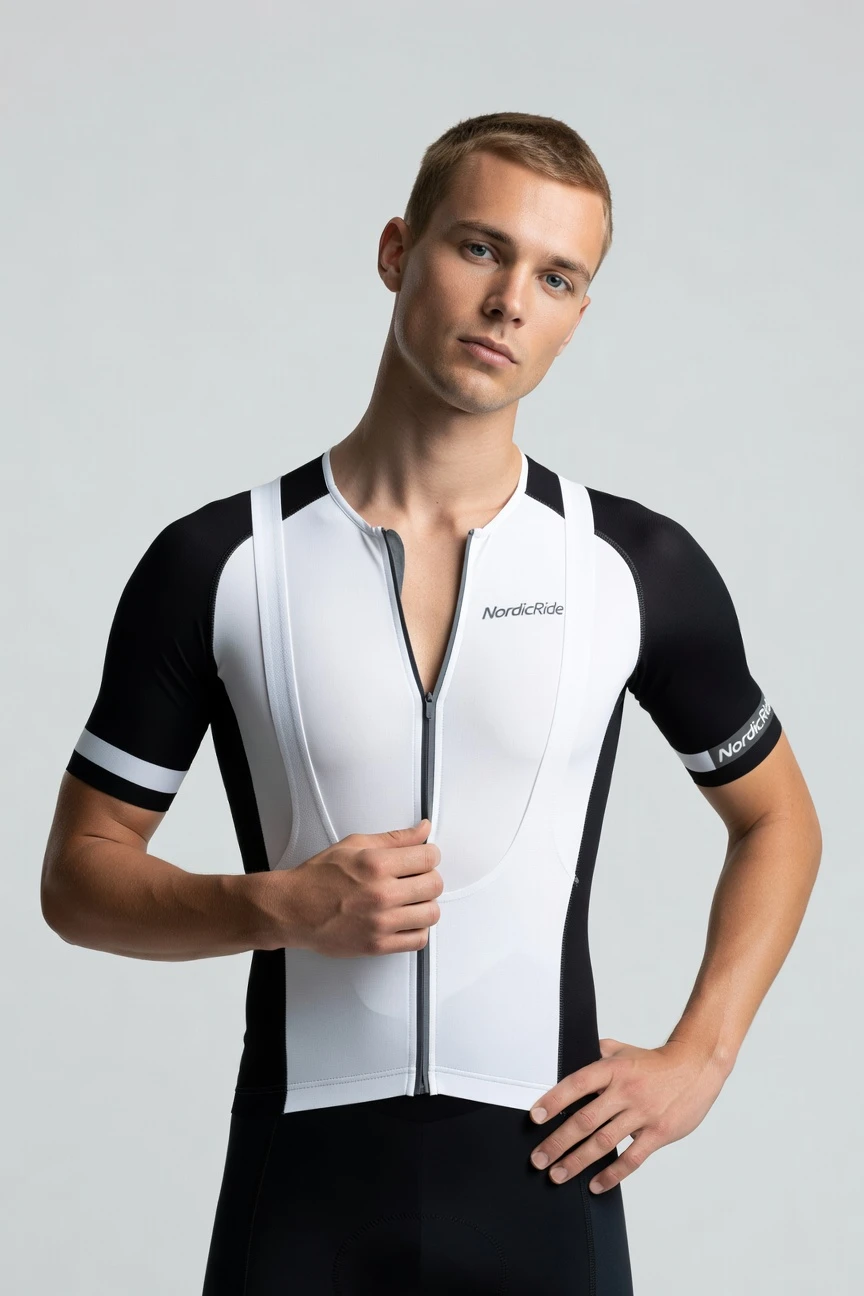
Preset for cycling apparel detail and fit clarity: an 85mm lens, half-body framing, 4:5 crop, 4K output, and full-outfit focus. It keeps attention on jersey paneling, logo placement, zip lines, and bib-short proportion without typing a single instruction. ~$0.55 per image · ~30-40s
- 4 clicks · 0 keystrokes
- app.rawshot.ai / new_shoot
How it works
From Kit Details to Ready-to-Ship Imagery
A garment-led workflow for cycling brands that need fit clarity, repeatable outputs, and clean control from one look to a full catalog.
- Step 01
Upload the Garment
Start from your real product visuals and select the pieces you want in frame. RAWSHOT is engineered around the garment, so jersey cut, panel seams, logos, and colour blocking stay central.
- Step 02
Set the Shot With Clicks
Choose lens, framing, pose, lighting, background, aspect ratio, and visual style from the interface. You direct campaign, studio, or catalog output through controls built for fashion teams.
- Step 03
Generate and Scale
Create stills in about 30–40 seconds, then repeat the same setup across variants and SKUs. Use the browser for single looks or the REST API for larger cycling catalog runs.
Spec sheet
Proof for Performance Apparel Teams
These twelve surfaces show how RAWSHOT handles garment accuracy, transparent labelling, and production reality for cycling collections.
- 01
Built to Avoid Likeness Risk
Every model is a synthetic composite built from 28 body attributes with 10+ options each. Accidental real-person resemblance is statistically negligible by design.
- 02
Every Setting Is a Click
You adjust the shoot with buttons, sliders, and presets. Lens, frame, pose, light, background, and style live in the UI, not in an empty text box.
- 03
Garment Detail Stays Central
RAWSHOT is designed around real apparel, so panel construction, zip placement, sleeve length, logo zones, and colour transitions are represented faithfully.
- 04
Diverse Synthetic Models
Cast across different body configurations for men’s, women’s, and broader fit presentations. Keep the product visible while broadening who gets represented in your store.
- 05
Consistency Across SKU Runs
Use the same model, framing, and visual logic across jerseys, bibs, base layers, and outerwear. That keeps collection pages coherent without reshooting every variation.
- 06
150+ Visual Styles
Switch from catalog clean to roadside campaign, studio editorial, noir, vintage, or street treatments in a few clicks. One collection can serve PDPs, ads, and launch assets.
- 07
2K, 4K, and Every Ratio
Generate square crops, portrait PDP formats, widescreen banners, and vertical social assets from the same workflow. Output is available in 2K and 4K.
- 08
Labelled and Compliance-Ready
Every output is AI-labelled, watermarked, and paired with provenance metadata. RAWSHOT is built for EU-hosted operations, GDPR needs, Article 50 readiness, and California SB 942 alignment.
- 09
Signed Audit Trail per Image
Each file carries a traceable record attached to the output itself. That gives commerce teams clearer internal review, handoff, and accountability than unlabeled image exports.
- 10
GUI for One Shoot, API for Scale
Use the browser for lookbook work and connect the REST API for nightly catalog production. The same engine serves indie launches and enterprise apparel pipelines.
- 11
Fast, Clear, and Token-Safe
Stills cost about $0.55 each and usually generate in 30–40 seconds. Tokens never expire, and failed generations refund their tokens automatically.
- 12
Commercial Rights Included
Every output comes with full commercial rights, permanent and worldwide. You can publish across PDPs, ads, marketplaces, lookbooks, and retail materials without separate licensing layers.
Outputs
Cycling Apparel in context
Show the same kit as clean ecommerce, launch campaign, performance editorial, or detail-led merchandising. The garment stays the brief while the presentation changes around it.


Browse 150+ visual styles →
Comparison
RAWSHOT vs category tools vs DIY prompting
Three lenses on every dimension — what you optimize for in RAWSHOT versus typical category tools and blank-box AI workflows.
01
Interface
RAWSHOT
Click-driven controls for camera, framing, light, style, and product focusCategory tools + DIY
Fashion-specific tools often narrow control to lighter presets and simplified toggles. DIY prompting: You type instructions repeatedly and hope the model interprets apparel direction correctly02
Garment fidelity
RAWSHOT
Built around the real garment’s cut, colour, logos, and drapeCategory tools + DIY
Often polished visually, but apparel details can soften or simplify. DIY prompting: Garment drift, invented logos, and altered panel lines appear between outputs03
Model consistency across SKUs
RAWSHOT
Reuse the same model logic across jersey, bib, and outerwear rangesCategory tools + DIY
Consistency may vary between sessions or depend on saved templates. DIY prompting: Faces and body presentation shift from image to image with no reliable continuity04
Provenance and labelling
RAWSHOT
C2PA-signed, visibly watermarked, cryptographically watermarked, and AI-labelledCategory tools + DIY
Labelling and provenance support is often partial or absent. DIY prompting: Exports usually carry no provenance metadata and no trustworthy labelling trail05
Commercial rights
RAWSHOT
Full commercial rights included for every output, worldwide and permanentCategory tools + DIY
Rights terms can be narrower or harder to audit at scale. DIY prompting: Rights clarity depends on model terms and leaves teams with review overhead06
Pricing transparency
RAWSHOT
About $0.55 per image, tokens never expire, failed generations refundCategory tools + DIY
Pricing can rely on seats, bundles, or gated higher-volume plans. DIY prompting: Usage feels cheap until retries, failed directions, and rework time pile up07
Catalog scale
RAWSHOT
Same product in browser GUI or REST API for large SKU pipelinesCategory tools + DIY
Scale features can sit behind sales-led plans or separate tiers. DIY prompting: No structured pipeline for repeatable apparel catalogs or signed audit output08
Operational overhead
RAWSHOT
Teams learn a visual application with repeatable settings and outputsCategory tools + DIY
Operators still adapt to tool-specific shortcuts and uneven workflow logic. DIY prompting: Prompt-engineering overhead falls on buyers and marketers instead of image operations
Prompting does not scale
Stop writing essays. Direct the shoot.
Most AI photo tools start with a blank text box. Rawshot turns the shoot into repeatable controls, so creative teams can produce consistent fashion imagery without prompt syntax or one-off hacks.
Category norm
ManualCreate a premium editorial fashion photograph of a model wearing the exact navy oversized wool coat from SKU-1842, full-body crop, realistic hands, consistent facial identity, clean e-commerce lighting, subtle Paris street background, 85mm lens, no logo distortion, no fabric hallucination, same pose as last campaign, repeatable for all colorways...
A prompt can describe one image. It cannot become a shared production system for hundreds of products, models, angles and markets.
Rawshot
ClicksSaved shoot recipe
Apply to 1 SKU or 10,000 via GUI, CSV or REST API.
Rawshot makes creative direction visible: buttons, presets and sliders instead of hidden prompt craft. The result is easier to teach, faster to approve and built for repeat production.
Use cases
Where Cycling Brands Win Access
Operator archetypes and how click-directed, garment-first output fits the way they actually work.
- 01
Indie Cycling Label Launching First Kits
Present jerseys, bib shorts, and gilets on-model before a traditional shoot budget exists, then publish PDPs and preorder pages with confidence.
Confidence · high
- 02
DTC Brands Updating Seasonal Colourways
Keep the same visual system while swapping team colours, limited drops, and capsule variations across product pages and paid social.
Confidence · high
- 03
Crowdfunded Performance Wear Campaigns
Show the collection in campaign-ready imagery before full-scale production, helping backers understand fit, silhouette, and range composition.
Confidence · high
- 04
Factory-Direct Manufacturers Selling to Retailers
Create clean line-sheet and ecommerce visuals for multiple private-label cycling programs without organizing separate shoots for each account.
Confidence · high
- 05
Marketplace Sellers With Broad SKU Depth
Standardize on-model product photography across many cycling apparel listings so storefronts look coherent instead of pieced together.
Confidence · high
- 06
Women’s Cycling Brands Expanding Representation
Direct a broader cast of synthetic models and keep focus on garment fit, support zones, and collection identity.
Confidence · high
- 07
Men’s Kit Merchandising Teams
Generate repeatable upper-body and full-outfit views that make jersey pocket placement, bib proportion, and layering pieces easy to compare.
Confidence · high
- 08
Accessory and Apparel Bundle Merchants
Show jerseys, bibs, gloves, and sunglasses together in one composition to increase basket context without separate set builds.
Confidence · high
- 09
Editorial Teams Building Launch Stories
Move from clean studio frames to mood-led cycling campaign imagery using the same garments, same model logic, and different style presets.
Confidence · high
- 10
Students and Emerging Designers Prototyping Collections
Test how cycling silhouettes read on-model before samples travel, helping refine range presentation early in the development cycle.
Confidence · high
- 11
Resale Operators Listing Premium Team Kit
Turn mixed-source flat garment inputs into cleaner on-model commerce imagery that gives vintage and secondhand pieces more presence.
Confidence · high
- 12
Enterprise Catalog Teams Running Nightly Updates
Push repeatable cycling apparel image generation through the REST API for large assortments without changing engines, rights, or audit logic.
Confidence · high
— Principle
Honest is better than perfect.
Cycling apparel brands sell performance and trust, so your imagery stack should be labelled with the same discipline. Every RAWSHOT output is AI-labelled, C2PA-signed, and watermarked with visible and cryptographic layers, giving commerce teams clear provenance instead of ambiguity. The result is a cleaner path for PDP publication, marketplace review, and internal brand governance.
Rights & provenance
Full commercial rights. Forever.
- C2PA-signed on every image — EU AI Act Article 50 compliant
- 28-attribute synthetic models — real-person likeness statistically impossible
- Full commercial rights to every generation — no recurring licensing fees
- Tokens never expire · One-click cancel · Transparent pricing
EU AI Act
C2PA
Commercial use
Pricing
~$0.55 per image.
~30–40 seconds per generation. Tokens never expire. Cancel in one click.
- 01The cancel button is on the pricing page.
- 02No per-seat gates. No 'contact sales' walls for core features.
- 03Failed generations refund their tokens.
- 04Full commercial rights to every output, permanent, worldwide.
FAQ
Practical answers on control, rights, pricing, scale, and compliant publishing.
Do I need to write prompts to use RAWSHOT?
Never—you direct every output with sliders, presets, and clicks on the garment, not typed prompts. That UI control is consistent across GUI and REST API payloads, which is why ecommerce teams onboard buyers without rewriting creative briefs as chat threads. Instead of translating a jersey, bib short, or outer shell into text syntax, you select lens, framing, lighting, background, product focus, aspect ratio, and visual style in a structured interface built for fashion image work.
For catalog teams, reliability matters more than model cleverness; RAWSHOT keeps tokens, timings, refund rules, commercial rights framing, provenance signalling, watermarking cues, REST surface, and SKU-scale batch patterns explicit so operations can rehearse PDP launches without hallucinated garment inventions. That means your team can build repeatable shot logic for cycling apparel and reuse it across collections, rather than depending on whoever is best at steering a chat box on a given day.
What does AI-assisted fashion photography change for SKU-scale cycling catalogs?
It changes who gets access to consistent on-model imagery and how repeatable that imagery becomes across a large assortment. For cycling catalogs, that matters because one range often includes jerseys, bib shorts, base layers, gilets, jackets, and color variants that all need to look related without hiding construction details. RAWSHOT gives teams a garment-led system where the product stays central and the shot logic stays reusable, so you can present technical apparel clearly without booking another studio day for every update.
Operationally, the gain is control through a real application rather than ad hoc image generation. You set framing, lens, style, output ratio, and product focus through the interface, then reuse the same structure in the browser or REST API. With about 30–40 seconds per still, tokens that never expire, refunded failed generations, and full commercial rights on every output, catalog teams can plan image production as infrastructure rather than a one-off creative scramble.
Why skip reshooting every SKU when a cycling collection gets new colours or trims?
Because the expensive part is not only the camera day; it is rebuilding consistency every time the assortment changes. Cycling apparel lines shift through seasonal palettes, sponsor updates, trim revisions, capsule drops, and region-specific merch bundles, and those changes rarely justify the cost and coordination of another full production cycle. RAWSHOT lets teams preserve the same visual logic across those updates, so the range stays coherent while the garment details change where they should.
That matters for ecommerce because shoppers compare products side by side, and inconsistent imagery makes fit, proportion, and feature differences harder to read. In RAWSHOT, you can keep the same model logic, framing, and overall presentation while adapting the output to new jerseys, bibs, and outer layers. The result is a cleaner merchandising system, faster refreshes, and less reliance on scattered reshoots just to keep a catalog from looking patched together.
How do we turn flat garments into catalogue-ready imagery without prompting?
You start with the real product inputs and then direct the output through interface controls built for fashion teams. In practice, that means selecting the category, setting product focus, choosing a lens and framing, and applying the lighting, background, aspect ratio, and style that match your store or campaign needs. The workflow is especially useful for cycling apparel because shoppers need to understand paneling, zipper lines, logo placement, and the relationship between tops and bottoms without visual clutter.
RAWSHOT supports upper-body, lower-body, full-outfit, footwear, jewelry, handbags, watches, sunglasses, accessories, and compositions with up to four products, so the same system can handle a jersey alone or a full performance kit. You can generate 2K or 4K stills in every aspect ratio, then carry the same settings into repeat runs for neighboring SKUs. That gives merchandising teams a practical method for moving from product assets to publishable imagery without relying on text syntax or improvised creative guesswork.
Why does garment-led control beat DIY prompting in ChatGPT, Midjourney, or generic image tools for apparel PDPs?
Because apparel commerce fails when the garment stops being the source of truth. Generic image tools can create attractive pictures, but they tend to drift on cut lines, invent or blur logos, change panel placement, and produce inconsistent faces or body presentation between outputs. For a cycling brand, those failures are not cosmetic; they confuse product comparison, weaken trust, and create extra review work before anything can reach a PDP, ad set, or marketplace listing.
RAWSHOT is structured differently. You are not trying to persuade a general model with longer wording; you are directing a fashion-specific application through clicks, presets, and controlled output settings. On top of that, RAWSHOT includes C2PA-signed provenance, visible and cryptographic watermarking, AI labelling, full commercial rights, and a repeatable REST API surface for scale. The practical advantage is simple: fewer invented garment details, cleaner reproducibility, and less operational chaos when the catalog grows.
Can I use cycling apparel ai product photography generator outputs in ads, PDPs, and marketplaces commercially?
Yes. RAWSHOT includes full commercial rights to every output, permanent and worldwide, so teams can publish images across product detail pages, paid social, emails, lookbooks, retail materials, and marketplace listings. That clarity matters because commerce teams need to know whether an image can move from launch deck to storefront to acquisition channel without another round of approvals or a separate licensing negotiation. RAWSHOT is designed to remove that uncertainty from the workflow.
Trust also depends on how the image is disclosed, not only on how it is licensed. Every output is AI-labelled and carries visible plus cryptographic watermarking, alongside C2PA provenance metadata and a signed audit trail per image. For brands in regulated or sensitive retail environments, that combination supports cleaner internal governance and clearer external disclosure, so publishing decisions rest on explicit facts rather than assumptions about where an image came from.
What should our team check before publishing synthetic cycling kit imagery?
Start with the garment itself. Review whether jersey paneling, seam logic, zip length, logo placement, hem finish, sleeve proportion, and bib-short relationship are represented the way your merchandising team expects shoppers to see them. Then confirm that the chosen framing, crop, and aspect ratio serve the selling task, whether that is a clean PDP, a launch tile, or a social placement. Quality control for apparel imagery is less about abstract image beauty and more about making the product readable and trustworthy.
Then review the transparency layer and operational basics. RAWSHOT outputs are AI-labelled, watermarked visibly and cryptographically, and paired with C2PA provenance plus a per-image audit trail, so governance checks should confirm those elements remain intact through export and publishing workflows. Teams should also confirm the image aligns with category standards, the selected model presentation matches the collection strategy, and the file is being routed under the correct commercial-use process. That turns publication into a repeatable checklist instead of a subjective debate.
How much does still-image generation cost for cycling apparel, and what happens if a generation fails?
For stills, RAWSHOT costs about $0.55 per image, and a generation usually completes in around 30–40 seconds. That makes budgeting straightforward for teams planning a handful of launch visuals or a larger cycling assortment, because the unit economics stay visible instead of being buried in seat counts or custom pricing layers. Tokens never expire, so you are not forced into artificial usage windows just to protect prepaid balance.
Failed generations refund their tokens automatically, which matters in real operations where teams test crops, garment groupings, and style directions before settling a final visual system. There is also one-click cancellation, and the cancel control is on the pricing page rather than hidden behind an account process. For commerce managers, the takeaway is practical: you can model cost per PDP, campaign, or category refresh with much less ambiguity than traditional shoots or loosely structured image-tool subscriptions.
How does the RAWSHOT API fit Shopify-scale merchandising or retailer feed workflows?
The REST API gives catalog teams the same core engine used in the browser, but in a form that can be wired into larger product operations. That is useful for Shopify-scale stores, marketplace programs, and retailer feed workflows where image production has to follow SKU updates instead of waiting for a manual creative queue. Rather than switching to a separate enterprise edition, teams can move from single-shoot use to batch generation with the same pricing logic, model system, and output standards.
For cycling apparel, that means a merchandising team can define repeatable image rules around product focus, framing, style, and ratios, then apply them across large assortments without rebuilding the process each time. RAWSHOT is PLM-integration ready and provides a signed audit trail per image, which supports traceability when assets travel through approval, syndication, and publishing systems. The practical result is a cleaner bridge between commerce operations and image generation, especially when assortment turnover is frequent.
Can one team handle a single launch in the browser and later scale the cycling apparel ai product photography generator through API?
Yes, and that continuity is one of the main operational advantages. RAWSHOT uses the same engine, the same model framework, the same per-image pricing logic, and the same output standards whether you are creating one launch visual in the browser or running a much larger pipeline through the API. That means a founder, merchandiser, or art lead can prove the visual direction interactively first, then hand a stable process to operations without changing tools or retraining the team around a different product tier.
For growing cycling brands, that matters because image needs expand unevenly. A team might begin with a few hero jerseys and later need full assortment coverage across regions, channels, and seasonal drops. With no per-seat gates, no core feature wall behind a sales call, and tokens that do not expire, the move from experimental use to structured production is straightforward. The best practice is to establish a repeatable shot system early in the GUI, then mirror that logic in batch workflows as volume grows.
Keep exploring