
— Activewear imagery · 150+ styles · 4K
Launch your next drop with the Gym Wear AI Product Photography Generator
Generate clean, high-energy gym wear imagery built for PDPs, campaigns, and social crops. Direct the shoot with lens, framing, pose, aspect ratio, and visual style controls in a real interface made for fashion teams. No studio. No samples. No prompts.
- ~$0.55 per image
- ~30–40s per generation
- 150+ styles
- 2K or 4K
- Every aspect ratio
- Full commercial rights
7-day free trial • 50 tokens (10 images) • Cancel anytime

Direct the shoot. Zero prompts.
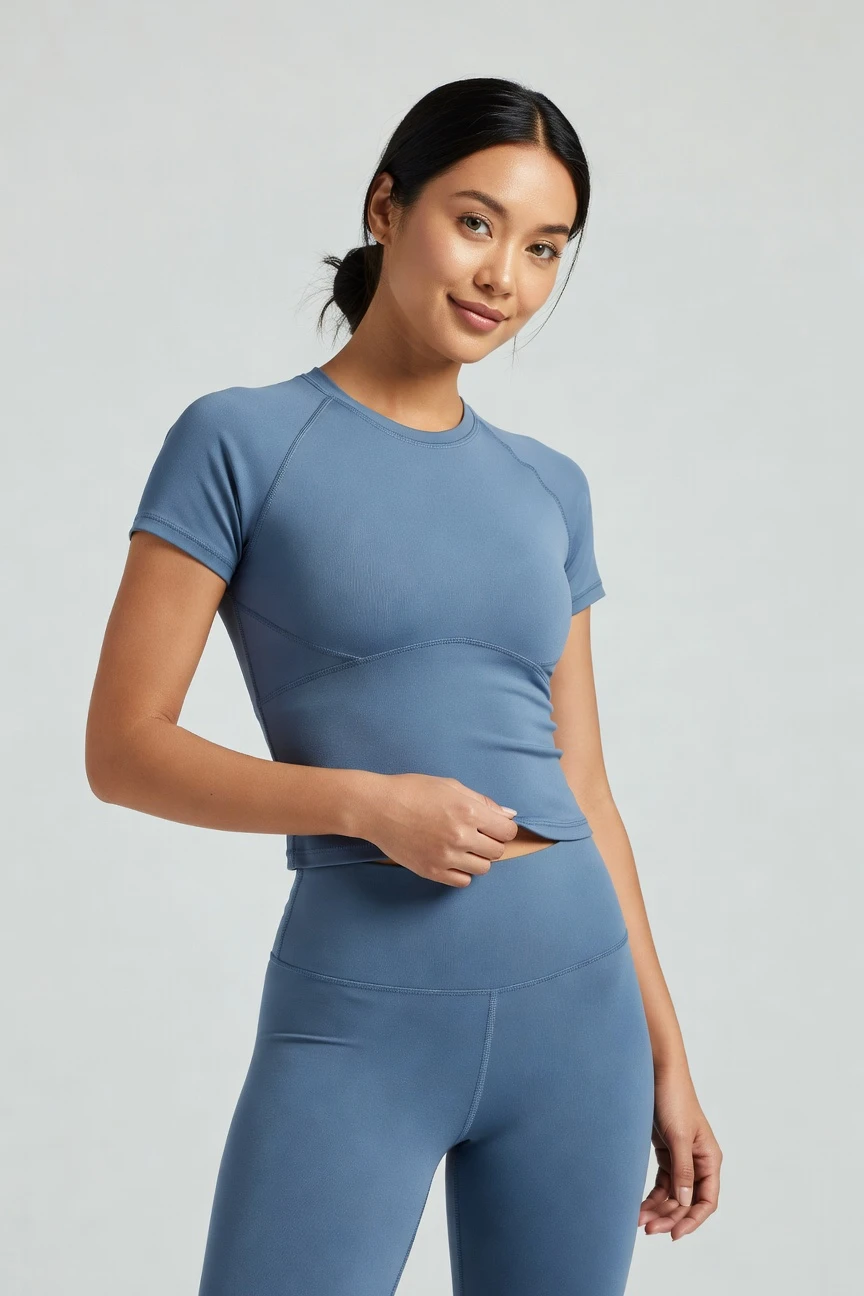
For gym wear, we preset a flattering 85mm lens, half-body crop, 4:5 ratio, 4K output, and full-outfit focus so performance sets read cleanly on product pages and paid social. You adjust the look with clicks, then generate consistent on-model images around the garment. ~$0.55 per image · ~30-40s
- 4 clicks · 0 keystrokes
- app.rawshot.ai / new_shoot
How it works
Build Gym Wear Shoots by Click
From compression sets to running layers, direct the frame around the product with controls made for fashion operations, not chat boxes.
- Step 01
Upload the Garment
Start with the real product so the cut, colour blocking, logos, and fabric read from the garment outward. That matters for gym wear, where fit lines and waistband placement sell the piece.
- Step 02
Set the Athletic Frame
Choose lens, crop, angle, pose, background, and style with buttons and presets. You can build anything from clean studio activewear PDPs to sharper campaign visuals without learning syntax.
- Step 03
Generate and Scale
Create single images in the browser or move the same setup into batch workflows through the REST API. The same engine supports one launch-day hero image or a full activewear catalog refresh.
Spec sheet
Proof for Activewear Teams That Need Control
These twelve surfaces show how RAWSHOT keeps gym wear imagery faithful, labelled, scalable, and commercially usable from first test to full catalog.
- 01
Synthetic Models by Design
Every model is a synthetic composite built from 28 body attributes with 10+ options each, making accidental real-person likeness statistically negligible by design.
- 02
Every Setting Is a Click
Camera, crop, pose, light, background, style, and product focus live in controls and presets. You direct the outcome in an application built for fashion work.
- 03
Garment-Led Representation
RAWSHOT is engineered around the actual product so seams, colour panels, logos, drape, and proportion stay tied to the garment instead of drifting with text interpretation.
- 04
Diverse Synthetic Casting
Choose from diverse synthetic models for different brand directions and fit stories. That gives activewear labels broader representation without casting logistics for every test.
- 05
Consistency Across SKUs
Keep the same model, framing, and visual system across leggings, bras, jackets, and matching sets. Your catalog stays coherent from drop to drop.
- 06
150+ Visual Styles
Move from catalog-clean fitness shots to moodier campaign treatments with preset looks covering studio, lifestyle, editorial, street, vintage, and more.
- 07
2K, 4K, and Every Crop
Generate stills in 2K or 4K and choose the aspect ratio that fits PDPs, marketplaces, email blocks, and paid social placements without rebuilding the shoot.
- 08
Labelled and Compliant
Outputs are AI-labelled, watermarked, and aligned with EU AI Act Article 50, California SB 942, and GDPR-minded workflows. Honest presentation is built in.
- 09
Signed Audit Trail per Image
Each output carries provenance metadata and a recordable chain of origin. That gives teams a clearer review path when assets move across ecommerce, creative, and compliance workflows.
- 10
GUI for One Shoot, API for Scale
Use the browser interface for quick activewear launches, then automate larger catalogs through the REST API. One product, same pricing logic, same output standard.
- 11
Fast, Transparent Economics
Images run about $0.55 each and generate in roughly 30–40 seconds. Tokens never expire, and failed generations refund tokens automatically.
- 12
Commercial Rights Included
Every output comes with full commercial rights, permanent and worldwide. You can publish across product pages, ads, marketplaces, and brand channels without extra licensing layers.
Outputs
Gym Wear Outputs Across the Funnel
From clean PDP frames to sharper campaign imagery, activewear visuals can stay consistent while adapting to where the customer sees them. Build around the same garment, then shift crop, styling, and energy by channel.


Browse 150+ visual styles →
Comparison
RAWSHOT vs category tools vs DIY prompting
Three lenses on every dimension — what you optimize for in RAWSHOT versus typical category tools and blank-box AI workflows.
01
Interface
RAWSHOT
Buttons, sliders, and presets built for fashion image directionCategory tools + DIY
Usually mix light controls with lighter text inputs and fewer fashion-specific controls. DIY prompting: Typed instructions in generic chat or image tools with inconsistent repeatability02
Garment fidelity
RAWSHOT
Engineered around the garment’s cut, colour, logo placement, and drapeCategory tools + DIY
Often strong on mood, less reliable on exact product details. DIY prompting: Garment drift, invented logos, warped seams, and changed colour blocking03
Model consistency
RAWSHOT
Same synthetic model can stay stable across large activewear catalogsCategory tools + DIY
Consistency varies across sessions, especially at volume. DIY prompting: Faces, body shape, and pose logic drift from image to image04
Provenance
RAWSHOT
C2PA-signed outputs with AI labelling and layered watermarkingCategory tools + DIY
Labelling and provenance support are often partial or absent. DIY prompting: No dependable provenance metadata and no built-in signing standard05
Commercial rights
RAWSHOT
Full commercial rights included, permanent and worldwideCategory tools + DIY
Rights terms can be narrower or harder to parse across plans. DIY prompting: Rights clarity depends on model, platform, and upstream asset terms06
Pricing transparency
RAWSHOT
Same per-image pricing, no per-seat gates, tokens never expireCategory tools + DIY
Often plan-gated with seat limits or sales-led feature access. DIY prompting: Cheap to try, expensive in team time, retries, and unusable outputs07
Catalog scale
RAWSHOT
Browser GUI for one shoot and REST API for nightly SKU pipelinesCategory tools + DIY
Some support batch work but separate scale features by plan. DIY prompting: Manual recreation across SKUs with weak reproducibility and no audit layer08
Operational overhead
RAWSHOT
Teams click visual controls and reuse repeatable setupsCategory tools + DIY
Partly structured, but often still depend on operator wording. DIY prompting: Prompt-engineering overhead slows buyers, marketers, and catalog teams
Prompting does not scale
Stop writing essays. Direct the shoot.
Most AI photo tools start with a blank text box. Rawshot turns the shoot into repeatable controls, so creative teams can produce consistent fashion imagery without prompt syntax or one-off hacks.
Category norm
ManualCreate a premium editorial fashion photograph of a model wearing the exact navy oversized wool coat from SKU-1842, full-body crop, realistic hands, consistent facial identity, clean e-commerce lighting, subtle Paris street background, 85mm lens, no logo distortion, no fabric hallucination, same pose as last campaign, repeatable for all colorways...
A prompt can describe one image. It cannot become a shared production system for hundreds of products, models, angles and markets.
Rawshot
ClicksSaved shoot recipe
Apply to 1 SKU or 10,000 via GUI, CSV or REST API.
Rawshot makes creative direction visible: buttons, presets and sliders instead of hidden prompt craft. The result is easier to teach, faster to approve and built for repeat production.
Use cases
Where Gym Wear Brands Need Imagery Fast
Operator archetypes and how click-directed, garment-first output fits the way they actually work.
- 01
Indie activewear founders
Launch a first collection with on-model gym wear imagery before a traditional shoot budget exists.
Confidence · high
- 02
DTC fitness brands
Keep leggings, bras, layers, and sets visually consistent across PDPs, email, and paid social.
Confidence · high
- 03
Crowdfunded performance labels
Show campaign-ready product photography for prototypes and preorders without shipping samples to a studio.
Confidence · high
- 04
Marketplace sellers
Generate clean activewear product images in marketplace-friendly crops for fast listing turnover.
Confidence · high
- 05
Gym wear subscription brands
Refresh monthly drops with the same visual system so recurring customers recognize the line instantly.
Confidence · high
- 06
Factory-direct manufacturers
Turn incoming product data into on-model fitness imagery for wholesale sheets and direct storefronts.
Confidence · high
- 07
Private-label operators
Test different visual directions for the same garment across storefronts without recasting or reshooting.
Confidence · high
- 08
Sports club merch teams
Present training tops, joggers, and branded layers with sharper product storytelling than flat packshots alone.
Confidence · high
- 09
Resale and vintage sellers
Style second-hand sportswear into cleaner, more consistent product pages for mixed inventory catalogs.
Confidence · high
- 10
Creative agencies
Build athletic campaign concepts quickly when clients need option sets before committing to live production.
Confidence · high
- 11
Merchandising teams
Update seasonal colourways and coordinated sets with repeatable framing that keeps the catalog easy to scan.
Confidence · high
- 12
Students and new labels
Create credible activewear presentation while learning brand direction, fit communication, and channel-specific crops.
Confidence · high
— Principle
Honest is better than perfect.
Gym wear customers buy on fit cues, product trust, and brand clarity, so labelled output matters. Every RAWSHOT image is AI-labelled, watermarked, and C2PA-signed with provenance metadata. We host in the EU, design for GDPR-aware operations, and treat transparency as part of the product, not a footer disclaimer.
Rights & provenance
Full commercial rights. Forever.
- C2PA-signed on every image — EU AI Act Article 50 compliant
- 28-attribute synthetic models — real-person likeness statistically impossible
- Full commercial rights to every generation — no recurring licensing fees
- Tokens never expire · One-click cancel · Transparent pricing
EU AI Act
C2PA
Commercial use
Pricing
~$0.55 per image.
~30–40 seconds per generation. Tokens never expire. Cancel in one click.
- 01The cancel button is on the pricing page.
- 02No per-seat gates. No 'contact sales' walls for core features.
- 03Failed generations refund their tokens.
- 04Full commercial rights to every output, permanent, worldwide.
FAQ
Practical answers on control, rights, pricing, scale, and compliant publishing.
Do I need to write prompts to use RAWSHOT?
Never—you direct every output with sliders, presets, and clicks on the garment, not typed prompts. That UI control is consistent across GUI and REST API payloads, which is why ecommerce teams onboard buyers without rewriting creative briefs as chat threads. You choose framing, lens, pose, lighting, background, aspect ratio, and visual style in a way that feels like directing a shoot inside software, not negotiating with a text box.
For catalog teams, reliability matters more than model cleverness; RAWSHOT keeps tokens, timings, refund rules, commercial rights framing, provenance signalling, watermarking cues, REST surface, and SKU-scale batch patterns explicit so operations can rehearse PDP launches without hallucinated garment inventions. The practical takeaway is simple: if your team can review product imagery, it can already use RAWSHOT, because the workflow is built around selecting visual settings and generating repeatable outputs.
What does AI-assisted fashion photography change for SKU-scale activewear catalogs?
It changes who gets access to on-model imagery and how consistently a catalog can be maintained. For activewear teams, the problem is not only making one strong image; it is keeping bras, leggings, jackets, and matching sets visually coherent across hundreds or thousands of SKUs. RAWSHOT lets you keep the same model logic, crop logic, and style direction while adapting only what needs to change around the garment.
That matters operationally because gym wear catalogs often span colourways, fabric updates, and seasonal drops that arrive faster than studio schedules. With RAWSHOT, images generate in roughly 30–40 seconds, stills cost about $0.55 each, and failed generations refund tokens. Teams can use the browser for quick approvals or move straight into the REST API for batch production, all while keeping outputs labelled, watermarked, and commercially usable worldwide.
Why skip reshooting every SKU when a new gym wear drop lands?
Because repeated live production is often the bottleneck, not the creative idea. Activewear collections change through colour updates, set extensions, fabric revisions, and regional assortments, yet each change traditionally pulls teams back into sample logistics, casting, and studio coordination. RAWSHOT gives you a way to rebuild the imagery layer around the real garment without treating every update like a full production event.
The value is not only lower spend; it is continuity and access. You keep a stable visual system across the catalog, direct changes with interface controls, and generate new outputs in 2K or 4K for the channels you actually use. For commerce teams, that means seasonal updates become a repeatable workflow rather than a reshoot negotiation, and smaller brands can maintain an image standard they previously could not afford to operate.
How do we turn flat garments into catalogue-ready imagery without prompting?
You start with the product, then set the frame around it with controls. In RAWSHOT, teams select lens, crop, pose, angle, lighting, background, visual style, aspect ratio, and product focus directly in the interface. That is especially useful for gym wear because compression seams, waistband height, logo placement, and panel lines need to stay readable while the presentation still feels energetic and sellable.
Once the setup is right, you generate single images in the browser or reuse the same configuration for larger batches. The process stays structured because the garment remains the brief, not a text interpretation of the brief. In practice, teams should lock a few repeatable activewear setups for PDP, campaign, and marketplace use, then run each new SKU through those templates to keep catalog quality stable over time.
Why does garment-led control beat ChatGPT, Midjourney, or generic image tools for fashion PDPs?
Because generic tools are built to respond to text, not to protect the product. For fashion commerce, that creates a familiar failure pattern: logos shift, seam lines soften, colour blocking mutates, and one image no longer matches the next. Activewear is particularly sensitive to those problems because shoppers inspect fit cues and technical details closely before buying. RAWSHOT is built around garment representation first, then visual direction second.
The operational difference is equally important. RAWSHOT adds click-driven controls, per-image provenance, AI labelling, watermarking, and clearer commercial usage terms, while generic tools leave teams to manually chase reproducibility and rights clarity. If your job is to publish dependable product imagery rather than experiment loosely, garment-led control wins because it reduces drift, shortens review cycles, and gives merchandising teams a repeatable standard.
Can I use outputs from a gym wear ai product photography generator in ads and product pages?
Yes—RAWSHOT includes full commercial rights to every output, permanent and worldwide. That covers the practical places commerce teams need imagery to work: PDPs, collection pages, paid social, marketplaces, email, and campaign placements. The key advantage is that usage rights are not hidden behind a separate licensing conversation when you are already trying to move a drop live.
RAWSHOT also pairs those rights with transparent signalling. Outputs are AI-labelled, watermarked in visible and cryptographic ways, and carry C2PA provenance metadata, which helps teams publish with clearer internal review standards. For operators, the useful habit is to treat rights and transparency as part of asset readiness; if an image has the visual quality, the label, and the provenance record, it is ready to move through your channel mix with less uncertainty.
What should our team check before publishing AI-labelled activewear images?
Review the same things a strong commerce team should always review, but do it with garment fidelity and provenance in mind. Confirm that seams, logos, trims, colour panels, and silhouette proportions match the actual item, then verify the chosen crop, background, and style fit the channel where the image will appear. For activewear, also check that support details and waistband placement read clearly enough for the customer to understand the product.
RAWSHOT helps by keeping outputs labelled, watermarked, and C2PA-signed, with a per-image audit trail that supports internal handoff. That means QA is not only visual; it is operational and compliance-aware as well. Teams should create a short approval checklist that covers product accuracy, channel fit, provenance presence, and rights readiness, then use that checklist consistently before anything reaches the storefront or ad account.
How much does still-image generation cost for fitness apparel, and what happens if a render fails?
RAWSHOT stills cost about $0.55 per image, and a generation usually completes in around 30–40 seconds. Tokens never expire, which matters for fashion teams whose launch calendars move in bursts rather than in smooth monthly usage. You can test a few activewear looks, pause, and come back later without losing the balance you already bought.
Failed generations refund their tokens automatically, and cancellation is simple because the cancel button sits on the pricing page. There are no per-seat gates and no contact-sales wall for core features, so the economics stay visible from the start. For operators, that means you can estimate a drop budget directly from image count and variant count, rather than padding the plan for seat fees, expiring credits, or unclear failure handling.
Can RAWSHOT plug into Shopify-scale catalogs or our internal product pipeline?
Yes. RAWSHOT supports browser-based single-shoot work and a REST API for catalog-scale production, so teams can start manually and automate when volume demands it. That flexibility matters for activewear businesses because a brand might begin with a handful of coordinated sets, then quickly grow into large size runs, colour families, and regional assortment splits that need regular image updates.
The practical benefit is that the same logic can carry from one-off art direction to nightly batch workflows. You do not have to switch products or learn a second system when moving from creative exploration into operations. Teams should use the GUI to lock visual standards, then translate those approved settings into API-driven production so catalog growth does not break consistency.
Is a gym wear ai product photography generator only useful for small brands, or can bigger teams use it too?
It works for both because the product is the same across scales. RAWSHOT is designed so an indie activewear founder and a larger catalog team use the same engine, the same model system, the same output quality, and the same per-image pricing. That matters because growth should not force a team into a different edition, a different rights model, or a different quality tier just to keep producing images.
In practice, smaller teams use RAWSHOT to get access to imagery they were previously priced out of, while larger teams use it to make image operations more repeatable across many SKUs and channels. With browser controls for fast direction, REST API support for batch runs, and signed provenance per image, the workflow scales from a single drop test to ongoing catalog infrastructure without changing the fundamentals.
Keep exploring