
— Sock imagery · 150+ styles · 4K
Direct clean ecommerce visuals for every pair with the Socks AI Product Photography Generator.
Generate sock imagery that sells fit, texture, color, and branding with clean framing and reliable product focus. Direct the shoot with lens, crop, aspect ratio, style, and garment-led controls in a real interface built for fashion teams. No studio. No shipped samples. No prompts.
- ~$0.55 per image
- ~30–40s per generation
- 150+ styles
- 2K or 4K
- Every aspect ratio
- Full commercial rights
7-day free trial • 50 tokens (10 images) • Cancel anytime

Direct the shoot. Zero prompts.
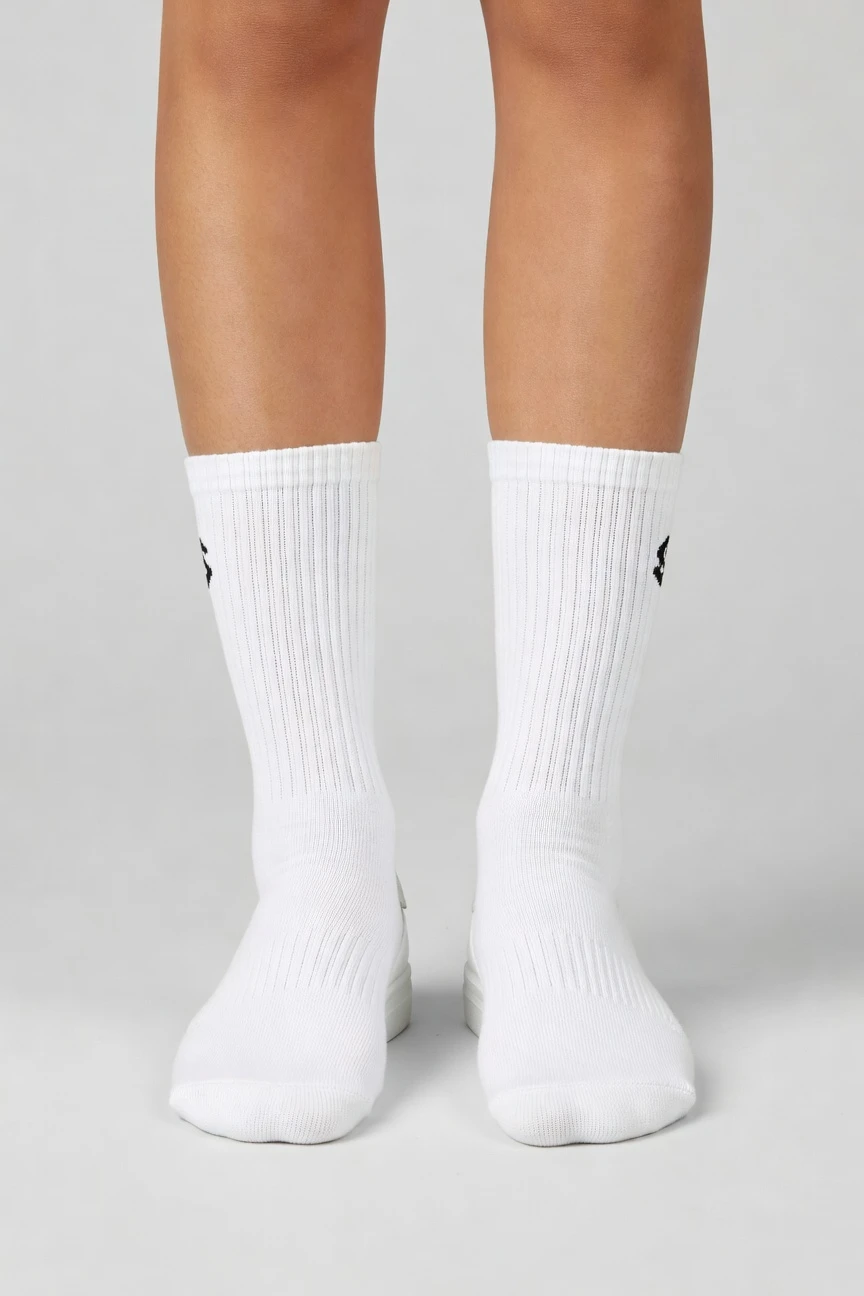
Preset for sock ecommerce imagery: a tighter crop, 85mm lens, and 4:5 output keep attention on ankle, calf, knit texture, and logo placement. You click the framing and finish, then generate consistent product imagery without typing anything. ~$0.55 per image · ~30-40s
- 4 clicks · 0 keystrokes
- app.rawshot.ai / new_shoot
How it works
Turn Sock Designs Into Sellable Images
Three steps: load the product, direct the frame, and generate consistent output for single drops or full catalogs.
- Step 01
Upload the Garment
Start with your sock design or product image. RAWSHOT builds the shoot around the actual garment so ribbing, color blocking, logos, and proportions stay central.
- Step 02
Set the Frame
Choose lens, crop, ratio, style, and output settings with clicks. For socks, you can tighten the composition around lower-leg styling and product detail without typing instructions.
- Step 03
Generate at Catalog Pace
Create one hero image or run the same setup across a full sock range. The same controls work in the browser for creative work and in the API for SKU-scale production.
Spec sheet
Proof That the Product Stays Central
These twelve surfaces show how RAWSHOT handles sock detail, operational control, provenance, and scale without turning the process into guesswork.
- 01
Built From Synthetic Attributes
Every RAWSHOT model is a synthetic composite built from 28 body attributes with 10+ options each. Accidental real-person likeness is statistically negligible by design.
- 02
Every Setting Is a Click
Lens, framing, lighting, background, visual style, and product focus live in controls, not an empty text box. You direct the outcome through an interface made for commerce work.
- 03
Sock Detail Holds Up
RAWSHOT is engineered around the garment brief. Knit structure, stripe placement, cuff height, heel contrast, color, and logo position stay more faithful to the product.
- 04
Diverse Models, Transparently Labelled
Choose from diverse synthetic models for different brand contexts and customer expectations. Output is clearly AI-labelled rather than passed off as something it is not.
- 05
Consistency Across Colorways
Keep a stable visual system as you roll one sock silhouette into multiple shades, packs, or seasonal drops. The result is cleaner merchandising and fewer near-miss retakes.
- 06
150+ Visual Styles
Move from clean catalog frames to sport, street, campaign, studio, or editorial looks without rebuilding the workflow. Style selection stays fast and visual.
- 07
2K, 4K, and Every Ratio
Generate square, portrait, landscape, and platform-ready crops in high resolution. That matters when one sock asset has to work for PDPs, ads, email, and marketplaces.
- 08
Labelled and Compliance-Ready
Every output carries provenance and labelling designed for honest commerce. RAWSHOT supports C2PA signing, visible and cryptographic watermarking, and compliance-focused deployment.
- 09
Signed Audit Trail Per Image
Each image can carry a traceable record of what it is and how it was produced. That gives teams a clearer review path for publishing, approvals, and governance.
- 10
Browser to REST API
Use the GUI when a merchandiser is building a single sock launch, then switch to the REST API for nightly catalog jobs. Same engine, same product, same output logic.
- 11
Fast, Clear Token Economics
Images run at about $0.55 each and usually generate in 30–40 seconds. Tokens never expire, and failed generations refund their tokens.
- 12
Permanent Commercial Rights
Every output includes full commercial rights, permanent and worldwide. That gives brands clear room to publish, crop, syndicate, and sell with confidence.
Outputs
Sock Output, Directed by clicks
From clean PDP crops to styled lower-leg imagery, RAWSHOT lets you show sock fit, branding, and material character across commerce and campaign surfaces.


Browse 150+ visual styles →
Comparison
RAWSHOT vs category tools vs DIY prompting
Three lenses on every dimension — what you optimize for in RAWSHOT versus typical category tools and blank-box AI workflows.
01
Interface
RAWSHOT
Click-driven controls for lens, crop, style, and garment focusCategory tools + DIY
Preset-heavy interfaces with thinner directorial control and less product-specific framing. DIY prompting: Typed instructions in a generic image tool, with repeated trial and error02
Garment fidelity
RAWSHOT
Engineered around sock color, knit, logo, and proportion fidelityCategory tools + DIY
Often good at mood, weaker at preserving exact garment details. DIY prompting: Garments drift, logos mutate, and stripe placement changes across outputs03
Model consistency across SKUs
RAWSHOT
Stable visual system for repeated sock launches and colorway setsCategory tools + DIY
Consistency depends on tool-specific presets and narrower scaling workflows. DIY prompting: Faces, bodies, crops, and styling shift from one generation to the next04
Provenance + labelling
RAWSHOT
C2PA-signed, watermarked, and AI-labelled output for honest publishingCategory tools + DIY
Labelling and provenance support vary, often without signed records per asset. DIY prompting: No dependable provenance metadata, weak disclosure support, and unclear asset traceability05
Commercial rights
RAWSHOT
Full commercial rights to every output, permanent and worldwideCategory tools + DIY
Rights can be harder to parse across plans, seats, or usage scopes. DIY prompting: Usage terms are platform-dependent and often unclear for commerce teams06
Pricing transparency
RAWSHOT
Per-image pricing, non-expiring tokens, one-click cancel, refunds on failuresCategory tools + DIY
Seat limits, gated plans, or volume structures can complicate budgeting. DIY prompting: Cheap-looking entry points hide time costs, retries, and manual clean-up work07
Catalog scale
RAWSHOT
Same product works for one shoot or API-driven SKU pipelinesCategory tools + DIY
Scale features are commonly pushed into higher-touch sales processes. DIY prompting: No reliable batch workflow for thousands of commerce-ready garment outputs08
Prompt overhead
RAWSHOT
No syntax work; creative direction lives in buttons, sliders, and presetsCategory tools + DIY
Some tools reduce typing but still depend on text-led direction. DIY prompting: Teams spend hours chasing usable instructions instead of approving imagery
Prompting does not scale
Stop writing essays. Direct the shoot.
Most AI photo tools start with a blank text box. Rawshot turns the shoot into repeatable controls, so creative teams can produce consistent fashion imagery without prompt syntax or one-off hacks.
Category norm
ManualCreate a premium editorial fashion photograph of a model wearing the exact navy oversized wool coat from SKU-1842, full-body crop, realistic hands, consistent facial identity, clean e-commerce lighting, subtle Paris street background, 85mm lens, no logo distortion, no fabric hallucination, same pose as last campaign, repeatable for all colorways...
A prompt can describe one image. It cannot become a shared production system for hundreds of products, models, angles and markets.
Rawshot
ClicksSaved shoot recipe
Apply to 1 SKU or 10,000 via GUI, CSV or REST API.
Rawshot makes creative direction visible: buttons, presets and sliders instead of hidden prompt craft. The result is easier to teach, faster to approve and built for repeat production.
Use cases
Where Sock Brands Need More Than Packshots
Operator archetypes and how click-directed, garment-first output fits the way they actually work.
- 01
Indie Sock Labels
Launch a first collection with on-model sock imagery before a studio budget exists.
Confidence · high
- 02
DTC Basics Brands
Roll core crews, ankle socks, and seasonal colorways into a consistent PDP system.
Confidence · high
- 03
Performance Sock Companies
Show compression, sport styling, and lower-leg fit in cleaner commerce visuals.
Confidence · high
- 04
Marketplace Sellers
Generate compliant-looking catalog assets for multi-pack and single-pair listings at scale.
Confidence · high
- 05
Crowdfunded Product Launches
Present campaign-ready images for sock concepts before final inventory lands.
Confidence · high
- 06
Factory-Direct Manufacturers
Turn production-ready designs into sales assets for buyers, distributors, and house brands.
Confidence · high
- 07
Wholesale Line Builders
Create quick presentation imagery for sock ranges across retail pitches and line sheets.
Confidence · high
- 08
Subscription Brands
Keep monthly drops visually consistent as themes, palettes, and bundle logic change.
Confidence · high
- 09
Resale and Vintage Sellers
Standardize hosiery listings with cleaner framing when source photography is inconsistent.
Confidence · high
- 10
School and Team Merch Programs
Show logo placement, stripe layouts, and house colors across multiple sock variants.
Confidence · high
- 11
Fashion Students
Build portfolio imagery for hosiery projects without booking a studio day.
Confidence · high
- 12
Retail Catalog Teams
Use the browser for hero selections and the API for bulk sock SKU production.
Confidence · high
— Principle
Honest is better than perfect.
Sock imagery still needs trust when it reaches a PDP, ad account, or marketplace feed. RAWSHOT outputs are AI-labelled, watermarked, and C2PA-signed, with provenance designed for accountable publishing. We are EU-built, GDPR-compliant, and engineered so transparency is part of the product, not a disclaimer.
Rights & provenance
Full commercial rights. Forever.
- C2PA-signed on every image — EU AI Act Article 50 compliant
- 28-attribute synthetic models — real-person likeness statistically impossible
- Full commercial rights to every generation — no recurring licensing fees
- Tokens never expire · One-click cancel · Transparent pricing
EU AI Act
C2PA
Commercial use
Pricing
~$0.55 per image.
~30–40 seconds per generation. Tokens never expire. Cancel in one click.
- 01The cancel button is on the pricing page.
- 02No per-seat gates. No 'contact sales' walls for core features.
- 03Failed generations refund their tokens.
- 04Full commercial rights to every output, permanent, worldwide.
FAQ
Practical answers on control, rights, pricing, scale, and compliant publishing.
Do I need to write prompts to use RAWSHOT?
Never—you direct every output with sliders, presets, and clicks on the garment, not typed prompts. That UI control is consistent across GUI and REST API payloads, which is why ecommerce teams onboard buyers without rewriting creative briefs as chat threads. Instead of translating a sock launch into text syntax, you set lens, framing, style, aspect ratio, and product focus in an interface that behaves like production software.
For catalog teams, reliability matters more than model cleverness; RAWSHOT keeps tokens, timings, refund rules, commercial rights framing, provenance signalling, watermarking cues, REST surface, and SKU-scale batch patterns explicit so operations can rehearse PDP launches without hallucinated garment inventions. In practice, that means your team spends time approving color accuracy, crop choice, and merchandising consistency rather than troubleshooting wording experiments.
What does a socks AI product photography generator actually change for ecommerce teams?
It changes who gets access to product imagery and how quickly that imagery can be produced across a range. Instead of waiting for a studio day, shipping samples, coordinating models, and reshooting every variation, a commerce team can generate on-model sock visuals directly from the garment with controlled framing and consistent styling. That matters for basics lines, multipacks, seasonal color refreshes, and marketplace listings where the image workload is high but the budget per SKU is tight.
With RAWSHOT, the shift is operational as much as visual. You work in a click-driven application, choose the crop that best shows cuff height or logo placement, generate in roughly 30–40 seconds per image, and keep costs legible at about $0.55 per still. Because tokens never expire, failed generations refund tokens, and outputs include full commercial rights plus provenance features, teams can plan catalog production like infrastructure rather than treat it as an occasional studio event.
Why skip reshooting every sock SKU for seasonal updates or color drops?
Because the cost and timing of repeated studio production block many brands from keeping imagery current. Socks are especially prone to this problem: one silhouette may come in ten colors, holiday packs, sport editions, and wholesale-exclusive variants, but each update still needs clean visuals that show knit, branding, and styling context. If every change requires another physical shoot, the image backlog starts controlling the launch calendar instead of supporting it.
RAWSHOT lets teams keep one visual system while updating only the garment inputs and selected controls. You can preserve framing logic across a core range, move into fresh campaign styles when needed, and generate assets in 2K or 4K for PDPs, email, marketplaces, and paid media without rebuilding the workflow from scratch. For operators, the practical takeaway is simple: update imagery when the product changes, not only when budget and studio coordination finally align.
How do we turn flat sock designs into catalogue-ready imagery without prompting?
You start with the garment input, then direct the shoot through interface controls rather than typed instructions. For sock imagery, that usually means selecting a crop that keeps attention on ankle or calf, choosing a lens that avoids distortion, setting the aspect ratio required by your storefront or marketplace, and picking a visual style that matches your merchandising system. The process is concrete and repeatable, which matters when different teammates need to generate assets that still look like one brand made them.
RAWSHOT is built around the garment brief, so the product stays central while you adjust the frame around it. Teams can generate clean catalog images, campaign-led variants, or closer detail views that emphasize texture and branding, then reuse those decisions across a full SKU range. In operational terms, that means your workflow becomes upload, click, generate, review, and publish rather than write, revise, retry, and hope the garment survives the interpretation.
Why does garment-led control beat ChatGPT, Midjourney, or generic image tools for fashion PDPs?
Because commerce imagery has a stricter job than general image generation. A PDP image must represent the actual sock a customer can buy, keep branding and color placement stable, and stay reproducible across dozens or hundreds of variants. Generic tools are built for broad image invention, so teams often spend time fighting garment drift, invented logos, inconsistent crops, and outputs that look interesting but fail basic merchandising discipline.
RAWSHOT is narrower on purpose. Instead of asking a merchandiser to become a syntax specialist, it gives them controls for lens, framing, style, output size, and product focus inside a fashion-specific application. It also adds the governance layer generic tools usually lack: C2PA-oriented provenance, visible and cryptographic watermarking, AI labelling, clear commercial rights, and an API path for repeatable scale. For fashion teams, garment-led control wins because it produces assets you can approve, track, and publish with less operational friction.
Can I use these sock images commercially, and are they clearly labelled as AI output?
Yes. RAWSHOT provides full commercial rights to every output, permanent and worldwide, so brands can use the resulting sock imagery across PDPs, ads, marketplaces, email, social placement, and wholesale materials without a separate rights maze. That clarity matters because image production is not useful if the legal position is vague or changes the moment a team scales beyond test usage.
RAWSHOT also treats disclosure and traceability as product features, not afterthoughts. Outputs are AI-labelled and support provenance practices including C2PA signing plus visible and cryptographic watermarking, which helps teams publish honestly and maintain clearer internal governance. For operators, the practical standard is to review every asset for garment fidelity, then ship with confidence knowing the usage rights and labelling posture are already built into the workflow.
What should a merchandiser check before publishing AI-assisted sock imagery?
The first check is always the product itself: confirm cuff height, knit texture, stripe placement, logo location, heel and toe contrast, and overall color accuracy against the actual sock or approved design. After that, review whether the crop supports the selling task, whether the styling context matches the channel, and whether all variants in the range follow the same visual logic. Good publishing discipline is less about chasing abstract realism and more about making sure the asset tells the truth about the garment.
RAWSHOT gives teams useful review anchors because the workflow is controlled and the outputs are labelled. Merchandisers can verify the selected framing, resolution, and aspect ratio, check that provenance and watermarking expectations are met, and reject any image that does not represent the product cleanly. In practice, the rule is straightforward: if the sock details are accurate, the crop serves the page, and the asset fits your governance standards, it is ready to publish.
How much does sock product imagery cost in RAWSHOT, and what happens to tokens?
Still images cost about $0.55 each, and a typical generation completes in roughly 30–40 seconds. That pricing model is useful for sock catalogs because the asset count tends to scale quickly across sizes, colors, bundles, and seasonal refreshes, and teams need to know what a launch will cost before they commit to a workflow. Predictable per-image economics also make it easier to compare a one-off creative run with a broader catalog update.
RAWSHOT keeps the token rules clear. Tokens never expire, failed generations refund their tokens, and cancellation is one click from the pricing page rather than a support ticket. There are also no per-seat gates and no contact-sales wall for core usage, which means a small DTC team and a larger retail operation can budget the same way. For day-to-day planning, that makes imagery easier to treat as an ongoing capability instead of a special project expense.
Can we run sock catalogs through the REST API instead of generating every image by hand?
Yes. RAWSHOT supports both browser-based creative work and REST API workflows, so teams can move from a single hero image to large catalog runs without changing products or inventing a second system. That matters for socks because the number of near-related variants is often high, and manually recreating the same visual setup across each SKU quickly becomes an operations bottleneck rather than a creative task.
The practical approach is to establish a visual standard in the GUI first, then apply that logic programmatically where scale demands it. Because the same engine, pricing logic, and garment-led controls carry across both modes, teams can maintain consistency while increasing throughput. Add the signed audit trail per image, provenance support, and explicit commercial-rights framing, and the API becomes more than a generation endpoint; it becomes a usable production surface for catalog operations.
Can one team handle both one-off sock launches and thousands of SKU images in the same system?
That is exactly the point. RAWSHOT is designed so a designer, merchandiser, or marketer can direct a small shoot in the browser, while the same business can also run large-scale production through the API without jumping to a separate enterprise product. The indie label and the catalog team use the same engine, the same model logic, the same pricing unit, and the same output standards, which keeps visual operations from splitting into disconnected tools.
For sock brands, that continuity is especially useful. A team can test campaign treatments for a new drop, settle on the crop and style that best communicates the product, then expand the same logic across a broad SKU matrix as the range grows. Because there are no per-seat gates, no non-expiring-token traps, and no hidden wall before scale features, growth does not punish the team for finding a workflow that finally works.
Keep exploring