
— 28 attributes · 10+ options each · Save once
AI Swedish Female Generator — with click-driven control over every attribute.
When a Scandinavian-coded female presentation is the starting point, consistency matters more than guesswork. You select body attributes, save the model once, and reuse the same identity across lookbooks, PDPs, and bulk catalog runs. Every model is a synthetic composite by design, transparently labelled and C2PA-signed.
- ~$0.99 per model
- ~50–60s per generation
- 150+ styles
- 28 attributes × 10+ options
- Save once, reuse across catalog
- EU-hosted
7-day free trial • 50 tokens (10 images) • Cancel anytime

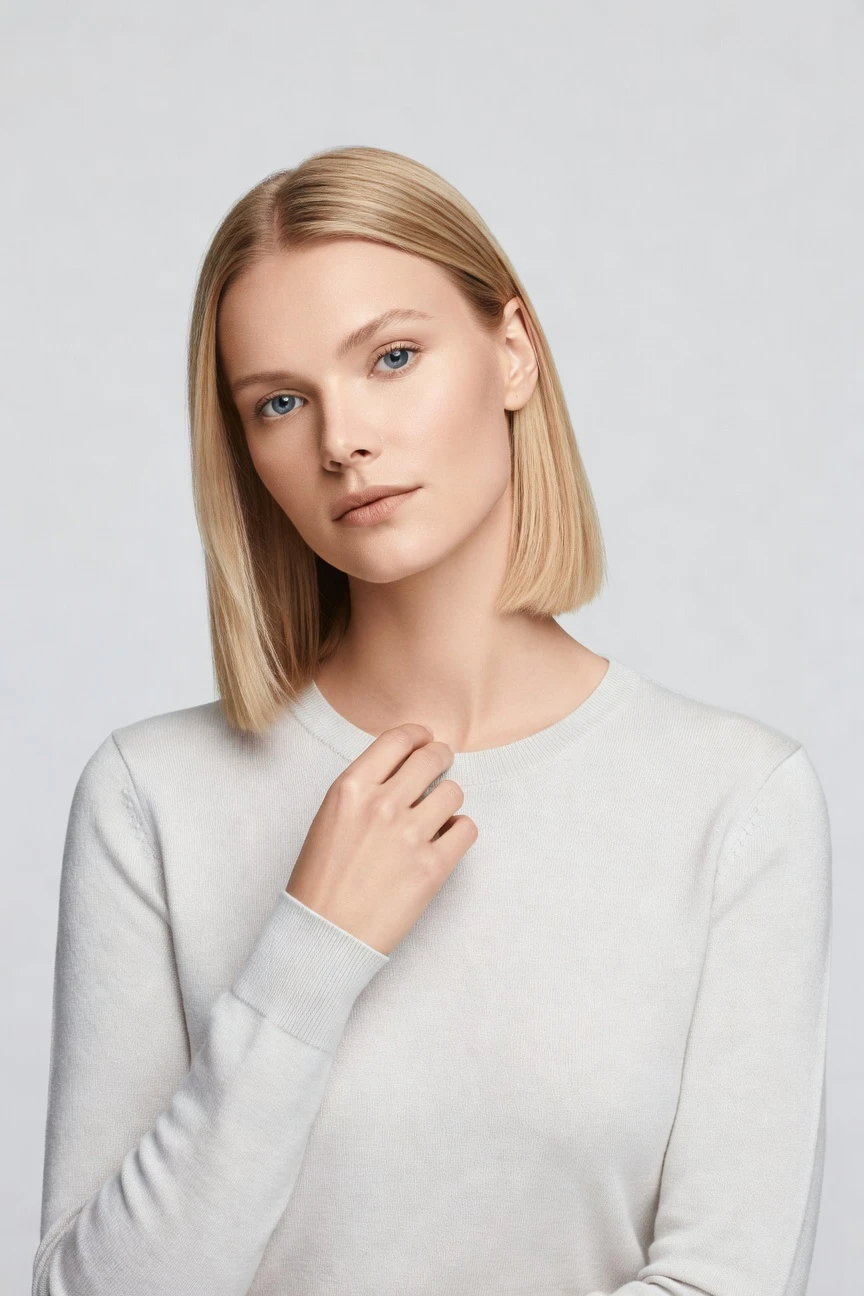
Saved model setup
Female · 26–35 · Blonde · 175cm
Build a model. Zero prompts.
This setup starts from a Scandinavian female presentation with a fair skin tone, average build, and soft commercial styling. You click the attributes once, save the model, and keep the same face and proportions across every SKU. 28 attributes · 10+ options each
- 8 clicks · 0 keystrokes
- app.rawshot.ai / build_model
How it works
Build Once, Reuse Across Every SKU
Create a Scandinavian female model in clicks, save it to your library, and keep the same identity steady from single looks to full catalog runs.
- Step 01
Select the Identity
Choose Scandinavian ethnicity, female presentation, skin tone, age range, body type, hair, eyes, and expression from visual controls. The interface behaves like a fashion tool, not a chat box.
- Step 02
Save the Model Once
Generate the synthetic composite, review the result, and save it to your library. That gives your team one reusable identity for every future garment, style preset, and framing.
- Step 03
Reuse Across the Catalog
Apply the same saved model in the browser GUI or through the REST API. Your lookbook test and your 10,000-SKU pipeline run on the same model logic, with the same consistency rules.
Spec sheet
Proof for Consistent Nordic-Fit Model Workflows
These twelve proofs show why reusable synthetic models matter for fashion teams that need identity control, garment fidelity, and honest provenance.
- 01
28 Attributes, Built for Control
You shape the model through 28 body attributes with 10+ options each. That composite approach keeps identity deliberate while making accidental real-person likeness statistically negligible by design.
- 02
Every Setting Is a Click
You direct the model with buttons, sliders, and presets. No one on your team has to learn syntax before they can build a usable fashion identity.
- 03
The Garment Stays the Brief
RAWSHOT is engineered around cut, colour, pattern, logo, fabric, and drape. The model serves the product instead of bending the product around a text box.
- 04
Synthetic Models, Transparently Labelled
Build diverse female-presenting composites for catalog, campaign, and retail tests. Each output is clearly labelled so your brand stays honest about what it publishes.
- 05
Same Face Across Every SKU
Save one model and apply it again and again. You get continuity across dresses, knitwear, outerwear, and accessories without face drift between outputs.
- 06
150+ Visual Styles
Once the model is saved, switch the visual treatment around it. Move from clean studio catalog to editorial, lifestyle, street, or campaign looks without rebuilding identity.
- 07
2K, 4K, and Every Ratio
Use the same model in portrait, square, landscape, PDP crops, and campaign frames. Resolution and aspect ratio adapt to the channel without changing who is wearing the garment.
- 08
EU-First Compliance by Design
Outputs are AI-labelled, watermarked, and aligned with EU AI Act Article 50 and California SB 942 disclosure expectations. The trust layer is part of the product, not an afterthought.
- 09
Signed Audit Trail per Image
Each image carries C2PA provenance metadata and a trackable record of what it is. That gives ecommerce, legal, and marketplace teams clearer evidence at publish time.
- 10
GUI for One Shoot, API for Scale
Build and approve a model in the browser, then reuse it in batch through the REST API. The indie founder and the enterprise catalog team work from the same system.
- 11
Fast, Clear Token Economics
Model generation runs in about 50–60 seconds at roughly $0.99 each. Tokens never expire, and failed generations refund their tokens automatically.
- 12
Permanent Worldwide Rights
Every approved output comes with full commercial rights for permanent worldwide use. That makes reuse across PDPs, ads, marketplaces, and internal sales assets straightforward.
Outputs
One Saved Model, many outputs.
Build the identity once, then apply it across product categories, crops, and visual styles. The point is not novelty. The point is stable brand-facing consistency.


Browse all 600+ models →
Comparison
RAWSHOT vs category tools vs DIY prompting
Three lenses on every dimension — what you optimize for in RAWSHOT versus typical category tools and blank-box AI workflows.
01
Interface
RAWSHOT
Click-driven model builder with visual attribute controls and saved presetsCategory tools + DIY
Usually mix lightweight controls with partial text-led creative direction. DIY prompting: Typed instructions in ChatGPT or generic image tools, then repeated revisions by trial and error02
Garment fidelity
RAWSHOT
Built around real garments, preserving cut, colour, logos, and drapeCategory tools + DIY
Often prioritize mood and styling over exact apparel representation. DIY prompting: Garments drift, logos mutate, trims vanish, and proportions change between outputs03
Model consistency across SKUs
RAWSHOT
Save one synthetic model and reuse it across the full catalogCategory tools + DIY
Identity consistency varies by tool and often weakens across larger sets. DIY prompting: Faces and body proportions shift constantly, so matching PDP series becomes manual rework04
Provenance and labelling
RAWSHOT
C2PA-signed, watermarked, and clearly AI-labelled on every outputCategory tools + DIY
Disclosure and provenance support are inconsistent or not surfaced clearly. DIY prompting: No built-in provenance metadata, weak attribution clarity, and unclear downstream disclosure handling05
Commercial rights
RAWSHOT
Permanent worldwide commercial rights included for approved outputsCategory tools + DIY
Rights language can differ by plan, seat, or workflow layer. DIY prompting: Usage boundaries are often unclear across model providers and generic generation stacks06
Pricing transparency
RAWSHOT
Per-model pricing, tokens never expire, one-click cancel, refunds on failuresCategory tools + DIY
Seats, usage bands, or gated plans can complicate cost forecasting. DIY prompting: Costs spread across multiple tools, retries, and manual cleanup with little predictability07
Catalog scale
RAWSHOT
Same engine works in browser GUI and REST API batch pipelinesCategory tools + DIY
Scale features may sit behind higher plans or separate enterprise flows. DIY prompting: No reliable catalog pipeline; teams copy prompts manually and track versions in spreadsheets08
Operational overhead
RAWSHOT
Merch, creative, and ecommerce teams use the same reproducible controlsCategory tools + DIY
Workflows often depend on specialist operators to keep results aligned. DIY prompting: Prompt-engineering overhead absorbs time before teams even start reviewing product accuracy
Prompting does not scale
Stop writing essays. Direct the shoot.
Most AI photo tools start with a blank text box. Rawshot turns the shoot into repeatable controls, so creative teams can produce consistent fashion imagery without prompt syntax or one-off hacks.
Category norm
ManualCreate a premium editorial fashion photograph of a model wearing the exact navy oversized wool coat from SKU-1842, full-body crop, realistic hands, consistent facial identity, clean e-commerce lighting, subtle Paris street background, 85mm lens, no logo distortion, no fabric hallucination, same pose as last campaign, repeatable for all colorways...
A prompt can describe one image. It cannot become a shared production system for hundreds of products, models, angles and markets.
Rawshot
ClicksSaved shoot recipe
Apply to 1 SKU or 10,000 via GUI, CSV or REST API.
Rawshot makes creative direction visible: buttons, presets and sliders instead of hidden prompt craft. The result is easier to teach, faster to approve and built for repeat production.
Use cases
Where Reusable Female Model Identity Pays Off
Operator archetypes and how click-directed, garment-first output fits the way they actually work.
- 01
Indie knitwear labels
Launch a small run with one saved female model across sweaters, cardigans, and scarves before any studio day is even on the calendar.
Confidence · high
- 02
Nordic-inspired DTC brands
Keep the same Scandinavian-coded identity across seasonal drops so your homepage, PDPs, and paid social read as one coherent brand world.
Confidence · high
- 03
Marketplace apparel sellers
Standardize female-presenting product imagery across mixed suppliers without rebooking talent every time inventory shifts.
Confidence · high
- 04
Preorder and crowdfunding teams
Show how garments will sit on a consistent body before production samples are shipped across borders.
Confidence · high
- 05
Outerwear catalogs
Reuse one saved model for jackets, coats, and layering stories so fit perception stays stable between SKUs.
Confidence · high
- 06
Denim launches
Compare rises, washes, and silhouettes on the same proportions instead of introducing face and body drift into every listing.
Confidence · high
- 07
Accessories brands
Pair handbags, sunglasses, and jewellery with one repeatable female identity to keep product pages visually aligned.
Confidence · high
- 08
Private-label manufacturers
Generate retailer-ready imagery for multiple collections with a stable model library that merch teams can approve once and reuse.
Confidence · high
- 09
Resale and vintage operators
Present mixed one-off pieces on a consistent Scandinavian female model so the catalog feels curated instead of patchworked together.
Confidence · high
- 10
Editorial test shoots
Try campaign directions around one saved identity before committing budget to a larger seasonal production.
Confidence · high
- 11
Children's and family adjacencies
Build adult female-presenting supporting talent for parent-facing product stories without the delays of traditional casting logistics.
Confidence · high
- 12
Enterprise catalog teams
Approve one model definition centrally, then deploy it through the API across large SKU batches without losing identity control.
Confidence · high
— Principle
Honest is better than perfect.
For model-building pages like this, trust matters as much as aesthetics. Every RAWSHOT output is AI-labelled, carries visible and cryptographic watermarking, and includes C2PA provenance metadata. The model itself is a synthetic composite across many selectable attributes, designed to avoid real-person likeness while giving commerce teams a reusable identity they can document and publish responsibly.
Rights & provenance
Full commercial rights. Forever.
- C2PA-signed on every image — EU AI Act Article 50 compliant
- 28-attribute synthetic models — real-person likeness statistically impossible
- Full commercial rights to every generation — no recurring licensing fees
- Tokens never expire · One-click cancel · Transparent pricing
EU AI Act
C2PA
Commercial use
Pricing
~$0.99 per model generation.
~50–60 seconds per generation. Save the model once, reuse it across your entire catalog.
- 01Tokens never expire. Cancel in one click.
- 02Same face, same body, every SKU — no drift between shoots.
- 03No per-seat gates. No 'contact sales' walls for core features.
- 04Failed generations refund their tokens.
FAQ
Practical answers on control, rights, pricing, scale, and compliant publishing.
Do I need to write prompts to use RAWSHOT?
Never—you direct every output with sliders, presets, and clicks on the garment, not typed prompts. That matters for fashion teams because buyers, merchandisers, founders, and ecommerce managers should be able to work in the tool without translating visual decisions into command-style language. In RAWSHOT, model attributes, framing, lighting, visual style, and product focus are exposed as interface controls, so the process behaves like software your team can actually operate under deadline.
For catalog work, repeatability matters more than clever wording. The same click-driven structure applies whether you are building one reusable model in the browser or passing approved settings into a REST API workflow at scale. That keeps onboarding simpler, review cycles shorter, and output logic easier to document across creative, legal, and operations teams. The practical takeaway is straightforward: your team learns a production interface, not a new writing discipline.
What does AI-assisted fashion photography change for SKU-scale catalogs?
It changes who gets access to consistent on-model imagery, and it changes how reliably teams can scale it. Traditional shoots ask you to coordinate talent, garments, samples, schedules, retakes, and budget before you get a usable catalog set. RAWSHOT gives you a way to build a reusable synthetic model, keep that identity steady across products, and generate publishable imagery without turning every seasonal update into a new production event.
For SKU-heavy catalogs, the real gain is operational consistency. You can save one female-presenting model, apply it across categories, switch visual styles when needed, and keep the same identity from a single browser session to a large REST API pipeline. Because outputs are clearly labelled, watermarked, and C2PA-signed, the workflow is not only faster to repeat but easier to govern internally. That means catalog expansion becomes a controlled system, not a chain of exceptions.
Why skip reshooting every SKU for season updates and collection refreshes?
Because most seasonal refreshes do not need a full physical production cycle to create useful product imagery. If the product line changes in colour, fabrication, styling context, or assortment depth, the expensive part is not always creativity; it is reassembling logistics. RAWSHOT lets teams keep a saved model identity and update garments, framing, or visual treatment without rebuilding the entire production stack from scratch.
That is especially valuable for operators managing frequent drops, restocks, or market-specific edits. You can hold the face, body proportions, and overall model definition steady while changing the garment mix around it, which makes side-by-side catalog presentation cleaner and easier for shoppers to parse. The result is not about replacing high-end shoots where they matter most. It is about giving teams a dependable option for the many updates that otherwise never get photographed at all.
How do we turn flat garments into catalogue-ready imagery without prompting?
You start by uploading the garment and selecting the presentation through controls rather than typed instructions. In the same workflow, you choose the model identity, framing, camera distance, pose, expression, lighting, background, and style preset. Because the garment stays central to the system, RAWSHOT is designed to preserve cut, colour, pattern, logo placement, fabric feel, and proportion instead of treating the clothing as a vague suggestion.
For commerce teams, that means the path from flat asset to on-model output is operationally legible. A buyer can review the model choice, a creative lead can approve the styling direction, and an ecommerce manager can publish with a clear audit trail and rights position. You are not trying to coax the software into understanding apparel. You are using a fashion-specific application where the product is already the brief.
Why does garment-led control beat DIY prompting in ChatGPT, Midjourney, or generic image AI for fashion PDPs?
Because PDP work depends on consistency, product accuracy, and reproducibility, not on one surprisingly good image. Generic image systems tend to reward broad visual mood, but fashion teams need the opposite: stable garments, stable faces, readable logos, and predictable reruns across a whole range. When results depend on typed guesswork, teams spend time correcting invented trims, drifting proportions, mutated branding, and identity changes that make adjacent SKUs feel unrelated.
RAWSHOT is built to remove that roulette. You click through model attributes, styling controls, and output settings in a fixed interface, then reuse what worked instead of rebuilding intent each time. Add C2PA provenance, visible and cryptographic watermarking, and permanent worldwide commercial rights, and the workflow becomes easier to review and easier to operationalize. For fashion PDPs, the winning system is the one your team can repeat without surprises.
Can I use an ai swedish female generator for commercial fashion work with clear labelling and rights?
Yes. RAWSHOT is built for commercial use, and approved outputs come with full commercial rights that are permanent and worldwide. That matters because brands, agencies, and marketplace operators need a clean answer on whether imagery can move from internal review to PDPs, ads, lookbooks, and retail presentations without uncertain licensing language hanging over every asset.
RAWSHOT also treats disclosure as part of the product. Outputs are AI-labelled, include visible and cryptographic watermarking, and carry C2PA-signed provenance metadata so teams can document what the asset is. For operators using a Swedish-coded female model identity across multiple channels, that combination of rights clarity and provenance discipline is what makes the workflow publishable, not just technically possible. The operational rule is simple: clear the model once, then publish with confidence and records attached.
What should our team check before publishing synthetic model imagery on a product page?
Check the same things a disciplined commerce team should always check, then add provenance review. First, verify the garment itself: silhouette, colour, fabric read, logo placement, closure details, and any category-specific fit cues that affect purchase confidence. Second, review the model consistency across adjacent products so your catalog does not unintentionally swap identities or body proportions between listings that are meant to feel unified.
Then review the trust layer. Confirm the output is appropriately labelled, that watermarking is present, and that the asset includes C2PA provenance metadata for your records. In RAWSHOT, these controls are built into the workflow rather than bolted on later, which gives ecommerce and legal teams something concrete to approve. The best publishing practice is to treat synthetic imagery like any other sell-through asset: product-accurate, documented, and governed before it goes live.
How much does a reusable model setup cost, and what happens to tokens if generations fail?
Model generation in RAWSHOT costs about $0.99 per generation and typically takes around 50–60 seconds. That pricing is direct enough for a merch or ecommerce team to budget without guessing how many seats, tiers, or sales calls stand between them and actual use. Tokens never expire, which matters when model-building work happens in waves around launches rather than on a neat monthly schedule.
If a generation fails, the tokens are refunded. That sounds like a small policy detail, but it is important operationally because model selection often happens during experimentation, and teams need to know unsuccessful runs do not silently erode budget. Add one-click cancellation directly on the pricing page and no per-seat gate for core features, and the economics stay usable for both small labels and larger catalog programs. The practical benefit is predictable spend while your team iterates.
Can we plug this into Shopify-scale catalogs or internal merchandising systems through an API?
Yes. RAWSHOT supports a browser GUI for single-shoot or review-heavy work and a REST API for catalog-scale pipelines. That split matters because most brands need both: a human-friendly place to define and approve a reusable model, and a programmable surface to apply that approved identity across larger product sets without recreating the work manually. The same engine underpins both paths, so your pilot workflow and your production workflow do not diverge.
For a Shopify-scale operation or an internal merchandising stack, that means approved model definitions can become part of a repeatable asset pipeline rather than a one-off creative experiment. RAWSHOT is also PLM-integration ready and provides a signed audit trail per image, which helps teams keep creative decisions tied to operational records. In practice, the right move is to define once in the GUI, then automate reuse where volume begins.
Is the ai swedish female generator useful for both a founder working in the browser and a catalog team running 10,000 SKUs overnight?
Yes, because RAWSHOT is designed as one product across both scales rather than a lightweight version for small users and a gated version for larger ones. A founder can build a Swedish-coded female model in the browser, save it to the library, test visual styles, and start shipping assets immediately. A larger catalog team can take the same saved identity and run it through structured API workflows for high-volume output without changing engines, pricing logic, or output standards.
That consistency is the point. The same per-model pricing applies, tokens do not expire, core features are not hidden behind seat restrictions, and provenance rules remain in place at every volume. For teams with mixed roles, it also means creative, merchandising, and operations can share one model definition instead of maintaining separate systems. The best implementation pattern is simple: approve identity centrally, then let scale happen without reopening the identity question every night.