
— 28 attributes · 10+ options each · Save once
AI Human Photo Generator — with click-driven control over every attribute.
Build the human presence your catalog needs, then keep it consistent across every SKU, season, and channel. You select body attributes, expression, and styling cues in a real interface, save the model once, and reuse it across the whole catalog. Every model is a transparently labelled synthetic composite with C2PA-signed output and no real-person likeness by design.
- ~$0.99 per generation
- ~50–60s
- 28 attributes × 10+ options each
- Save once, reuse across catalog
- 150+ styles
- 2K and 4K
7-day free trial • 50 tokens (10 images) • Cancel anytime

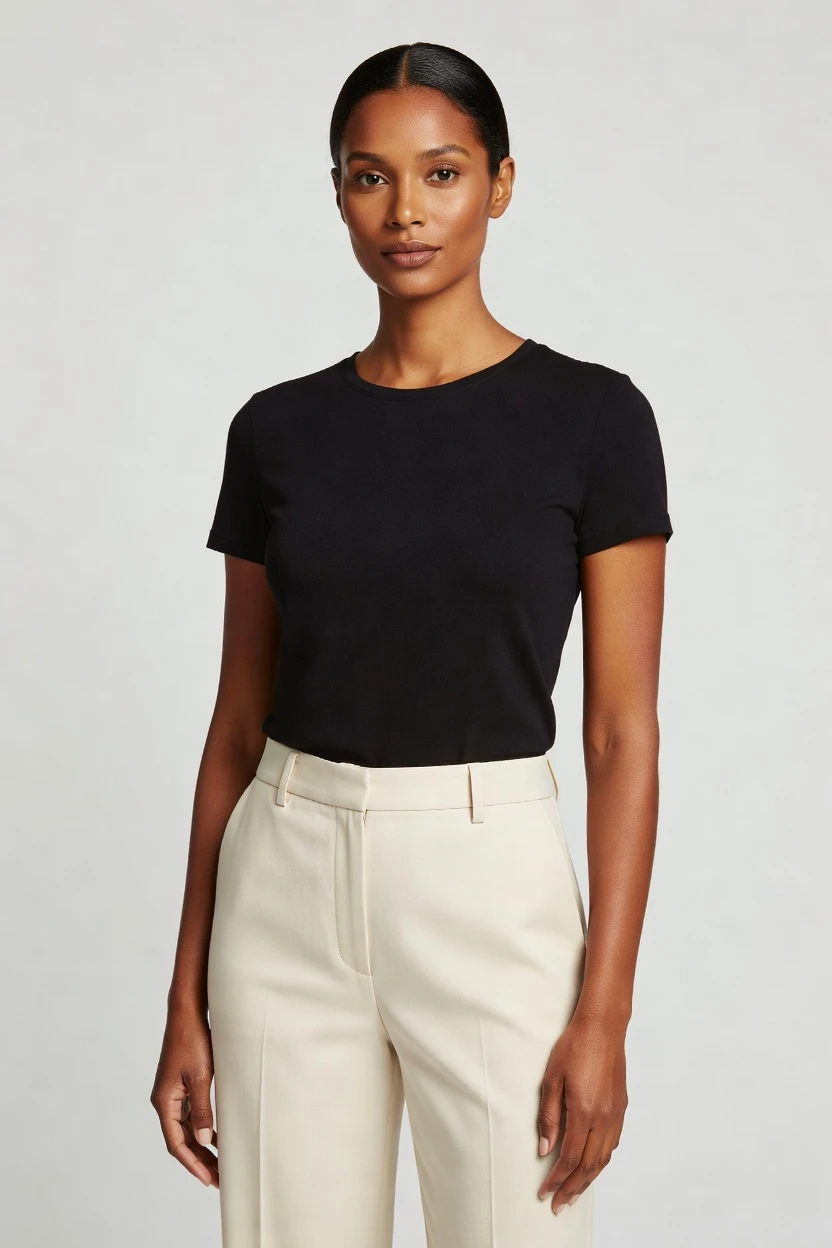
Saved model setup
Female · 26–35 · Dark brown · 175cm
Build a model. Zero prompts.
This setup starts from a copper skin tone and builds a reusable fashion model with balanced proportions, neutral expression, and catalog-ready features. You click through the core attributes once, save to your library, and keep the same face and body across the entire assortment. 28 attributes · 10+ options each
- 6 clicks · 0 keystrokes
- app.rawshot.ai / build_model
How it works
Build Once, Reuse Across Every SKU
Start with the human profile, save it to your library, then keep the same face and body consistent across catalog production.
- Step 01
Set the Human Baseline
Choose the core body attributes, skin tone, age range, height, hair, and expression from visual controls. You are defining a reusable model identity, not improvising one output at a time.
- Step 02
Save the Model to Your Library
Lock the face and body once so the same person carries through every garment change. That consistency matters for PDPs, collection pages, and seasonal refreshes.
- Step 03
Reuse Across the Whole Catalog
Apply the saved model in the browser for one shoot or through the API for catalog-scale production. The same model stays stable while garments, framing, styles, and channels change around it.
Spec sheet
Proof for Human-Led Catalog Consistency
These twelve proof points show how RAWSHOT keeps the model stable, the garment faithful, and the operation usable at any scale.
- 01
No Real-Person Likeness
Every saved model is a synthetic composite built from 28 body attributes with 10+ options each. Accidental real-person likeness is statistically negligible by design.
- 02
Every Setting Is a Click
You direct the model with buttons, sliders, and presets inside a real application. No empty text box, no syntax work, no chat-style guesswork.
- 03
Garment Fidelity Comes First
RAWSHOT is engineered around the product, so cut, colour, pattern, logo, fabric, and drape stay represented faithfully. The garment is the brief.
- 04
Diverse Synthetic Models
Build across a wide range of body attributes, tones, ages, and presentations with transparently labelled synthetic models. That gives more brands access to on-model imagery without sourcing talent for every test.
- 05
Same Face Across SKUs
Save a model once and reuse it across your assortment without face drift or body changes between outputs. Your catalog reads like one brand world, not a stack of near matches.
- 06
150+ Visual Styles
Move the same saved model through catalog, lifestyle, editorial, campaign, street, Y2K, vintage, noir, and more. Style changes while identity stays stable.
- 07
2K, 4K, Every Ratio
Generate outputs in 2K or 4K and publish in the aspect ratio each channel needs. One model can serve PDPs, lookbooks, paid social, and marketplace slots.
- 08
Labelled and Compliant
Outputs are C2PA-signed, AI-labelled, and built for EU AI Act Article 50 and California SB 942 compliance. Honesty is part of the product, not a disclaimer.
- 09
Signed Audit Trail per Image
Each output carries a signed audit trail for review, governance, and handoff. That matters when creative, commerce, and legal teams all touch the same asset pipeline.
- 10
GUI for One Shoot, API for Scale
Use the browser GUI when you are directing one collection, then move the same model logic into the REST API for nightly catalog runs. No separate product tier is required.
- 11
Fast, Clear Unit Economics
Photo generation runs at about ~$0.55 per image in ~30–40 seconds, and tokens never expire. The same transparent pricing logic carries from single tests to production volume.
- 12
Full Commercial Rights Included
Every output comes with full commercial rights, permanent and worldwide. Rights clarity stays simple whether you publish one image or a full global assortment.
Outputs
One Saved Model, Many Outputs
The same human baseline can carry editorial, catalog, and campaign work without losing identity. You keep consistency at the model level while changing garments, framing, and style presets around it.


Browse all 600+ models →
Comparison
RAWSHOT vs category tools vs DIY prompting
Three lenses on every dimension — what you optimize for in RAWSHOT versus typical category tools and blank-box AI workflows.
01
Interface
RAWSHOT
Click-driven controls for body attributes, styling, framing, and reuseCategory tools + DIY
Often mix lighter controls with less precise fashion-specific direction. DIY prompting: You type instructions manually and spend time steering the model into something usable02
Model Consistency
RAWSHOT
Save one model and reuse the same face and body everywhereCategory tools + DIY
Consistency exists, but often with weaker locking across larger assortments. DIY prompting: Faces change between outputs, so catalogs drift from SKU to SKU03
Garment Fidelity
RAWSHOT
Built around the garment so logos, cut, colour, and drape holdCategory tools + DIY
Can handle fashion imagery, but product details often soften under style changes. DIY prompting: Garment drift and invented logos appear between variations and reruns04
Provenance + Labelling
RAWSHOT
C2PA-signed, AI-labelled, visibly and cryptographically watermarkedCategory tools + DIY
Provenance and labelling are often partial or absent. DIY prompting: No clear provenance metadata, no labelling standard, no audit-ready record05
Commercial Rights
RAWSHOT
Full commercial rights to every output, permanent and worldwideCategory tools + DIY
Rights terms vary by plan, seat, or contract layer. DIY prompting: Rights clarity is often unclear for commerce teams and downstream partners06
Pricing Transparency
RAWSHOT
Flat per-generation pricing, tokens never expire, failed runs refundCategory tools + DIY
Per-seat plans, tiering, or volume rules can complicate scaling. DIY prompting: Usage costs are detached from fashion workflow outcomes and hard to forecast07
Catalog API
RAWSHOT
Browser GUI and REST API use the same core model systemCategory tools + DIY
API access may sit behind higher tiers or separate enterprise packaging. DIY prompting: No dependable catalog pipeline for repeatable SKU-scale production08
Iteration Reliability
RAWSHOT
Reusable saved models keep variants aligned across seasons and channelsCategory tools + DIY
Variants can work, but identity control is less durable over long runs. DIY prompting: Each new attempt restarts the process with more prompt-engineering overhead
Prompting does not scale
Stop writing essays. Direct the shoot.
Most AI photo tools start with a blank text box. Rawshot turns the shoot into repeatable controls, so creative teams can produce consistent fashion imagery without prompt syntax or one-off hacks.
Category norm
ManualCreate a premium editorial fashion photograph of a model wearing the exact navy oversized wool coat from SKU-1842, full-body crop, realistic hands, consistent facial identity, clean e-commerce lighting, subtle Paris street background, 85mm lens, no logo distortion, no fabric hallucination, same pose as last campaign, repeatable for all colorways...
A prompt can describe one image. It cannot become a shared production system for hundreds of products, models, angles and markets.
Rawshot
ClicksSaved shoot recipe
Apply to 1 SKU or 10,000 via GUI, CSV or REST API.
Rawshot makes creative direction visible: buttons, presets and sliders instead of hidden prompt craft. The result is easier to teach, faster to approve and built for repeat production.
Use cases
Who Builds Human Consistency With RAWSHOT
Operator archetypes and how click-directed, garment-first output fits the way they actually work.
- 01
Indie Designer Launching a First Drop
Build one consistent human model for your first collection so every SKU looks part of the same brand, even before you can afford a studio day.
Confidence · high
- 02
DTC Apparel Team Refreshing PDPs
Reuse a saved model across the full assortment when fits, colors, or seasonal styling updates need fresh on-model imagery without recasting.
Confidence · high
- 03
Marketplace Seller Managing Many SKUs
Keep one stable face and body across a broad catalog so product listings feel coherent instead of stitched together from mismatched outputs.
Confidence · high
- 04
Factory-Direct Manufacturer Pitching New Lines
Show garments on a consistent synthetic model before arranging physical sample shoots, helping buyers evaluate fit direction and presentation faster.
Confidence · high
- 05
Resale and Vintage Operator Standardising Listings
Use the same human baseline to bring visual order to mixed inventory where original brand photography is missing or unusable.
Confidence · high
- 06
Adaptive Fashion Brand Testing Representation
Build human photo outputs that reflect the audience you serve, then keep that identity stable while iterating garment combinations and framing.
Confidence · high
- 07
Kidswear Creative Team Planning Future Shoots
Prototype styling direction and assortment logic with labelled synthetic models before booking production for the final campaign.
Confidence · high
- 08
Lingerie DTC Brand Building Catalog Trust
Maintain the same model identity across related products so shoppers compare fit, silhouette, and styling on a stable visual reference.
Confidence · high
- 09
Crowdfunding Founder Proving the Concept
Create a polished human-led product story for your launch page when you need brand consistency before full-scale production exists.
Confidence · high
- 10
Editorial Commerce Team Running Seasonal Stories
Carry one saved model from clean catalog frames into more expressive style presets while preserving a recognizable human presence.
Confidence · high
- 11
PLM-Connected Catalog Operation at Scale
Push a saved model through API-driven production so thousands of SKUs inherit the same face, body, and governance rules automatically.
Confidence · high
- 12
Student Brand Building a Portfolio
Use a click-driven human model workflow to present garments professionally when traditional casting, styling, and studio access are out of reach.
Confidence · high
— Principle
Honest is better than perfect.
Human-led fashion imagery needs trust as much as polish. RAWSHOT labels outputs, signs them with C2PA provenance, and adds visible plus cryptographic watermarking so teams can publish clearly and govern reuse properly. For brands building reusable synthetic models, that honesty is stronger infrastructure than pretending the image came from somewhere else.
Rights & provenance
Full commercial rights. Forever.
- C2PA-signed on every image — EU AI Act Article 50 compliant
- 28-attribute synthetic models — real-person likeness statistically impossible
- Full commercial rights to every generation — no recurring licensing fees
- Tokens never expire · One-click cancel · Transparent pricing
EU AI Act
C2PA
Commercial use
Pricing
~$0.99 per model generation.
~50–60 seconds per generation. Save the model once, reuse it across your entire catalog.
- 01Tokens never expire. Cancel in one click.
- 02Same face, same body, every SKU — no drift between shoots.
- 03No per-seat gates. No 'contact sales' walls for core features.
- 04Failed generations refund their tokens.
FAQ
Practical answers on control, rights, pricing, scale, and compliant publishing.
Do I need to write prompts to use RAWSHOT?
Never. You direct every output with sliders, presets, and clicks on the garment, not typed instructions. That matters for fashion teams because repeatability beats improvisation when you are trying to keep model identity, framing, and product detail steady across a live assortment. Instead of translating a visual decision into syntax, you select body attributes, camera choices, style presets, lighting, expression, and other controls in the interface.
For commerce operations, that means buyers, marketers, and catalog managers can use the same workflow without becoming text-box specialists. The same click-driven logic also maps cleanly into the REST API, so single-look experimentation in the browser and SKU-scale production follow the same operating model. In practice, teams move faster, spend less time correcting drift, and keep output rules visible enough for handoff, review, and launch planning.
What does an AI human photo generator actually change for fashion catalog teams?
It changes who gets access to consistent on-model imagery and how reliably teams can produce it. Traditional fashion photography is often priced far beyond indie labels, marketplace sellers, and growing DTC operations, while generic image tools make the user do too much interpretive work before the result is even usable. RAWSHOT gives teams a saved synthetic model they can reuse across the catalog, so the human presence stays stable while the garments change.
That shift matters operationally because consistency is what turns isolated images into a usable catalog system. You can build one model, keep the same face and body across seasons and channels, and generate labelled outputs with clear rights and provenance. Instead of resourcing each update like a new shoot, teams treat the human baseline as reusable infrastructure and focus attention on the garment, publication timing, and channel-specific styling.
Why skip reshooting every SKU when the season changes?
Because most seasonal updates are about presentation, not rebuilding the entire production chain from scratch. When the product line expands or styling direction changes, teams still need visual coherence across PDPs, collection pages, and paid placements. RAWSHOT lets you keep the same saved model while changing garments, framing, lighting, and style presets, so you can refresh assortment imagery without re-casting and re-staging every look.
That approach is especially useful for brands managing frequent drops, broad colorways, or marketplace deadlines. The model identity remains stable, which improves visual continuity for shoppers and reduces review friction for internal teams. With C2PA-signed, labelled outputs and a consistent browser-plus-API workflow, seasonal refreshes become a governed production step rather than an all-or-nothing shoot decision.
How do we turn flat garments into catalogue-ready imagery without prompting?
You start by building or selecting a reusable synthetic model, then apply garment images through RAWSHOT’s click-driven workflow. From there, you control framing, styling direction, expression, lighting, and output format with interface controls instead of typed instructions. The system is built around the garment, so the product remains the central brief while the human presentation is kept stable and reusable.
For catalog teams, that means the path from source garment imagery to publishable on-model output is structured enough for repeat work. You can move from single tests in the browser GUI to batch production through the REST API without changing the basic logic of the job. In practice, the best workflow is to lock the model first, validate garment fidelity on a small set, then scale the same setup across the range once review criteria are met.
Why does RAWSHOT beat ChatGPT, Midjourney, or generic image tools for fashion PDPs?
Because fashion commerce needs controllable repetition, not occasional lucky images. Generic image systems are built around typed instruction loops, which often leads to garment drift, invented logos, inconsistent faces, and a lot of manual retrying before a team gets something close to publishable. RAWSHOT is different because it is a real application for fashion teams, with click-driven controls, reusable saved models, and product-first logic that keeps the garment central.
The difference becomes obvious when you need the same face and body across many SKUs, channel ratios, and update cycles. RAWSHOT also adds C2PA provenance, visible and cryptographic watermarking, and a cleaner commercial-rights story, which generic DIY workflows usually do not provide in a usable commerce format. For PDP work, the practical win is not novelty; it is reliable, governed output that your team can reproduce on demand.
Can we use RAWSHOT outputs commercially and publish them worldwide?
Yes. RAWSHOT includes full commercial rights to every output, permanent and worldwide, which is essential for brands publishing across owned stores, marketplaces, paid media, and wholesale materials. Rights clarity matters because fashion assets move through many hands after generation, from creative and ecommerce teams to agencies, retailers, and regional operators. A clean rights position reduces hesitation at the moment of publishing.
RAWSHOT also pairs that rights clarity with transparent labelling and provenance rather than hiding what the asset is. Outputs are AI-labelled, C2PA-signed, and watermarked visibly plus cryptographically, so teams can use them commercially without creating ambiguity around origin. The practical takeaway is simple: treat the files like governed commercial assets, keep the provenance record intact, and publish with the same confidence you expect from any professional content workflow.
What quality checks should a buyer or ecommerce lead run before publishing saved-model imagery?
Start with the garment itself. Check cut, colour, pattern, logo placement, fabric behaviour, and drape against the source material, then confirm that the saved model remains consistent across the selected SKU set. After that, verify framing, ratio, and styling alignment for the destination channel, whether that is a PDP, marketplace tile, collection page, or campaign crop.
Teams should also review trust signals, not just appearance. Confirm the output is properly labelled, retain the C2PA provenance record, and make sure watermarking and audit-trail expectations are understood internally before distribution. The strongest operating habit is to approve a reference set first, then use that approved combination of model, style, and output settings as the baseline for scaled generation through the GUI or API.
How much does the model workflow cost, and what happens to unused tokens?
Model generation costs about ~$0.99 per model generation and usually completes in about 50–60 seconds. Tokens never expire, which matters for fashion teams because assortment planning and creative testing rarely happen on a perfectly regular calendar. You can build the core model now, return later for garment production, and keep the same credit value available when the catalog is ready.
RAWSHOT also keeps the commercial terms simple for operators. There are no per-seat gates for core features, the cancel button is available on the pricing page, and failed generations refund their tokens. The useful planning approach is to budget model creation as the reusable identity layer, then treat stills and video as downstream production choices once the human baseline is approved.
Can we plug this into Shopify-scale or PLM-driven catalog pipelines?
Yes. RAWSHOT is built for both single-shoot browser work and catalog-scale production through the REST API, so teams can connect the same model logic to broader commerce systems. That matters when product data, merchandising calendars, and image-generation tasks need to move together instead of being handled as disconnected creative experiments. A saved model becomes a stable reference object in the workflow rather than a one-off asset.
For operational teams, the best use is to standardise approved models, map them to product groups, and run controlled generation sequences as assortments update. Because each image carries a signed audit trail and provenance signals, governance remains intact even when output volume grows. The result is a cleaner path from source product data to publishable human-led imagery across storefronts and internal systems.
Will this still work when one team uses the GUI and another runs API batches?
Yes. RAWSHOT is designed so the indie designer building one shoot in the browser and the enterprise catalog team running batch production are using the same engine, the same model logic, and the same core pricing structure. That continuity matters because handoffs usually break when creative exploration and operations scale live in separate products with separate rules. Here, the saved model remains the anchor regardless of who is driving the next step.
In practice, creative or merchandising teams can establish the approved human baseline in the GUI, then operations teams can reuse that same model through the REST API for larger runs. There is no need to rebuild the identity or reinterpret it in another tool. That keeps visual consistency, governance, and throughput aligned as more roles join the process and output volume increases.
Keep exploring