
— Body shape · Reuse across SKUs · Save once
AI Lean Female Generator — with click-driven control over every attribute.
A lean female fit reference helps brands show proportion, drape, and silhouette with more precision across repeated product drops. You set body shape, height, age range, hair, and expression with 28 attributes and 10+ options each, then save the model once and reuse it across the whole catalog. Every model is a synthetic composite, transparently labelled and C2PA-signed.
- ~$0.99 per model
- ~50–60s per generation
- 150+ styles
- 28 attributes × 10+ options
- Save once, reuse across catalog
- C2PA-signed
7-day free trial • 50 tokens (10 images) • Cancel anytime

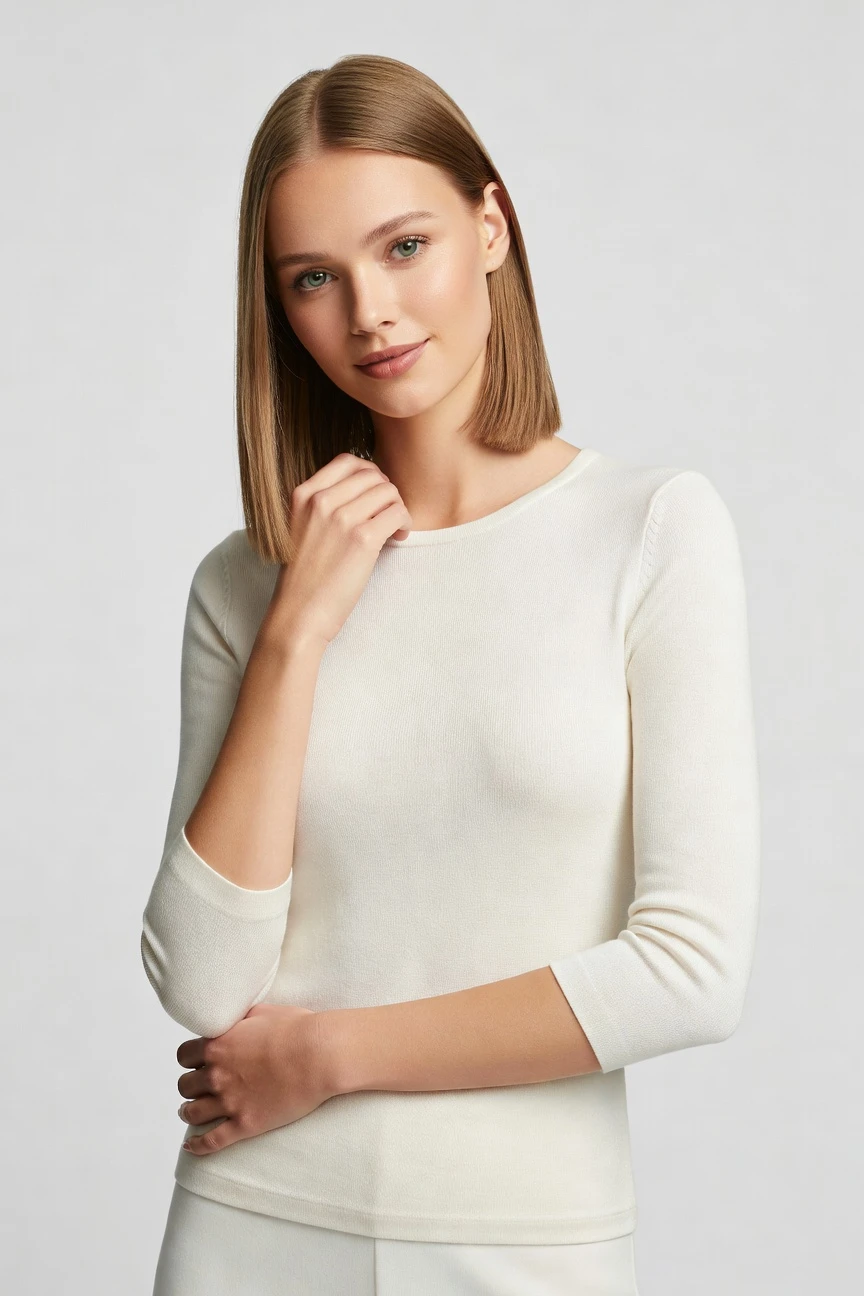
Saved model setup
Female · 26–35 · Dark brown · 175cm
Build a model. Zero prompts.
This setup starts from a female presentation with a leaner silhouette, then locks in age, height, hair, and color choices for repeatable on-model output. You click the attributes once, save the model to your library, and reuse it anywhere the garment needs the same body reference. 28 attributes · 10+ options each
- 5 clicks · 0 keystrokes
- app.rawshot.ai / build_model
How it works
Build Once, Reuse Across Every SKU
A lean-fit model works best when the body reference stays stable from first sample images to full catalog rollout.
- Step 01
Set the Body Reference
Choose the model attributes that matter for fit, silhouette, and brand direction. A lean female configuration becomes a saved reference instead of a one-off guess.
- Step 02
Save the Model Once
Lock the face, body, height, and expression into your library. That gives your team one consistent model to reuse across every garment and season.
- Step 03
Reuse Across the Catalog
Apply the saved model in the browser or through the API whenever new products land. You keep consistency across SKUs without rebuilding the same person each time.
Spec sheet
Proof for Lean-Fit Model Workflows
These twelve surfaces show how RAWSHOT handles body control, garment accuracy, provenance, and scale without turning fashion teams into chat operators.
- 01
Attribute-Driven by Design
Build from 28 body attributes with 10+ options each. Every saved model is a synthetic composite engineered to avoid real-person likeness.
- 02
Every Setting Is a Click
Body shape, height, hair, expression, and presentation live in controls, not an empty text box. Your team directs the model through buttons, sliders, and presets.
- 03
Garment Comes First
RAWSHOT is built around the product, so cut, color, pattern, logo, and drape stay central. The garment does not get bent around generic image behavior.
- 04
Diverse Synthetic Model Range
Create model libraries across body types, ages, tones, and presentations. That lets smaller brands show broader representation without booking separate shoots.
- 05
Consistent Across SKUs
Save one model and keep the same face and body across repeated listings. No drift between launches, restocks, and seasonal updates.
- 06
150+ Visual Styles
Move the same saved model through catalog, studio, lifestyle, editorial, street, noir, or vintage looks. Brand direction changes without rebuilding identity.
- 07
Ready for Every Format
Use outputs in 2K or 4K and crop for any aspect ratio. One model library can support PDPs, campaigns, email, and marketplace formats.
- 08
Labelled and Compliant
Outputs carry C2PA provenance, visible and cryptographic watermarking, and AI labelling. The system is built for EU hosting, GDPR, and emerging disclosure rules.
- 09
Signed Audit Trail per Image
Each output carries a traceable record tied to the generation event. That gives commerce teams a cleaner approval path for internal review and external use.
- 10
GUI and REST API
Style one look in the browser or run the same model library through catalog-scale pipelines. The indie team and the enterprise catalog crew use the same core product.
- 11
Fast, Transparent Economics
Model generations run in about 50–60 seconds at roughly $0.99 each. Tokens never expire, and failed generations refund their tokens.
- 12
Commercial Rights Included
Every output comes with permanent, worldwide commercial rights. You are not left untangling separate licensing terms after production.
Outputs
Saved Model Across Every Collection
A lean-fit model only becomes useful when it stays stable across product lines, styles, and channels. Save it once, then reuse it anywhere the catalog needs the same body reference.


Browse all 600+ models →
Comparison
RAWSHOT vs category tools vs DIY prompting
Three lenses on every dimension — what you optimize for in RAWSHOT versus typical category tools and blank-box AI workflows.
01
Interface
RAWSHOT
Click-driven model builder with visual controls for every core attributeCategory tools + DIY
Usually mix preset selectors with lighter control depth and less repeatable setup. DIY prompting: You type instructions repeatedly and hope the tool interprets body shape consistently02
Garment fidelity
RAWSHOT
Engineered around the garment, preserving cut, color, pattern, and logosCategory tools + DIY
Often prioritize scene styling over exact apparel representation. DIY prompting: Garments drift, logos get invented, and proportions change between outputs03
Model consistency across SKUs
RAWSHOT
Save one model identity and reuse it across the whole catalogCategory tools + DIY
May offer character reuse, but often with looser continuity across batches. DIY prompting: Faces, body proportions, and styling shift from image to image04
Provenance and labelling
RAWSHOT
C2PA-signed outputs with visible and cryptographic watermarking cuesCategory tools + DIY
Disclosure practices vary and provenance metadata is often limited. DIY prompting: Usually no built-in provenance record or consistent AI labelling workflow05
Commercial rights
RAWSHOT
Permanent worldwide commercial rights included with every outputCategory tools + DIY
Rights are often platform-specific and less clearly framed for operators. DIY prompting: Usage rights can be unclear across models, tools, and source assets06
Pricing transparency
RAWSHOT
Flat per-model pricing, tokens never expire, failed generations refundCategory tools + DIY
Credits, seats, and plan limits often complicate forecasting. DIY prompting: Costs sprawl across tools, retries, and manual cleanup time07
Catalog API
RAWSHOT
Same product works in browser GUI and REST API at scaleCategory tools + DIY
Scale features are more often separated behind higher plans or sales motion. DIY prompting: No dependable fashion workflow, no signed audit trail, and weak batch reproducibility08
Operational overhead
RAWSHOT
Teams save approved models once and reuse them without relearning controlsCategory tools + DIY
Still require more setup translation between creative and operations. DIY prompting: Someone becomes the in-house syntax wrangler just to get usable fashion output
Prompting does not scale
Stop writing essays. Direct the shoot.
Most AI photo tools start with a blank text box. Rawshot turns the shoot into repeatable controls, so creative teams can produce consistent fashion imagery without prompt syntax or one-off hacks.
Category norm
ManualCreate a premium editorial fashion photograph of a model wearing the exact navy oversized wool coat from SKU-1842, full-body crop, realistic hands, consistent facial identity, clean e-commerce lighting, subtle Paris street background, 85mm lens, no logo distortion, no fabric hallucination, same pose as last campaign, repeatable for all colorways...
A prompt can describe one image. It cannot become a shared production system for hundreds of products, models, angles and markets.
Rawshot
ClicksSaved shoot recipe
Apply to 1 SKU or 10,000 via GUI, CSV or REST API.
Rawshot makes creative direction visible: buttons, presets and sliders instead of hidden prompt craft. The result is easier to teach, faster to approve and built for repeat production.
Use cases
Where a Lean-Fit Model Pays Off
Operator archetypes and how click-directed, garment-first output fits the way they actually work.
- 01
Indie Womenswear Designer
Show first-drop dresses and separates on the same lean-fit model before you can afford repeated studio production.
Confidence · high
- 02
DTC Basics Brand
Keep tees, tanks, and denim on one consistent female body reference so shoppers compare silhouette more easily across SKUs.
Confidence · high
- 03
Marketplace Seller
Standardize listings with a saved model instead of mixing supplier images, mannequins, and inconsistent flat product shots.
Confidence · high
- 04
Pre-Launch Crowdfunding Team
Present concept garments on a stable lean female model while samples and final production are still moving through development.
Confidence · high
- 05
Resale and Vintage Curator
Use one repeatable body reference to give mixed-era inventory a cleaner and more unified storefront presentation.
Confidence · high
- 06
Adaptive Fashion Startup
Test which cuts read clearly on a slimmer frame while keeping imagery labelled, traceable, and easy to iterate.
Confidence · high
- 07
Lingerie DTC Operator
Compare fit lines and product coverage on a saved female presentation without rebuilding the model for every new colorway.
Confidence · high
- 08
Factory-Direct Manufacturer
Generate buyer-facing presentations for multiple clients using the same approved model setup across fast-moving assortments.
Confidence · high
- 09
Catalog Merchandising Team
Apply the saved model to nightly SKU batches through the API so product pages stay visually consistent at scale.
Confidence · high
- 10
Editorial Brand Marketer
Move the same lean body reference from clean catalog images into mood-led campaign styles without losing model continuity.
Confidence · high
- 11
Student Fashion Graduate
Build a professional-looking portfolio around one controlled model identity when budget and access are both tight.
Confidence · high
- 12
Kids-to-Women Transition Label
Show junior and petite-adjacent silhouettes on a leaner female model to make proportion changes clearer between ranges.
Confidence · high
— Principle
Honest is better than perfect.
When body shape is part of the buying signal, clear labelling matters even more. RAWSHOT models are synthetic composites, not scans or stand-ins for real people, and every output can carry C2PA provenance plus visible and cryptographic watermarking. That gives fashion teams a cleaner way to use lean-fit model imagery while staying transparent with customers, partners, and platforms.
Rights & provenance
Full commercial rights. Forever.
- C2PA-signed on every image — EU AI Act Article 50 compliant
- 28-attribute synthetic models — real-person likeness statistically impossible
- Full commercial rights to every generation — no recurring licensing fees
- Tokens never expire · One-click cancel · Transparent pricing
EU AI Act
C2PA
Commercial use
Pricing
~$0.99 per model generation.
~50–60 seconds per generation. Save the model once, reuse it across your entire catalog.
- 01Tokens never expire. Cancel in one click.
- 02Same face, same body, every SKU — no drift between shoots.
- 03No per-seat gates. No 'contact sales' walls for core features.
- 04Failed generations refund their tokens.
FAQ
Practical answers on control, rights, pricing, scale, and compliant publishing.
Do I need to write prompts to use RAWSHOT?
Never—you direct every output with sliders, presets, and clicks on the garment, not typed prompts. That UI control is consistent across the browser workflow and REST API payloads, which is why ecommerce teams can onboard buyers, merchandisers, and creative leads without turning them into syntax specialists. In practice, that means body shape, age range, height, hair, expression, camera choices, lighting, and visual style are all selected through an application interface built for fashion operations.
For catalog teams, reliability matters more than model cleverness; RAWSHOT keeps timing, token rules, refund handling, commercial rights, provenance signalling, watermarking, and repeatable model setup explicit. You save a model once, reuse it across SKUs, and keep the same control logic whether you are building a single look in the GUI or running large batches through the API. The outcome is simple: your team spends time directing images, not wrestling a text box.
What does an ai lean female generator actually change for catalog and fit-led product pages?
It gives your team a stable body reference for showing silhouette, proportion, and drape across multiple garments without scheduling repeated shoots. For catalog work, that matters because shoppers compare products side by side, and inconsistent models make it harder to read differences in cut, length, rise, or overall fit. A lean female configuration becomes useful when it can be saved once, reused across the full assortment, and kept visually coherent from one launch to the next.
RAWSHOT makes that operational rather than theoretical. You set the body through structured controls across 28 attributes with 10+ options each, save the approved model to your library, and then apply it wherever that body reference supports the buying journey. Because outputs are labelled, watermarked, and C2PA-signed, the workflow also gives commerce teams clearer provenance discipline than ad hoc image generation. The practical takeaway is to treat the model as catalog infrastructure, not as a one-off creative experiment.
Why skip reshooting every SKU when body consistency matters so much?
Because consistency is exactly why repeatable model setup matters. Traditional shoots create quality, but they also tie every update to calendar slots, shipping, samples, crew availability, and a daily cost structure that many brands cannot sustain for every color drop or replenishment cycle. If your objective is stable on-model presentation across frequent catalog updates, rebuilding the same visual identity in a studio each time is often the slowest and least accessible path.
RAWSHOT lets you preserve the approved face, body, and core appearance once, then reuse that model across new garments as they arrive. That keeps product pages coherent while avoiding the usual drift that comes from mixing old photography, supplier assets, and improvised generative experiments. Teams still use traditional photography where it makes sense; RAWSHOT expands access for the products and moments that otherwise would go unseen. Operationally, you gain a reusable model system instead of a backlog of reshoots.
How do we turn flat garments into catalogue-ready imagery without prompting?
You start with the product and the model controls, not a blank text field. In RAWSHOT, the workflow is built around selecting the garment presentation, framing, camera, light, visual style, and saved model identity through UI elements that fashion teams can review together. That matters because apparel teams work best when choices are visible, repeatable, and easy to hand off between buying, merchandising, and creative roles.
Once your lean-fit female model is saved, you apply it to the garment, choose the output framing, and generate catalogue-ready visuals in a structured workflow. The same system supports stills in 2K or 4K, every aspect ratio, and large-scale production through the REST API when volume grows. Failed generations refund tokens, so the process is easier to budget than endless manual retries elsewhere. The best practice is to approve your model library first, then use that library as the basis for routine product imaging.
Why does RAWSHOT beat ChatGPT, Midjourney, or generic image tools for fashion PDP work?
Because fashion PDP work depends on repeatability and garment accuracy more than open-ended image invention. Generic tools are broad by design, which is why they often drift on logos, alter color, change the cut, or produce a different face every time you ask for another angle. That creates extra review work and undermines the very thing ecommerce teams need most: a stable, comparable view of the product across many SKUs.
RAWSHOT is structured around garment-led controls and saved model consistency. You click through body attributes, camera choices, framing, lighting, and style presets in a purpose-built application, then keep the same model identity across the whole catalog. On top of that, outputs are labelled, watermarked, and C2PA-signed, with permanent worldwide commercial rights included. For operations teams, the takeaway is straightforward: use generic tools for experimentation if you want, but use a fashion-specific workflow when the product page has to hold up under repeated scrutiny.
Can we use these labelled synthetic model outputs in paid commerce and brand channels?
Yes. RAWSHOT includes permanent, worldwide commercial rights for every output, which is what most teams need before publishing to PDPs, marketplaces, email, social campaigns, and paid media. That rights clarity matters because fashion assets rarely stay in one place; once a product image works, it gets reused across channels, translated into regional storefronts, and handed to multiple operators. Unclear usage terms create friction long after the image is made.
RAWSHOT also takes disclosure seriously rather than treating it like a footnote. Outputs can carry visible and cryptographic watermarking, AI labelling, and C2PA-signed provenance metadata, giving teams a stronger record of what the asset is and how it should be handled. Because the models are synthetic composites designed to avoid real-person likeness, the workflow is also cleaner for internal governance. In practice, brands should pair publishing rules with provenance-aware asset review, then deploy outputs confidently across commerce channels.
What quality checks should a buyer or ecommerce lead run before publishing model outputs?
Start with the garment itself. Confirm that cut, color, pattern, logo placement, fabric behavior, and overall proportion read correctly on the saved body reference, because those are the details that shape shopper trust on a PDP. Then review whether the chosen framing, lighting, and style preset serve the product’s purpose rather than overpowering it. For model-led pages, the second check is consistency: make sure the face, body, and expression remain aligned with the approved library entry used for that range.
RAWSHOT supports a cleaner review trail by keeping outputs labelled and C2PA-signed, with watermarking options and a per-image audit path that commerce teams can use during approval. That is useful when multiple people touch the same asset before publication. The operational takeaway is to run image QA as both a product check and a provenance check, so the asset is accurate, reusable, and transparent before it reaches the storefront.
How much does this cost if we need a reusable lean female model, not just one image?
RAWSHOT charges about $0.99 per model generation, and a model usually takes around 50–60 seconds to generate. That pricing matters because a reusable model is a setup asset, not a disposable experiment; once approved, it can anchor a long run of product imagery across categories, drops, and channels. Tokens never expire, failed generations refund their tokens, and the cancel control is available directly on the pricing page, so budgeting stays clearer than credit systems designed to obscure real usage.
From an operations standpoint, the right way to think about cost is model plus reuse. You create the body reference once, save it to the library, and then apply it across garments without rebuilding identity from scratch every time. That gives smaller brands access to a consistent model system without a studio-day threshold, while larger teams gain a predictable setup layer they can standardize. Plan around approved reusable models, not isolated one-off outputs.
Can we plug saved models into Shopify-scale or PLM-connected catalog pipelines?
Yes. RAWSHOT is built for both browser-based production and REST API workflows, so the same saved model that works for a small merchandising team can also support catalog-scale operations. That matters when product data, garment assets, and launch timing already live in structured systems; teams do not want a separate creative tool that breaks the chain between approved imagery rules and production rollout. A reusable model library becomes more valuable when it can be called consistently by downstream systems.
Because RAWSHOT keeps the same pricing logic and output approach across single-item work and high-volume pipelines, teams can prototype in the GUI and then operationalize in the API without switching products. The platform is PLM-integration ready and provides a signed audit trail per image, which helps governance as image volumes rise. The practical advice is to treat your approved model library as a shared production asset, then connect it to the catalog process where launches already happen.
How do teams scale from one browser user to thousands of SKU runs without losing control?
They standardize the decisions that should stay fixed and automate the parts that should repeat. In RAWSHOT, that usually means approving a model library, defining the framing and style presets that match the channel, and then letting merchandisers or operations teams apply those approved building blocks across large product volumes. Because the workflow is click-driven and not dependent on one person’s wording habits, the process is easier to document, delegate, and repeat.
The same engine supports a one-off browser session and a large API-driven run, with no per-seat gate for core functionality and no separate enterprise-only product to relearn later. That continuity matters when brands grow from early assortment testing into nightly catalog production. With clear per-model pricing, non-expiring tokens, refunded failed generations, labelled outputs, and signed provenance, the scaling path stays operationally legible. The key is to lock creative rules once, then scale execution around them.