
— On-model imagery · 150+ styles · 2K/4K
Direct your next drop with the AI Nu Metal Fashion Photography Generator.
Generate studio-quality on-model fashion imagery from your real garment using a click-driven interface, not a prompt field. Select camera, framing, pose, light, background, mood, and visual style presets—then generate. No studio. No samples. No prompting.
- ~$0.55 per image
- ~30–40s per generation
- 150+ style presets
- 2K or 4K
- C2PA-signed provenance
- Full commercial rights, permanent worldwide
7-day free trial • 50 tokens (10 images) • Cancel anytime

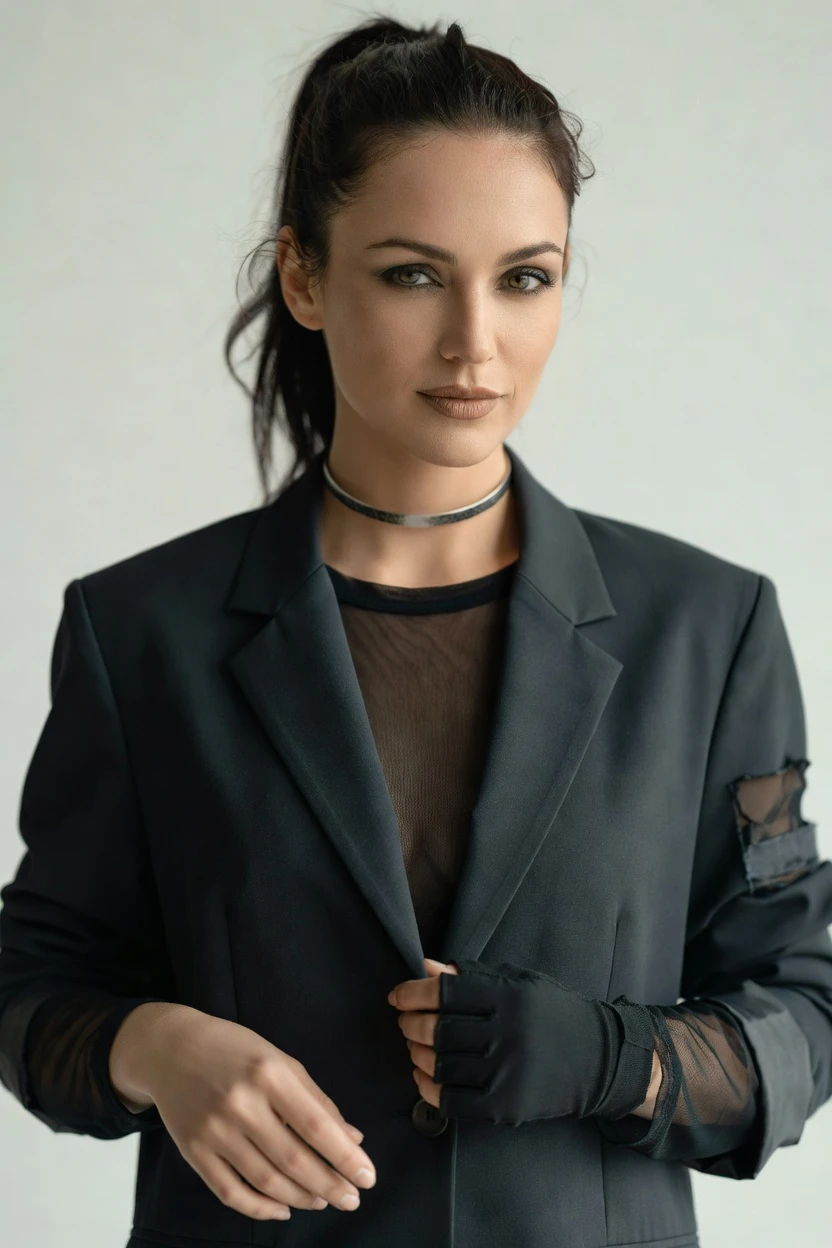
Direct the shoot. Zero prompts.
Pick a nu metal-ready visual style preset, then lock the look with camera, framing, lighting, background, and mood controls. The garment stays the brief—everything else is a click. 5 tokens · ~34s per image
- 6 clicks · 0 keystrokes
- app.rawshot.ai / new_shoot
How it works
Click-driven control for garment-led shoots
Nu metal vibes, editorial lighting, and campaign framing—built from presets and sliders so you can iterate fast without prompt work.
- Step 01
Select the look, then direct the scene
Choose a visual style preset and lock your camera, framing, and mood. Every decision is a UI control you click and adjust—no typed instructions to learn.
- Step 02
Keep the garment as the brief
Upload your real garment and treat it as the center of the composition. Cut, color, pattern, logo placement, and fabric character stay faithful while you change the creative context.
- Step 03
Generate with catalog-ready consistency
Use the same model library controls to keep faces and body attributes consistent across SKUs. When you generate variations, RAWSHOT outputs carry signed provenance, watermarking cues, and clear commercial rights.
Spec sheet
Proof you can publish—style without drift
Twelve proof surfaces show what RAWSHOT guarantees: no prompts, garment fidelity, consistent synthetic models, signed provenance, and clean commercial rights.
- 01
No-likeness by design
Synthetic models are constructed from 28 body attributes with 10+ options each. Accidental real-person likeness is statistically negligible by design, and model outputs are transparently labelled.
- 02
Zero prompts in the workflow
Every creative decision is a button, slider, or preset: lens, framing, pose, angle, light, background, mood, and visual style. You direct the shoot through the interface, not a text field.
- 03
Garment fidelity first
RAWSHOT represents cut, color, pattern, logo, fabric character, and drape faithfully. Where generic image tools bend results around a prompt, RAWSHOT is engineered around the garment.
- 04
Diverse synthetic models
You get a set of diverse synthetic models, transparently labelled for honesty and workflow trust. Choose the look that fits your brand without guessing whether identity will drift.
- 05
SKU consistency without retakes
Save a model setup and reuse it across your entire catalog. The face and body stay consistent across SKUs so your product pages look like one continuous campaign.
- 06
150+ visual styles for nu metal
Switch between catalog clean, lifestyle warmth, editorial noir, street flash, film grain, and more. Presets give you fast direction while keeping the garment the brief.
- 07
2K/4K and every aspect ratio
Generate in 2K or 4K resolution and choose aspect ratios that fit each platform. Get full-body, half-body, close-up, detail, and flat-lay framings with consistent framing logic.
- 08
Compliance with provenance signals
Outputs include C2PA-signed provenance and labelled AI cues. RAWSHOT is designed to align with EU AI Act Article 50 and California SB 942 requirements for labelled outputs.
- 09
Signed audit trail per image
Each generated image carries a signed audit trail so your publishing team can verify lineage. Watermarking and labelling help reviewers trust what they’re shipping.
- 10
GUI + REST API for scale
Use the browser GUI for single shoots and the REST API for catalog-scale pipelines. Same engine, same controls, and consistent output rules across your workflow.
- 11
Fast generation with clear pricing
Photos run around ~30–40 seconds per generation with per-image pricing. Tokens never expire, and failed generations refund tokens so operations can iterate confidently.
- 12
Full commercial rights, worldwide
You receive full commercial rights to every output, permanent and worldwide. No ambiguity in the rights story—publish, market, and launch with clear provenance and licensing.
Outputs
Nu metal-ready outputs, directed by clicks Style presets + garment-led control
Browse example compositions for campaign, editorial, and catalog-style nu metal imagery. Each output is labelled and carries signed provenance so your team can ship with confidence.


Browse 150+ visual styles →
Comparison
RAWSHOT vs category tools vs DIY prompting
Three lenses on every dimension — what you optimize for in RAWSHOT versus typical category tools and blank-box AI workflows.
01
Interface
RAWSHOT
Click-driven controls for every creative decision—no text field.Category tools + DIY
More limited controls; often prompt-centric interaction patterns. DIY prompting: Typed prompts and prompt iteration to reach usable results.02
Garment fidelity
RAWSHOT
Cut, color, pattern, logo, fabric, and drape stay faithful.Category tools + DIY
Garment traits can drift when the tool prioritizes a prompt’s aesthetics. DIY prompting: Garments mutate across attempts; logos and placements can change.03
Model consistency across SKUs
RAWSHOT
Save and reuse the same synthetic model setup across SKUs.Category tools + DIY
Faces and body renderings can change between outputs. DIY prompting: Inconsistent faces and body appearance across variants are common.04
Provenance + labelling
RAWSHOT
C2PA-signed provenance with labelled AI output and watermarked cues.Category tools + DIY
Provenance may be missing or not consistently packaged for review. DIY prompting: DIY outputs often lack C2PA, labelling, and signed audit trails.05
Commercial rights
RAWSHOT
Full commercial rights to every output, permanent worldwide.Category tools + DIY
Rights story can be unclear or vary by workflow and plan. DIY prompting: Licensing and rights clarity is frequently hard to establish for production use.06
Iteration speed per variant
RAWSHOT
Adjust presets and controls, then generate—~30–40 seconds per still.Category tools + DIY
Iteration may require multiple settings with less repeatable control. DIY prompting: Prompt-engineering overhead slows down repeatable variant creation.07
Pricing transparency
RAWSHOT
Per-image pricing (~$0.55) with token rules and refund on failure.Category tools + DIY
Per-seat pricing and volume tiers that can punish growth. DIY prompting: Hidden time costs from repeated prompt trials and rework.08
Catalog API
RAWSHOT
REST API designed for catalog-scale pipelines and batch generation.Category tools + DIY
Limited automation and weaker API surfaces for bulk work. DIY prompting: DIY pipelines are harder to operationalize across thousands of SKUs.
Prompting does not scale
Stop writing essays. Direct the shoot.
Most AI photo tools start with a blank text box. Rawshot turns the shoot into repeatable controls, so creative teams can produce consistent fashion imagery without prompt syntax or one-off hacks.
Category norm
ManualCreate a premium editorial fashion photograph of a model wearing the exact navy oversized wool coat from SKU-1842, full-body crop, realistic hands, consistent facial identity, clean e-commerce lighting, subtle Paris street background, 85mm lens, no logo distortion, no fabric hallucination, same pose as last campaign, repeatable for all colorways...
A prompt can describe one image. It cannot become a shared production system for hundreds of products, models, angles and markets.
Rawshot
ClicksSaved shoot recipe
Apply to 1 SKU or 10,000 via GUI, CSV or REST API.
Rawshot makes creative direction visible: buttons, presets and sliders instead of hidden prompt craft. The result is easier to teach, faster to approve and built for repeat production.
Use cases
Style workflows from single looks to catalog scale
Operator archetypes and how click-directed, garment-first output fits the way they actually work.
- 01
Indie designer shipping a new drop
Upload your garment and click through editorial lighting and nu metal style presets to publish lookbook-ready imagery without booking studio days.
Confidence · high
- 02
DTC brand refreshing PDPs
Generate consistent packshot-style and half-body visuals across sizes and variants so every product page looks like one campaign.
Confidence · high
- 03
Catalog manager running 1,000+ SKUs
Use the REST API to batch-generate on-model imagery while keeping the same face and body setup across the catalog.
Confidence · high
- 04
Influencer launching a capsule collection
Lock the same model face and choose platform aspect ratios so your posts look cohesive from teaser to haul content.
Confidence · high
- 05
Adaptive fashion line operator
Direct framing and mood with garment-led control so your product details and silhouette remain faithful across repeat content cycles.
Confidence · high
- 06
Lingerie DTC for recurring collections
Generate consistent upper-body and close-up compositions with controlled visual styles that match your brand’s on-site look.
Confidence · high
- 07
Resale and vintage marketplace seller
Turn listed garments into uniform thumbnails and listings by applying consistent framing, lighting, and style presets across inventory.
Confidence · high
- 08
Factory-direct manufacturer for wholesale previews
Produce campaign-style imagery for seasonal approvals using repeatable model setups and signed provenance for internal review.
Confidence · high
- 09
Student fashion team producing assignments
Create editorial and street-inspired visuals from your own garments using clicks, so you learn production direction without prompt syntax overhead.
Confidence · high
- 10
Adaptive kidswear label for size sets
Generate consistent on-model imagery across outfit sets, keeping the garment faithful while changing framing and mood for different placements.
Confidence · high
- 11
On-demand label testing design tweaks
Iterate faster by regenerating variants with the same camera and style controls, avoiding garment drift between outputs.
Confidence · high
- 12
Accessory brand building a unified visual system
Compose up to 4 products per image with controlled camera and backgrounds so bracelets, bags, and details share one coherent aesthetic.
Confidence · high
— Principle
Honest is better than perfect.
Nu metal fashion imagery is only useful if your production team can verify what they’re publishing. RAWSHOT outputs carry C2PA-signed provenance, labelled AI cues, and a signed audit trail, supporting EU AI Act Article 50 and California SB 942 aligned workflows.
Rights & provenance
Full commercial rights. Forever.
- C2PA-signed on every image — EU AI Act Article 50 compliant
- 28-attribute synthetic models — real-person likeness statistically impossible
- Full commercial rights to every generation — no recurring licensing fees
- Tokens never expire · One-click cancel · Transparent pricing
EU AI Act
C2PA
Commercial use
Pricing
~$0.55 per image.
~30–40 seconds per generation. Tokens never expire. Cancel in one click.
- 01The cancel button is on the pricing page.
- 02No per-seat gates. No 'contact sales' walls for core features.
- 03Failed generations refund their tokens.
- 04Full commercial rights to every output, permanent, worldwide.
FAQ
Practical answers on control, rights, pricing, scale, and compliant publishing.
Do I need to write prompts to use RAWSHOT?
Never—you direct every output with sliders, presets, and clicks on the garment, not typed prompts. That UI control is consistent across GUI and REST API payloads, which is why ecommerce teams onboard buyers without rewriting creative briefs as chat threads. You stay focused on the look: camera, framing, lighting, background, mood, and visual style are all explicit controls.
For catalog teams, reliability matters more than model cleverness; RAWSHOT keeps tokens, timings, refund rules, commercial rights framing, provenance signalling, watermarking cues, REST surface, and SKU-scale batch patterns explicit so operations can rehearse PDP launches without hallucinated garment inventions.
What changes for an ecommerce team when the shoot is garment-led instead of prompt-led?
You stop spending cycles fixing mutated products. RAWSHOT is engineered around your real garment, so cut, color, pattern, logo, fabric character, and drape stay faithful while you adjust the scene. That means fewer “close enough” variations and more predictable PDP visuals across seasons and drops.
In practice, you upload the garment once, then click your way through composition choices (lens to framing to mood) while the product remains the brief. For teams, that translates into repeatable output for thumbnails, collection pages, and merchandising layouts.
Why skip reshooting every SKU for season updates?
Because reshoots are time-bound, sample-bound, and budget-bound—especially when you need consistent on-model imagery across many variants. With RAWSHOT, you generate new looks from the same garment setup using the same model library controls, so your catalog stays coherent. You keep momentum without shipping samples or booking studio days just to change lighting or style.
When updates are frequent, SKU-scale consistency matters: you can reuse a saved model setup so your faces and bodies don’t drift between generations. The result is cleaner approvals and faster merchandising cycles.
How do we turn flat garments into catalog-ready imagery without prompt work?
Upload the garment, then choose the creative controls you want: camera/lens, framing, pose, angle, lighting, background, and a visual style preset. The interface is built like a real application, so each setting is a click or slider, not a command. You direct the scene while RAWSHOT keeps garment fidelity as the anchor.
If you need multiple placements, switch aspect ratio and framing (full body, half body, close-up, detail, flat lay) using the UI controls. Your team can iterate with predictable outputs instead of rewriting creative instructions for every variant.
How does RAWSHOT compare to ChatGPT, Midjourney, or generic image models for fashion PDPs?
Generic image AI often optimizes around a typed prompt, which is where garment drift, invented branding, and inconsistent faces can show up. RAWSHOT keeps garment fidelity and SKU consistency as first-class requirements, and it packages provenance and labelling for production review. For PDPs, that reliability beats prompt roulette.
Operationally, you avoid prompt-engineering overhead because every creative decision lives in UI controls. Your workflow becomes repeatable for your catalog team instead of dependent on an individual “prompt person.”
What does RAWSHOT provide for trust and publishing—beyond the image itself?
Every output is designed for review and compliance, not just aesthetics. RAWSHOT outputs include C2PA-signed provenance, labelled AI cues, and a signed audit trail per image, plus visible and cryptographic watermarking cues. That gives your team a clear story for what was generated and how it was produced.
It also matters commercially: you get full commercial rights to every output, permanent and worldwide. That reduces legal back-and-forth when marketing needs imagery for launch windows.
What QA checks should we run before publishing RAWSHOT outputs for a nu metal collection?
Use the same practical checks you’d run on a real photo, but faster: verify garment details (cut, color, pattern, logo placement, fabric character) and check that framing matches each placement (hero, listing, detail). Then confirm model consistency for campaigns and verify that the output carries the expected provenance and watermark cues. This keeps approvals grounded in production reality.
Because synthetic models are transparently labelled, your internal workflow can treat outputs consistently across catalog and campaign teams. You don’t need extra “best guess” steps to interpret what the image represents.
How do token pricing and generation times work for photos?
For photos, pricing is per image at about ~$0.55, with generation around ~30–40 seconds per still. Tokens never expire, and failed generations refund tokens, so you can iterate without worrying that a failed attempt permanently costs you. The cancel button is available on the pricing page.
For shoppers and operators, that means predictable workload budgeting for variant sets—especially when you’re producing many SKUs or testing multiple nu metal visual styles for the same garment.
Can RAWSHOT integrate into a catalog pipeline with REST API, or is it only a browser tool?
Both are supported. You can direct single shoots in the browser GUI when you’re experimenting with a new look, and you can run catalog-scale pipelines via the REST API for batch generation. The same garment-led control philosophy and output rules apply across both surfaces.
That makes it easier to operationalize merchandising at scale, whether your team publishes to a storefront directly or feeds assets into your PLM and approval workflow. You’re not forced into manual generation for thousands of variants.
If we start with one look in the UI, how do we scale to thousands of SKUs without losing consistency?
Start by saving your preferred model setup and the creative controls you want (visual style, camera, framing, lighting, background, mood). Then reuse that setup across new garments and variants so faces and bodies stay consistent from SKU to SKU. When you’re ready, move the workflow to the REST API for batch generation.
Because outputs include signed provenance and labelled cues, your review process stays stable as you scale. You keep the same editorial standard across campaign assets and product catalogs, without reshoots and without prompt overhead.
Keep exploring