
— Bridal imagery · 150+ styles · 4K
Direct bridal campaign imagery with the AI Wedding Dress Photography Generator
Generate clean catalogue frames, romantic campaign shots, and detail-led bridal imagery from the garment itself. Select lens, framing, light, backdrop, aspect ratio, and finish through buttons, sliders, and presets in a real application for fashion teams. No studio. No sample traffic. No typed instructions.
- ~$0.55 per image
- ~30–40s per generation
- 150+ styles
- 2K or 4K
- Every aspect ratio
- Full commercial rights
7-day free trial • 50 tokens (10 images) • Cancel anytime

Direct the shoot. Zero prompts.
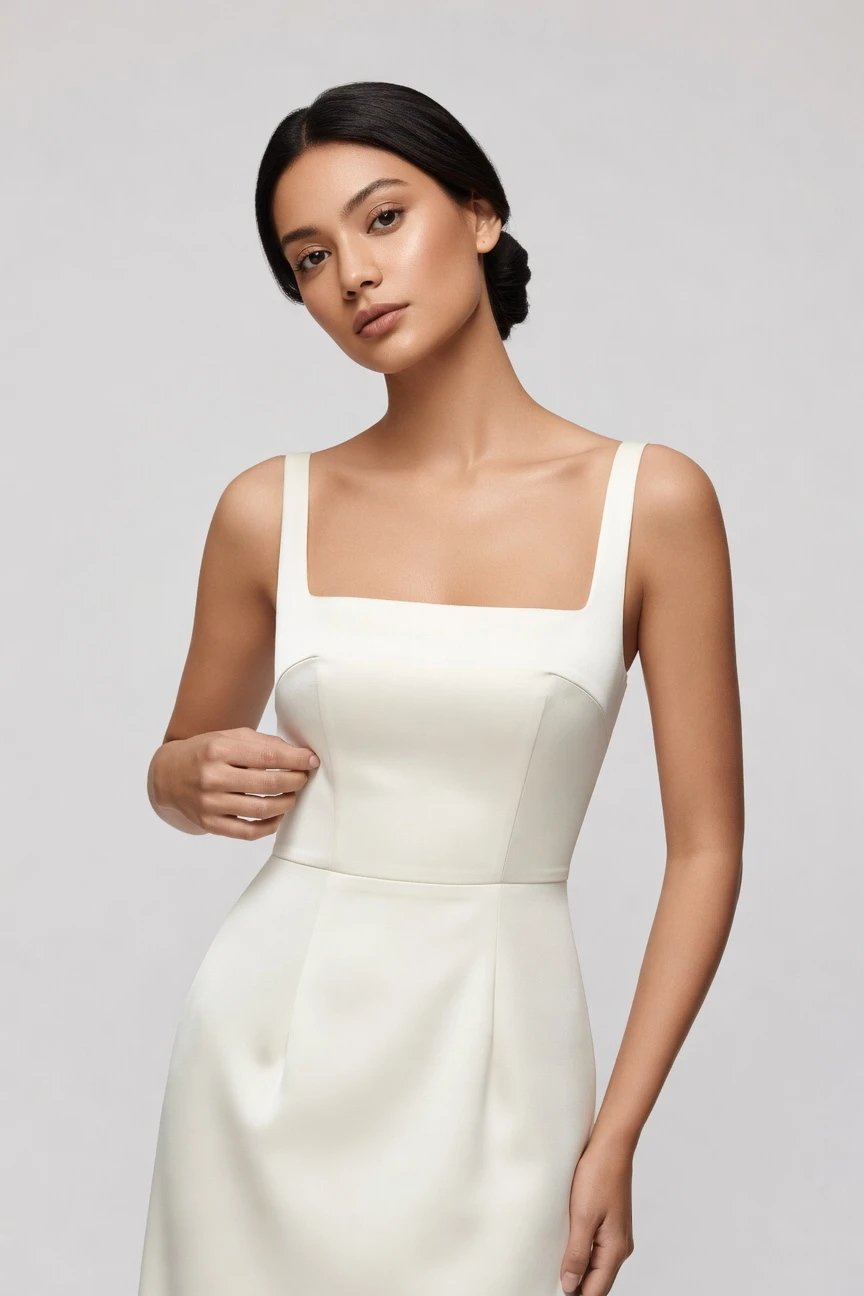
For bridal product pages and launch campaigns, the setup here uses an 85mm lens, half-body framing, a 4:5 crop, and 4K output to hold shape, bodice detail, and fabric finish clearly. You adjust the dress presentation with controls, then generate consistent bridal imagery without writing anything. ~$0.55 per image · ~30-40s
- 4 clicks · 0 keystrokes
- app.rawshot.ai / new_shoot
How it works
From Bridal Garment to Publish-Ready Frames
Three steps turn a wedding dress into on-model imagery for product pages, launch campaigns, and catalog coverage without studio scheduling.
- Step 01
Upload the Dress
Start from the real garment so silhouette, neckline, trim, and fabric behaviour stay central. Bridal imagery works best when the dress is the brief, not an afterthought around text.
- Step 02
Set the Bridal Direction
Choose lens, framing, pose, light, backdrop, aspect ratio, and visual style with clicks. You can move from clean ecommerce coverage to romantic campaign art direction without leaving the same interface.
- Step 03
Generate and Reuse at Scale
Create stills in about 30–40 seconds, keep approved looks consistent, and repeat them across collections or catalogs. The same workflow works for one launch image or a large SKU pipeline through the API.
Spec sheet
Proof for Bridal Commerce Teams
These twelve points show how RAWSHOT handles garment accuracy, control, provenance, scale, and rights for wedding dress imagery.
- 01
Built From Synthetic Attributes
Every model is assembled from 28 body attributes with 10+ options each. Accidental real-person likeness is statistically negligible by design.
- 02
Every Setting Is a Click
You direct lens, angle, framing, lighting, pose, mood, and aspect ratio through interface controls. The workflow behaves like software, not a chat thread.
- 03
The Dress Leads the Image
Cut, train, bodice structure, lace placement, beading, drape, and proportion are treated as the source material. RAWSHOT is engineered around the garment so bridal details stay readable.
- 04
Diverse Models for Bridal Casting
Use diverse synthetic models to represent different body presentations across your bridal range. That gives smaller labels access to broader on-model coverage without organising separate castings.
- 05
Keep Looks Consistent Across SKUs
Reuse the same approved face, framing logic, and visual direction across multiple dresses. Catalog teams avoid drift between one bridal product page and the next.
- 06
150+ Styles for Bridal Stories
Move from catalog clean to soft editorial, luxe campaign, vintage romance, or studio minimal with presets. Style changes happen in the UI without rebuilding the workflow from zero.
- 07
2K, 4K, and Every Ratio
Generate bridal stills in 2K or 4K and crop for PDPs, marketplaces, social, or launch assets. Full-body, half-body, close-up, detail, and flat-lay framings are all supported.
- 08
Labelled and Compliance-Ready
Outputs are C2PA-signed, AI-labelled, and watermarked with visible and cryptographic layers. RAWSHOT is built for EU AI Act Article 50, California SB 942, and GDPR-aligned operations.
- 09
Per-Image Audit Trail
Each output carries a signed record of what it is. That helps teams track provenance and maintain internal approval confidence across bridal launches and retailer handoffs.
- 10
GUI for Shoots, API for Catalogs
Use the browser app for one-off bridal campaigns or the REST API for large product libraries. The indie bridal label and enterprise merchandising team work on the same engine.
- 11
Transparent Speed and Pricing
Images cost about $0.55 each and generate in roughly 30–40 seconds. Tokens never expire, and failed generations refund their tokens.
- 12
Rights Stay With the Output
Every generated image includes full commercial rights, permanent and worldwide. Teams can publish bridal imagery across ecommerce, marketing, ads, and wholesale materials with clear usage terms.
Outputs
Bridal Outputs, directed by clicks
See the same wedding dress presented as clean product imagery, romantic campaign creative, and detail-led close work. Bridal teams can keep one garment central while adapting the frame to each channel.


Browse 150+ visual styles →
Comparison
RAWSHOT vs category tools vs DIY prompting
Three lenses on every dimension — what you optimize for in RAWSHOT versus typical category tools and blank-box AI workflows.
01
Interface
RAWSHOT
Buttons, sliders, and presets direct every bridal image decisionCategory tools + DIY
Often mix templates with partial text controls and looser fashion-specific UI. DIY prompting: Typed instructions drive the process, with repeated rewrites to chase usable outputs02
Garment fidelity
RAWSHOT
Dress silhouette, trim, texture, and proportion stay anchored to the garmentCategory tools + DIY
Can stylise quickly but often soften product-specific construction details. DIY prompting: Generic models often bend hems, invent embellishments, or alter logos and seams03
Model consistency
RAWSHOT
Same approved model logic can repeat across many wedding dress SKUsCategory tools + DIY
Consistency varies between sessions and product sets. DIY prompting: Faces drift from image to image, making collections look mismatched04
Provenance and labelling
RAWSHOT
C2PA-signed, AI-labelled, with visible and cryptographic watermarkingCategory tools + DIY
Labelling and provenance support are often partial or absent. DIY prompting: No reliable provenance metadata or built-in disclosure layer for commerce teams05
Commercial rights
RAWSHOT
Full commercial rights on every output, permanent and worldwideCategory tools + DIY
Rights terms differ by plan, seat, or workflow tier. DIY prompting: Usage clarity is often unclear across model providers and generation stacks06
Pricing transparency
RAWSHOT
Same per-image pricing, no seat gates, tokens never expireCategory tools + DIY
May add plan complexity, volume tiers, or gated feature access. DIY prompting: Tool costs, retries, and manual cleanup time are hard to predict07
Iteration speed
RAWSHOT
New bridal variants generate in about 30–40 seconds eachCategory tools + DIY
Fast for simple changes, slower when control surfaces are limited. DIY prompting: Iteration slows under rewrite cycles and visual drift between attempts08
Catalog scale
RAWSHOT
Browser GUI for one shoot, REST API for 10,000-SKU pipelinesCategory tools + DIY
Often split small-team tools from enterprise workflow layers. DIY prompting: No clean production pipeline, audit trail, or repeatable SKU orchestration
Prompting does not scale
Stop writing essays. Direct the shoot.
Most AI photo tools start with a blank text box. Rawshot turns the shoot into repeatable controls, so creative teams can produce consistent fashion imagery without prompt syntax or one-off hacks.
Category norm
ManualCreate a premium editorial fashion photograph of a model wearing the exact navy oversized wool coat from SKU-1842, full-body crop, realistic hands, consistent facial identity, clean e-commerce lighting, subtle Paris street background, 85mm lens, no logo distortion, no fabric hallucination, same pose as last campaign, repeatable for all colorways...
A prompt can describe one image. It cannot become a shared production system for hundreds of products, models, angles and markets.
Rawshot
ClicksSaved shoot recipe
Apply to 1 SKU or 10,000 via GUI, CSV or REST API.
Rawshot makes creative direction visible: buttons, presets and sliders instead of hidden prompt craft. The result is easier to teach, faster to approve and built for repeat production.
Use cases
Who Uses Bridal Imagery Like This
Operator archetypes and how click-directed, garment-first output fits the way they actually work.
- 01
Indie Bridal Designers
Launch a first collection with on-model wedding dress imagery before a traditional shoot is financially realistic.
Confidence · high
- 02
Made-to-Order Wedding Labels
Show custom silhouettes, necklines, and fabric options across product pages without organising repeated bridal studio days.
Confidence · high
- 03
Crowdfunded Bridal Projects
Present campaign-ready dress visuals early enough to raise demand before committing to large production runs.
Confidence · high
- 04
Ecommerce Merchandising Teams
Create consistent bridal PDP imagery across neckline variants, sleeve versions, and colorways in one controlled workflow.
Confidence · high
- 05
Marketplace Bridal Sellers
Generate clean 4:5 and square wedding dress photography for marketplace listings and branded storefronts from the same source garment.
Confidence · high
- 06
Boutique Atelier Brands
Mix romantic campaign frames with close detail views to show craftsmanship, lacework, and finish without a full agency setup.
Confidence · high
- 07
Bridesmaid and Bridal Capsule Labels
Keep one visual system across wedding gowns, separates, veils, and accessories while matching each product category's framing needs.
Confidence · high
- 08
Factory-Direct Manufacturers
Create polished bridal catalog imagery for wholesale buyers, private-label decks, and direct ecommerce launches from one engine.
Confidence · high
- 09
Resale and Vintage Bridal Curators
Refresh archived gown listings with clear on-model presentation that makes shape and period detail easier to read online.
Confidence · high
- 10
Adaptive Bridal Brands
Represent accessibility-led wedding dress design with broader body presentation options and consistent visual direction.
Confidence · high
- 11
Student and Graduate Collections
Build a bridal portfolio that looks professionally directed even when there is no budget for casting, studio rental, or travel.
Confidence · high
- 12
Retail Catalog Operations
Use the same bridal image workflow in the browser for review and in the API for large nightly product pipelines.
Confidence · high
— Principle
Honest is better than perfect.
Bridal imagery carries emotional weight, which makes clear labelling matter even more. Every RAWSHOT output is AI-labelled, C2PA-signed, and watermarked with visible and cryptographic layers so wedding dress teams can publish with proof, not ambiguity. We host in the EU, build for GDPR-aligned operations, and treat provenance as part of the product.
Rights & provenance
Full commercial rights. Forever.
- C2PA-signed on every image — EU AI Act Article 50 compliant
- 28-attribute synthetic models — real-person likeness statistically impossible
- Full commercial rights to every generation — no recurring licensing fees
- Tokens never expire · One-click cancel · Transparent pricing
EU AI Act
C2PA
Commercial use
Pricing
~$0.55 per image.
~30–40 seconds per generation. Tokens never expire. Cancel in one click.
- 01The cancel button is on the pricing page.
- 02No per-seat gates. No 'contact sales' walls for core features.
- 03Failed generations refund their tokens.
- 04Full commercial rights to every output, permanent, worldwide.
FAQ
Practical answers on control, rights, pricing, scale, and compliant publishing.
Do I need to write prompts to use RAWSHOT?
Never—you direct every output with sliders, presets, and clicks on the garment, not typed prompts. That matters for bridal teams because wedding dresses need repeatable presentation, not chat-style guesswork around silhouette, lace placement, train length, and bodice detail. In RAWSHOT, camera, angle, framing, light, background, visual style, and product focus live in the interface, so buyers, merchandisers, and founders can work inside a stable production workflow instead of translating product knowledge into text syntax.
For catalog and campaign operations, reliability beats improvisation. RAWSHOT keeps pricing, timings, refund rules, commercial rights, provenance signalling, watermarking, and output controls explicit, which makes internal review simpler and launch planning more predictable. You can use the browser GUI for one bridal edit or run the same logic through the REST API at larger scale. The practical takeaway is simple: if your team can click through a shoot plan, it can produce publish-ready wedding dress imagery without learning a new writing discipline first.
What does AI-assisted bridal photography change for ecommerce teams selling wedding dresses?
It changes who gets access to on-model imagery and how quickly teams can publish it. Bridal ecommerce usually sits between two hard limits: studio budgets that smaller labels cannot justify and generic image tools that ask nontechnical users to steer complex results through text. RAWSHOT removes both barriers by giving wedding dress teams a click-driven application built around garment presentation, so product pages, launch assets, and marketplace images can be produced from the dress itself.
For commerce teams, that means faster coverage of neckline variants, sleeve options, fabric updates, and campaign crops without rebuilding the process every time. You can generate in 2K or 4K, choose aspect ratios for PDPs and social placements, and keep model and framing logic consistent across a collection. Outputs are AI-labelled, C2PA-signed, and commercially usable worldwide, which matters when bridal content moves across owned channels, retailer requests, and paid media. The operational gain is not novelty; it is dependable access to bridal imagery where there was none before.
Why skip reshooting every wedding dress SKU for seasonal updates or channel changes?
Because bridal assortments change more often than most teams can justify with repeated studio production. A hem update, sleeve change, ivory tone adjustment, or seasonal campaign refresh can trigger expensive coordination across samples, casting, retouching, and scheduling, even when the underlying product story is still the dress. RAWSHOT lets you keep the garment central and adapt the presentation through interface controls, which is far more workable for bridal labels managing many product changes across ecommerce and marketing calendars.
That matters especially when the same dress needs different outputs for product detail pages, launch announcements, wholesale decks, and social crops. Instead of organising another physical shoot day, teams can reuse approved visual direction, regenerate in new aspect ratios, and keep the collection visually coherent. At roughly $0.55 per image with 30–40 second generation times, the workflow supports iteration without forcing every change into a full reshoot decision. In practice, that lets bridal operators reserve physical photography for the moments that truly need it and use RAWSHOT for the rest.
How do we turn flat garment files into catalogue-ready wedding dress imagery without prompting?
You start with the garment and direct the presentation through controls rather than typed instructions. In RAWSHOT, a bridal team can select lens, framing, pose, camera angle, lighting, background, visual style, resolution, and aspect ratio from the interface, then generate outputs that reflect those choices. That structure is useful for wedding dresses because catalogue imagery depends on readable shape, clean proportion, and visible material detail, not just mood.
Once the first approved setup is established, the team can repeat it across related gowns or variants for consistency. Full-body views can show line and train, half-body crops can focus on bodice construction, and detail shots can emphasise lace, beadwork, or finishing. The browser GUI works well for one collection launch, while the REST API supports larger product flows when the catalog grows. The practical workflow is straightforward: set the visual rules once, generate controlled bridal outputs, review garment accuracy, and publish with a clear audit trail attached to each image.
Why does garment-led control beat DIY prompting in ChatGPT, Midjourney, or generic image tools for bridal PDPs?
Because bridal ecommerce needs reproducibility, not roulette. Generic image tools are built to interpret broad creative requests, which makes them prone to changing neckline shapes, inventing embellishment patterns, softening seams, drifting face consistency, or adding details that were never on the gown. For a wedding dress product page, those errors are not cosmetic; they affect trust, merchandising accuracy, and return risk. RAWSHOT is built around the garment and exposes the creative decisions as controls, so the team directs the image with structure instead of hoping a text-led workflow holds the dress together.
There is also an operational difference. RAWSHOT includes explicit commercial rights, C2PA provenance metadata, visible and cryptographic watermarking, and a repeatable path from GUI use to REST API scale. DIY stacks usually leave teams juggling multiple tools, unclear rights framing, no audit trail, and inconsistent results between attempts. If your goal is bridal PDP reliability, the better route is the one that keeps the product central, records what the output is, and lets nontechnical teams iterate without chat-style trial and error.
Can I use the ai wedding dress photography generator for paid ads, product pages, and wholesale decks?
Yes. RAWSHOT gives you full commercial rights to every output, permanent and worldwide, so bridal teams can use the images across ecommerce pages, paid campaigns, organic social, email, line sheets, and wholesale materials without separate usage add-ons. That clarity matters for wedding labels because the same visual assets often travel across many channels quickly, especially around launch dates, seasonal edits, and retailer outreach. Rights certainty should be built into the workflow, not negotiated as an afterthought.
RAWSHOT also pairs that rights clarity with transparent labelling and provenance. Outputs are AI-labelled, C2PA-signed, and watermarked with visible and cryptographic layers, which gives teams a stronger governance footing when assets move between internal teams, agencies, retail partners, and ad platforms. The result is not just permission to publish; it is a cleaner compliance and brand-trust posture around bridal imagery. In practice, your team can create, approve, and deploy wedding dress assets with fewer legal and operational grey areas slowing down the launch.
What should a bridal team check before publishing AI-labelled wedding dress imagery?
Start with garment truth. Review silhouette, hemline, bodice construction, trim placement, lace pattern, fabric behaviour, and overall proportion against the source dress, because those are the details shoppers use to judge bridal fit and value online. Then confirm the output matches the intended sales context: full-body where line matters, tighter crops where workmanship matters, and the right aspect ratio for the destination channel. Quality control on bridal imagery is not about chasing abstract perfection; it is about protecting product trust.
Next, confirm the governance layer is intact. RAWSHOT outputs are AI-labelled, C2PA-signed, and watermarked with visible and cryptographic layers, so your review should include both visual suitability and provenance readiness for publication. Teams should also verify that the chosen model and styling remain consistent across related SKUs so the collection reads as one system. A good publishing rule is simple: approve only the images that represent the actual dress clearly, fit the channel cleanly, and carry the disclosure and audit signals your brand wants attached.
How much does an ai wedding dress photography generator cost for still images, and what happens to unused tokens?
For stills, RAWSHOT runs at about $0.55 per image, with most generations completing in roughly 30–40 seconds. Tokens never expire, which matters for bridal teams with irregular production calendars, pre-order drops, and seasonal bursts where demand for imagery is not perfectly even month to month. You are not forced into a use-it-now model just to preserve value between launches. That makes planning easier for independent labels and larger merchandising teams alike.
The rest of the pricing model is equally direct. Failed generations refund their tokens, there are no per-seat gates for core features, and the cancel button is on the pricing page for one-click account control. If your team also moves into motion later, video is priced separately because it uses more tokens per second than stills, but the still-image economics remain stable. The practical takeaway is that bridal teams can budget image production in a transparent per-output way instead of absorbing hidden seat fees or wasted credits.
Can RAWSHOT plug into a Shopify-scale bridal catalog or a custom merchandising pipeline?
Yes. RAWSHOT supports both browser-based work for small shoot sessions and a REST API for larger production flows, which is useful when bridal imagery needs to move from manual review into systematic catalog operations. A growing label might begin in the GUI to establish visual direction, approve model choices, and validate how different gown categories should be framed, then carry the same logic into automated processes as the assortment expands. That continuity is important because teams should not have to switch products just because volume increases.
The platform is designed around the same engine, same output logic, and same per-image pricing whether you are handling one dress or thousands of SKUs. That means merchandising, ecommerce, and engineering teams can align on a single workflow rather than juggling a lightweight creative tool for one case and a separate enterprise stack for another. For a Shopify-scale bridal operation or a custom internal system, the takeaway is clear: define your visual rules once, then use the API to apply them consistently across the catalog.
How do small bridal brands and large catalog teams use the same wedding dress image workflow?
They use the same product with different operating rhythms, not different capabilities. A founder can direct a handful of wedding dress images in the browser by selecting lens, framing, lighting, style, and crop, while a larger catalog team can take that approved setup and apply it across broader assortments through the API. The important point is that RAWSHOT does not split access into a creative toy for small brands and a separate gated system for bigger ones. The workflow scales without changing its logic.
That matters because bridal businesses often grow unevenly. A label may start with a small made-to-order range, expand into multiple silhouettes, then need consistent imagery across ecommerce, marketplaces, wholesale requests, and campaign launches. RAWSHOT keeps model consistency, provenance signals, pricing rules, and rights terms stable through that growth. In practical terms, one person can establish the visual language and a larger team can operationalise it later, which keeps the brand coherent while giving every stage of the business real access to photography.
Keep exploring