
— On-model imagery · 150+ styles · 2K/4K
Direct your next shoot with click-driven controls via the Bow Tie AI On-model Photography Generator.
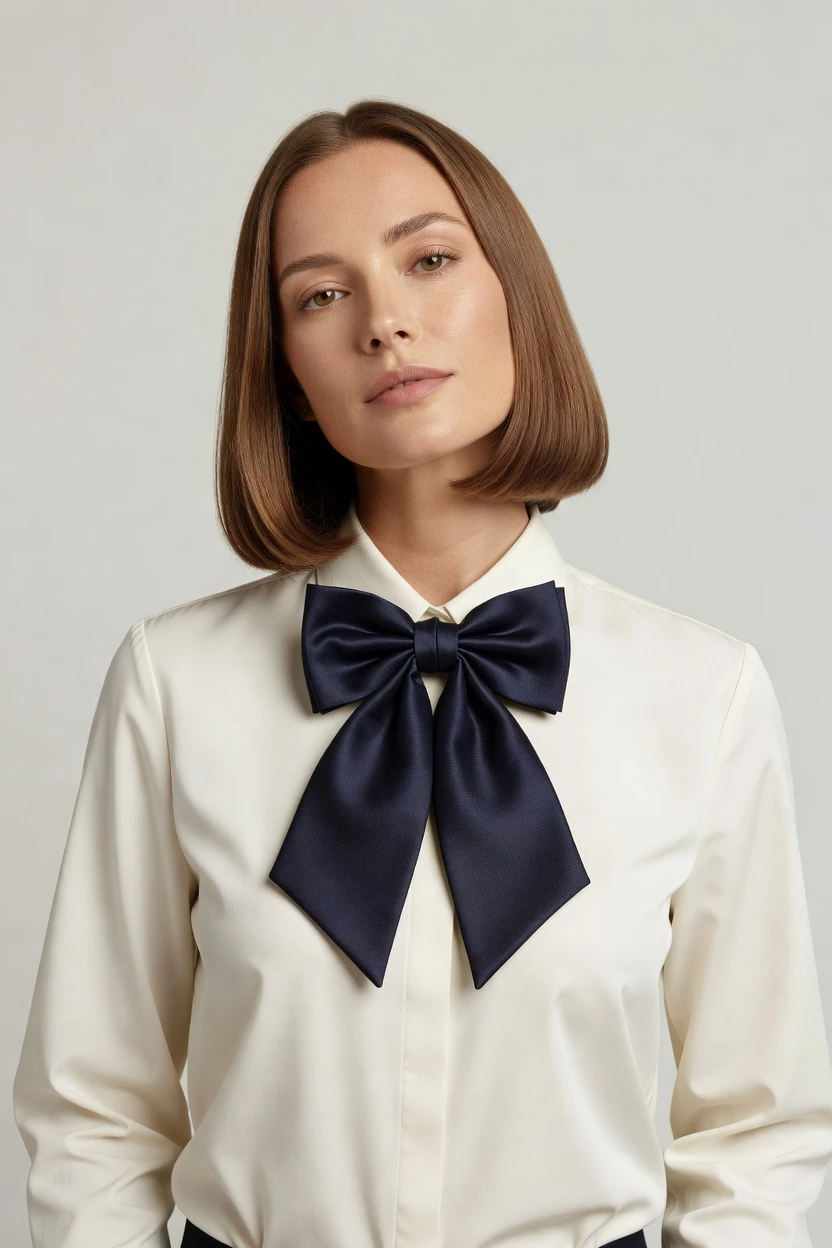
Generate catalogue-ready bow-tie on-model photos by selecting lens, framing, lighting, background, and visual style—every setting is a click, not a typed request. Keep the garment faithful and the presentation consistent across variations, with provenance signalling you can trust. No studio days. No samples shipped. No prompts.
- ~$0.55 per image
- ~30–40s per generation
- Tokens never expire
- 2K or 4K
- 150+ visual styles
- Full commercial rights, permanent, worldwide
7-day free trial • 50 tokens (10 images) • Cancel anytime

Direct the shoot. Zero prompts.
Click a preset look, then adjust the controls to frame the bow tie, set studio-style lighting, choose a clean background, and lock the visual mood. Everything is prewired around the real garment so you keep cut, colour, pattern, and proportions consistent. 5 tokens · ~34s per image
- 6 clicks · 0 keystrokes
- app.rawshot.ai / new_shoot
How it works
Click to direct the shoot, not prompt a model
Pick controls for camera, framing, lighting, and style—then generate on-model photos with garment-faithful results and provenance cues built in.
- Step 01
Select the garment-led setup
Choose your framing, lens, lighting, background, and visual style using the click-driven controls so the shoot matches your product presentation.
- Step 02
Direct the look with UI controls
Adjust pose, angle, mood, and resolution in the same interface for repeatable results across variants, without typed instructions.
- Step 03
Generate, label, and ship to catalog
Each output is watermarked and provenance-labelled, with an audit trail per image and full commercial rights for permanent worldwide use.
Spec sheet
Twelve proof surfaces, one on-model workflow
From no-likeness design to provenance and API scale, each tile validates one distinct layer of control for fashion product photography teams.
- 01
No-likeness by design
Your synthetic models are built from 28 body attributes × 10+ options each, making accidental real-person likeness statistically negligible by design.
- 02
Click-driven UI, zero prompts
Every creative decision is a button, slider, or preset—camera, angle, framing, pose, facial expression, lighting, and background.
- 03
Garment fidelity stays faithful
Cut, colour, pattern, logo, fabric, and drape are represented based on the actual garment product so the bow tie looks like the product.
- 04
Synthetic models are transparently labelled
Diverse synthetic models are used with clear AI labelling, so your team knows what it is seeing and how to present it downstream.
- 05
SKU consistency without drift
Save a model once and reuse it across your entire catalog so faces and body traits stay consistent between SKUs and seasonal updates.
- 06
150+ visual styles for every brief
Switch between catalog, lifestyle, editorial, campaign, street, Y2K, vintage, noir, and more—while keeping the garment the brief.
- 07
2K and 4K, every aspect ratio
Generate high-resolution stills with multiple compositions, from square to vertical formats, for storefronts and marketplaces.
- 08
Compliance you can show to teams
Outputs include C2PA-signed provenance metadata and satisfy EU AI Act Article 50 requirements, with California SB 942 alignment and GDPR hosting.
- 09
Signed audit trail per image
Every generation carries a signed audit trail so internal QA and approval workflows stay traceable for every published asset.
- 10
GUI for shoots, REST API for catalogs
Use the browser GUI for single looks and the REST API for nightly pipelines—same engine, same output quality.
- 11
Speed with per-image transparency
Photo generation runs in about 30–40 seconds per image at roughly ~$0.55, with tokens that never expire and one-click cancellation.
- 12
Full commercial rights, permanent worldwide
You get full commercial rights to every output, permanent and worldwide, so assets can live across campaigns, PDPs, and marketplaces.
Outputs
Preview output styles on your bow tie Catalog-ready in the browser
Generate bow-tie on-model photos with consistent framing and garment-led presentation. Use these previews as a style baseline for your catalog pipeline.


Browse 150+ visual styles →
Comparison
RAWSHOT vs category tools vs DIY prompting
Three lenses on every dimension — what you optimize for in RAWSHOT versus typical category tools and blank-box AI workflows.
01
Interface
RAWSHOT
Click-driven controls for lens, framing, lighting, mood, and style.Category tools + DIY
Chat-like control surfaces with fewer garment controls and less repeatability. DIY prompting: Typed prompts and settings you manage manually across runs.02
Garment fidelity
RAWSHOT
Garment is the brief; cut, colour, pattern, logo, and drape stay true.Category tools + DIY
Models can bend product appearance to match vague instructions or style words. DIY prompting: DIY wording often causes wardrobe drift and unpredictable details.03
Model consistency across SKUs
RAWSHOT
Save a model and keep the same face and body across your catalog.Category tools + DIY
Inconsistent model outputs across variants create catalog mismatches. DIY prompting: Each run can change the person, breaking SKU-to-SKU continuity.04
Provenance + labelling
RAWSHOT
C2PA-signed provenance metadata with visible and cryptographic watermarking.Category tools + DIY
Often no provenance story, no clear labelling, and weak QA traceability. DIY prompting: No built-in provenance or audit trail for compliance workflows.05
Commercial rights
RAWSHOT
Full commercial rights to every output, permanent, worldwide.Category tools + DIY
Rights are frequently unclear or gated behind licensing terms. DIY prompting: Rights and usage conditions are harder to verify for business publishing.06
Iteration speed per variant
RAWSHOT
Generate new looks in ~30–40 seconds per image with locked controls.Category tools + DIY
Slower iteration due to limited controls and more post-fixing. DIY prompting: Prompt iteration cycles add overhead before you get usable results.07
Pricing transparency
RAWSHOT
About ~$0.55 per image; tokens never expire; failed generations refund tokens.Category tools + DIY
Per-seat pricing and volume tiers that discourage growth and scale. DIY prompting: Opaque costs in model time, compute, and human prompt-tuning effort.08
Catalog API
RAWSHOT
Same engine in REST API for nightly SKU pipelines and browser GUI for single shots.Category tools + DIY
Limited integration paths or weaker batch workflows for ecommerce teams. DIY prompting: DIY pipelines require custom scripting and ongoing prompt maintenance.
Prompting does not scale
Stop writing essays. Direct the shoot.
Most AI photo tools start with a blank text box. Rawshot turns the shoot into repeatable controls, so creative teams can produce consistent fashion imagery without prompt syntax or one-off hacks.
Category norm
ManualCreate a premium editorial fashion photograph of a model wearing the exact navy oversized wool coat from SKU-1842, full-body crop, realistic hands, consistent facial identity, clean e-commerce lighting, subtle Paris street background, 85mm lens, no logo distortion, no fabric hallucination, same pose as last campaign, repeatable for all colorways...
A prompt can describe one image. It cannot become a shared production system for hundreds of products, models, angles and markets.
Rawshot
ClicksSaved shoot recipe
Apply to 1 SKU or 10,000 via GUI, CSV or REST API.
Rawshot makes creative direction visible: buttons, presets and sliders instead of hidden prompt craft. The result is easier to teach, faster to approve and built for repeat production.
Use cases
On-model photography for teams that need consistency
Operator archetypes and how click-directed, garment-first output fits the way they actually work.
- 01
Indie designer launches
Generate campaign-ready bow-tie imagery in the browser GUI for new drops without booking studio days.
Confidence · high
- 02
DTC ecommerce catalog refresh
Save one model and batch-generate SKU photos so every PDP stays consistent from colourway to colourway.
Confidence · high
- 03
Marketplace seller listings
Produce uniform on-model product photos across aspect ratios for multi-platform catalog uploads.
Confidence · high
- 04
Adaptive fashion line
Choose repeatable framing and lighting for accessible storytelling while keeping garment details faithful.
Confidence · high
- 05
Lingerie and accessory brand
Direct the look with visual presets and camera controls to build cohesive product pages.
Confidence · high
- 06
Resale and vintage catalog
Standardize imagery for mixed inventory by keeping composition and garment-led presentation consistent.
Confidence · high
- 07
Factory-direct manufacturer
Run nightly pipelines through the REST API to produce on-model assets at catalog scale.
Confidence · high
- 08
Crowdfunding creator updates
Generate fresh promotional visuals between campaign milestones without shipping samples cross-continent.
Confidence · high
- 09
Kidswear label on-demand
Iterate quickly on seasonal assortments with the same look and model consistency across SKUs.
Confidence · high
- 10
Adaptive studio QA assistant
Use the audit trail, watermarking, and labelling to keep approvals tight before publication.
Confidence · high
- 11
Student fashion team
Build a portfolio of branded on-model imagery using click-driven controls instead of prompt workflows.
Confidence · high
- 12
Enterprise catalog operator
Integrate into existing workflows using REST API batch generation with consistent output quality per image.
Confidence · high
— Principle
Honest is better than perfect.
Every output is C2PA-signed and watermarked, with visible and cryptographic records of origin plus AI labelling. That provenance and labelling support compliance review and internal QA for catalog and campaign publishing.
Rights & provenance
Full commercial rights. Forever.
- C2PA-signed on every image — EU AI Act Article 50 compliant
- 28-attribute synthetic models — real-person likeness statistically impossible
- Full commercial rights to every generation — no recurring licensing fees
- Tokens never expire · One-click cancel · Transparent pricing
EU AI Act
C2PA
Commercial use
Pricing
~$0.55 per image.
~30–40 seconds per generation. Tokens never expire. Cancel in one click.
- 01The cancel button is on the pricing page.
- 02No per-seat gates. No 'contact sales' walls for core features.
- 03Failed generations refund their tokens.
- 04Full commercial rights to every output, permanent, worldwide.
FAQ
Practical answers on control, rights, pricing, scale, and compliant publishing.
Do I need to write prompts to use RAWSHOT?
Never—you direct every output with sliders, presets, and clicks on the garment, not typed prompts. That UI control is consistent across GUI and REST API payloads, which is why ecommerce teams onboard buyers without rewriting creative briefs as chat threads.
For catalog teams, reliability matters more than model cleverness; RAWSHOT keeps tokens, timings, refund rules, commercial rights framing, provenance signalling, watermarking cues, REST surface, and SKU-scale batch patterns explicit so operations can rehearse PDP launches without hallucinated garment inventions.
What does click-driven on-model control change for my catalog workflow?
It turns fashion photo direction into deterministic steps you can repeat. You select framing, lens, lighting, background, pose, and a visual style preset, then generate photos that keep the garment faithful from variant to variant.
That matters when you manage hundreds of SKUs: you avoid reroll randomness and you keep the same presentation language across your storefront and marketplaces.
Why not just reshoot bow-tie inventory each season?
Reshooting every SKU burns studio time, shipping logistics, and approval cycles. RAWSHOT lets you generate on-model imagery from the product details so you can update imagery when colours, patterns, or seasonal assortments shift.
The practical win is fewer delays and fewer “close enough” compromises: model consistency, provenance labelling, and a signed audit trail per image support fast QA and cleaner publishing decisions.
How do we turn a flat garment asset into catalogue-ready on-model photos without prompting?
You start inside RAWSHOT’s browser interface and choose garment-led setup controls. Pick the product focus, set the camera lens and framing, select lighting and background, then apply a visual style preset that matches your catalog look.
Because every decision is a UI action, the workflow stays consistent for the whole team—stylists, buyers, and ops—while outputs include provenance metadata and watermarking cues for downstream review.
Will generic image AI drift the garment between variants, and how does RAWSHOT avoid that?
Generic prompt-driven tools often introduce garment drift: details can change between outputs as the model interprets your wording. RAWSHOT is built around the garment as the brief, so cut, colour, pattern, logo, fabric, and drape are represented faithfully.
For SKU-scale work, that fidelity is paired with reusable synthetic models so your face and body traits don’t shift between listings.
How is provenance handled for commercial publishing and internal compliance checks?
Every output includes C2PA-signed provenance metadata and watermarking that supports both visible review and cryptographic record keeping. You also get AI labelling and a signed audit trail per image for traceable approvals.
This is designed for teams that need to show what an asset is and how it was produced—without relying on vague “it looks right” decisions.
What should we check before using generated images on our PDP or campaign page?
Run a straightforward QA pass on garment fidelity, framing, and visual style alignment with your brand guidelines. Because controls are explicit and reproducible, you can regenerate with the same model and camera setup when something needs adjustment.
Also confirm provenance labelling and the signed audit trail per image, since that metadata and watermarking cues support compliance and publishing audits.
How do RAWSHOT’s token and generation times work for photo production?
Photo generation runs in roughly 30–40 seconds per image at about ~$0.55, with tokens that never expire. If a generation fails, tokens are refunded, and you can cancel with one click on the pricing page.
For shoppers and ops, that predictability makes planning easier than managing open-ended retries, prompt iterations, and unclear compute billing.
Can we integrate on-model photography generation into our existing catalog pipeline using an API?
Yes. RAWSHOT supports browser GUI for single shoots and a REST API for catalog scale, so your pipeline can generate images as part of nightly SKU processing.
Because the creative controls are consistent across the UI and API, the results stay aligned with your brand style system while your team keeps provenance, watermarking, and rights framing attached to every output.
When we scale from a few SKUs to thousands, what changes operationally?
You move from manual direction to repeatable pipeline execution, but the creative controls stay the same. Use the REST API for batch generation while locking model consistency and style presets so your catalog doesn’t fragment across runs.
That reduces approvals churn because each image carries labelled provenance and a signed audit trail, and it keeps rights clarity clean for publishing teams.
Keep exploring