
— On-model imagery · 150+ styles · 2K/4K
Direct campaign-ready fashion imagery with clicks — powered by Velour AI On-model Photography Generator.
You choose the camera, framing, pose, light, and look with buttons and presets, then generate on-model images in-browser. No prompts to write and no prompt roulette to manage. The garment stays the brief, from cut and drape to logo placement.
- ~$0.55 per image
- ~30–40 seconds per generation
- 150+ styles
- 2K/4K output
- Every aspect ratio
- C2PA-signed provenance
7-day free trial • 50 tokens (10 images) • Cancel anytime

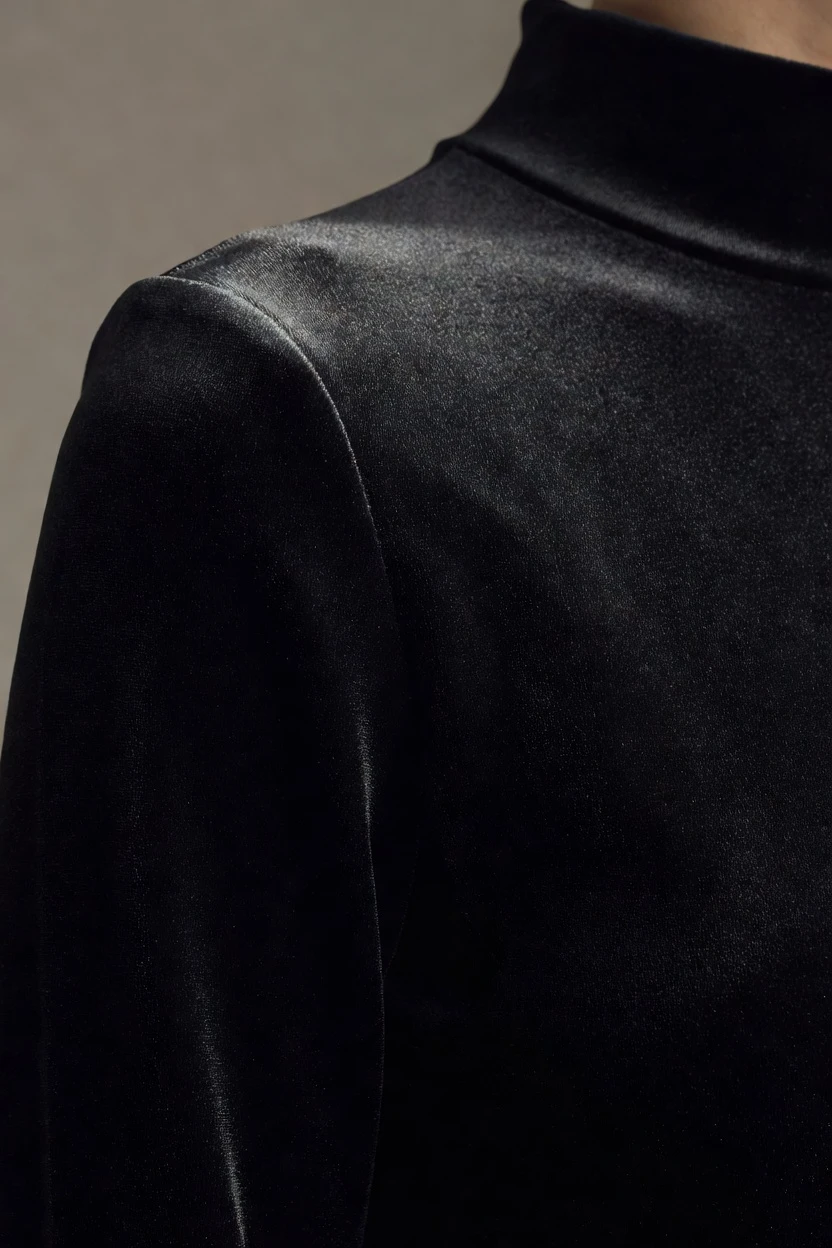
Direct the shoot. Zero prompts.
Velour’s UI selects a campaign-friendly camera + framing, then locks a clean studio light and garment-led focus. You adjust pose, angle, and background with sliders—every setting is a click, not a text instruction. 5 tokens · ~34s per image
- 6 clicks · 0 keystrokes
- app.rawshot.ai / new_shoot
How it works
Click-driven on-model shoots, built around the garment
A browser GUI for single variants and an API for catalog scale. You direct with controls, keep SKU consistency, and ship with signed provenance.
- Step 01
Click your camera, framing, and light
Pick a lens, choose the crop, and set the lighting with presets. Every creative choice is a control—no text field to translate.
- Step 02
Keep the garment the brief
Upload your real garment and direct the shoot around the cut, color, pattern, and logo placement. The output stays garment-faithful instead of being prompt-shaped.
- Step 03
Generate, then publish with provenance
Produce on-model imagery for your catalog or campaign, with C2PA-signed provenance and an audit trail per image. Download outputs with full commercial rights and clear labeling.
Spec sheet
12 proof surfaces for garment-led results
Each tile is one proof point: what you control, how the garment stays faithful, and how provenance, rights, and scale are handled per output.
- 01
No-likeness by design
Synthetic models use 28 body attributes with 10+ options each, with accidental real-person likeness statistically negligible by design—transparently labelled in outputs.
- 02
Every setting is a click
You direct the shoot through buttons, sliders, and visual presets. There is no prompting workflow—operators stay in the app, not in a chat box.
- 03
Garment fidelity first
Cut, color, pattern, logo, fabric cues, drape, and proportions are represented faithfully. The garment remains the brief that the output is built around.
- 04
Diverse synthetic models, labelled
Choose from diverse synthetic models that are clearly labelled. Your marketing team gets on-model variety without ambiguity.
- 05
SKU consistency, no drift
Same model, same face, every SKU—so you avoid the “close enough” problem across collections. Updates stay consistent without repeat shoots.
- 06
150+ visual styles
Switch between catalog, lifestyle, editorial, campaign, studio, street, Y2K, noir, and more. Styles stay consistent while your garment remains the anchor.
- 07
2K and 4K, every ratio
Export in 2K or 4K with every aspect ratio you need for PDPs and placements. Full-body, half-body, close-up, detail, and flat-lay framings are supported.
- 08
Compliance & signed provenance
Outputs include C2PA-signed provenance metadata. RAWSHOT is EU AI Act Article 50 compliant, and California SB 942 compliant.
- 09
Signed audit trail per image
Every image carries a signed audit trail so teams can verify what was generated and when. Provenance moves with the file, not in a spreadsheet.
- 10
GUI + REST API for catalogs
Run single-shoot work in the browser GUI and scale pipelines through the REST API. The same engine supports both small and nightly SKU updates.
- 11
Speed with flat per-image pricing
Stills price at about ~$0.55 per image with ~30–40 seconds per generation. Tokens never expire, and failed generations refund their tokens.
- 12
Full commercial rights, worldwide
You get full commercial rights to every output, permanent, worldwide. Multi-layer watermarking (visible + cryptographic) supports transparent usage.
Outputs
On-model outputs you can ship Catalog-ready, campaign-led
A set of on-model examples generated with garment-faithful controls, consistent synthetic models, and signed provenance for clear publishing.


Browse 150+ visual styles →
Comparison
RAWSHOT vs category tools vs DIY prompting
Three lenses on every dimension — what you optimize for in RAWSHOT versus typical category tools and blank-box AI workflows.
01
Interface
RAWSHOT
Click-driven controls for camera, framing, pose, light, and style.Category tools + DIY
Prompt-first tooling with limited controls and less direct art direction. DIY prompting: You type prompts and iterate through trial-and-error phrasing.02
Garment fidelity
RAWSHOT
Cut, color, pattern, logo, and drape stay garment-faithful.Category tools + DIY
More often reshapes products to match prompt intent. DIY prompting: Generic models drift around the garment when prompts change.03
Model consistency across SKUs
RAWSHOT
Same face, same body across SKUs to prevent catalog drift.Category tools + DIY
Less consistent identity and framing between outputs. DIY prompting: You get inconsistent faces across variants with no catalog-grade continuity.04
Provenance + labelling
RAWSHOT
C2PA-signed provenance plus an audit trail per image.Category tools + DIY
Often no signed provenance, labelling, or auditable metadata. DIY prompting: No clean provenance story to attach to files at publish time.05
Commercial rights
RAWSHOT
Full commercial rights to every output, permanent, worldwide.Category tools + DIY
Licensing can be unclear or gated by product tiers. DIY prompting: Rights interpretation varies and often lacks a straightforward commercial framing.06
Iteration speed per variant
RAWSHOT
~30–40 seconds per image with tokens that never expire.Category tools + DIY
Slower iteration due to weaker controls and inconsistent outcomes. DIY prompting: Prompt rework overhead adds time before you reach publishable results.07
Pricing transparency
RAWSHOT
Flat per-image pricing with refund rules for failed generations.Category tools + DIY
Per-seat pricing and volume tiers that penalize growth. DIY prompting: Costs show up indirectly as wasted iterations and labor.08
Catalog API
RAWSHOT
REST API for catalog-scale pipelines alongside the GUI.Category tools + DIY
API support is limited or not built for SKU-scale continuity. DIY prompting: DIY pipelines rely on brittle prompt scripts and manual post-checking.
Prompting does not scale
Stop writing essays. Direct the shoot.
Most AI photo tools start with a blank text box. Rawshot turns the shoot into repeatable controls, so creative teams can produce consistent fashion imagery without prompt syntax or one-off hacks.
Category norm
ManualCreate a premium editorial fashion photograph of a model wearing the exact navy oversized wool coat from SKU-1842, full-body crop, realistic hands, consistent facial identity, clean e-commerce lighting, subtle Paris street background, 85mm lens, no logo distortion, no fabric hallucination, same pose as last campaign, repeatable for all colorways...
A prompt can describe one image. It cannot become a shared production system for hundreds of products, models, angles and markets.
Rawshot
ClicksSaved shoot recipe
Apply to 1 SKU or 10,000 via GUI, CSV or REST API.
Rawshot makes creative direction visible: buttons, presets and sliders instead of hidden prompt craft. The result is easier to teach, faster to approve and built for repeat production.
Use cases
On-model imagery for teams that ship often
Operator archetypes and how click-directed, garment-first output fits the way they actually work.
- 01
Indie designer with a weekly drop
You direct lighting and framing per look, keep the same face across variants, and refresh PDP imagery without studio days.
Confidence · high
- 02
DTC brand building lookbooks in-browser
You generate editorial-style on-model shots with consistent crop logic and export in the ratios your site needs.
Confidence · high
- 03
Catalog team managing 1,000+ SKUs
You run batch generation through the REST API and keep SKU continuity so seasonal updates don’t drift.
Confidence · high
- 04
Marketplace seller refreshing listings
You generate consistent product imagery quickly for new colorways and avoid reinvented logos from generic models.
Confidence · high
- 05
Adaptive fashion line with strict garment requirements
You keep the garment the brief—cut, fabric cues, and proportions stay faithful while you iterate on backgrounds and styles.
Confidence · high
- 06
Lingerie DTC needing repeatable on-model framing
You set repeatable framing and lighting controls, then generate per-SKU outputs that keep a consistent model identity.
Confidence · high
- 07
Resale and vintage operator with varied inventory
You generate on-model imagery for each item while maintaining a stable visual language across uploads and listings.
Confidence · high
- 08
Factory-direct manufacturer producing seasonal catalogs
You scale nightly production with the same engine and audit-trail files so teams can publish with confidence.
Confidence · high
- 09
Student designer iterating without expensive shoots
You explore campaign and editorial looks by preset selection and export in 2K/4K without booking a studio.
Confidence · high
- 10
Influencer brand face across every platform
You keep the same model identity per run, then output sizes and framings that match where you post.
Confidence · high
- 11
Ecommerce merch team updating PDP art fast
You generate clean packshot-like on-model imagery, verify garment fidelity, and publish with labelled provenance.
Confidence · high
- 12
Crowdfunding creator launching early concept drops
You create consistent visuals for pitch pages and reward tiers without shipping physical samples cross-continent.
Confidence · high
— Principle
Honest is better than perfect.
RAWSHOT outputs are C2PA-signed with an audit trail per image, plus visible and cryptographic watermarking. This makes provenance and labelling part of your workflow, not an afterthought—so publication stays aligned with EU AI Act Article 50 and California SB 942.
Rights & provenance
Full commercial rights. Forever.
- C2PA-signed on every image — EU AI Act Article 50 compliant
- 28-attribute synthetic models — real-person likeness statistically impossible
- Full commercial rights to every generation — no recurring licensing fees
- Tokens never expire · One-click cancel · Transparent pricing
EU AI Act
C2PA
Commercial use
Pricing
~$0.55 per image.
~30–40 seconds per generation. Tokens never expire. Cancel in one click.
- 01The cancel button is on the pricing page.
- 02No per-seat gates. No 'contact sales' walls for core features.
- 03Failed generations refund their tokens.
- 04Full commercial rights to every output, permanent, worldwide.
FAQ
Practical answers on control, rights, pricing, scale, and compliant publishing.
Do I need to write prompts to use RAWSHOT?
Never—you direct every output with sliders, presets, and clicks on the garment, not typed prompts. That UI control is consistent across GUI and REST API payloads, which is why ecommerce teams onboard buyers without rewriting creative briefs as chat threads.
For catalog teams, reliability matters more than model cleverness; RAWSHOT keeps tokens, timings, refund rules, commercial rights framing, provenance signalling, watermarking cues, REST surface, and SKU-scale batch patterns explicit so operations can rehearse PDP launches without hallucinated garment inventions.
What does AI-assisted on-model photography change for SKU-scale catalogs?
It turns “reshoot the whole catalog” into “generate variants with locked controls.” You select camera, framing, pose, light, and visual style, and RAWSHOT keeps the garment as the brief so cut, color, pattern, and logo placement stay faithful across outputs.
When you scale, consistency matters: you can reuse the same model identity for SKUs to avoid drift. With C2PA-signed provenance and an audit trail per image, your publishing workflow stays auditable and ready for review.
Why do teams skip reshooting every SKU for season updates?
Because season updates are predictable, and reshoots are not. RAWSHOT lets you generate on-model imagery per SKU using the same click-driven settings so the visual language stays stable while the product changes.
DIY prompting often introduces failure modes like garment drift or invented branding—your product mutates between attempts. With RAWSHOT, garment fidelity is the design center, and your output includes labelled provenance so your team can publish faster with fewer surprises.
How do we turn flat garments into catalogue-ready imagery without prompting?
You upload the real garment, then direct the shoot through in-app controls for lens, framing, pose, angle, lighting, background, mood, and visual style presets. RAWSHOT builds the output around the garment rather than bending it to match text instructions.
Once you have a look you like, you replicate it across your product line. The workflow supports single-shoot work in the browser and batch-scale generation via REST API, with C2PA-signed provenance attached per image for easier approvals.
Why does garment-led control beat prompt roulette for PDP images?
Because the controls map directly to the decisions your merch team makes—framing, light quality, style direction, and product focus. With RAWSHOT, you click to direct the shoot, so iteration doesn’t depend on how well a model “interprets” your wording.
Generic image AI can create invented logos or inconsistent faces across outputs, which breaks catalog continuity. RAWSHOT focuses on garment fidelity and SKU consistency, plus it labels synthetic models so your team can publish with clear provenance.
How do you handle licensing and provenance for commercial use?
Every RAWSHOT output comes with full commercial rights, permanent and worldwide. Outputs also include C2PA-signed provenance metadata and a signed audit trail per image, plus watermarking that supports transparent usage.
That means your compliance story is built into the file deliverable, not a post-process email thread. For teams shipping campaign and PDP content, you get clear labelling and traceability aligned to EU AI Act Article 50 and California SB 942.
What quality checks should we run before publishing generated product imagery?
Confirm garment fidelity first: cut, color, pattern, logo placement, and drape should match your real product. Then check continuity: faces and framing should remain consistent across your SKU set, so PDPs feel like one cohesive catalog.
Finally, keep provenance visible in your workflow. RAWSHOT includes C2PA-signed metadata and per-image audit trails, so you can verify what was generated and attach the correct files confidently before launch.
How do pricing and token timing work for still images vs video workloads?
For photos, RAWSHOT prices around ~$0.55 per image with roughly ~30–40 seconds per generation, and tokens never expire. Failed generations refund tokens, and you can cancel with a one-click control on the pricing page.
Video uses more tokens per second than stills, so longer clips cost more. If your workload is primarily PDP and campaign selects, stills are the most direct way to build your on-model library quickly.
Can we integrate RAWSHOT into an ecommerce pipeline with an API?
Yes. RAWSHOT supports browser GUI for single-shoot work and a REST API for catalog-scale pipelines, so teams can run batch generation alongside existing production processes.
Because the controls and outputs are consistent, you can apply the same visual direction to thousands of SKUs without prompt rework. You also keep an audit trail per image and signed provenance metadata to support approvals at scale.
What throughput can a small team achieve using the UI plus batch runs?
A small team can move fast by splitting roles: one person directs the creative controls in the browser, while the pipeline runs batch generations for the rest of the catalog. SKU consistency and a stable model identity prevent the “re-shoot and re-approve” loop that slows launches.
As outputs arrive, provenance and watermarking make review smoother. With flat per-image pricing, token refund rules, and clear commercial rights, you can plan workload without per-seat gates or sales-call delays.
Keep exploring